Turning One-Time Clients Into Repeat Buyers With a Community Layer


The math nobody runs on their own marketplace
A repeat buyers community layer is the shortest description of what fixes this. Ask most service marketplace owners what percentage of their buyers come back for a second purchase and you get a shrug, or a guess that turns out to be wrong once someone actually pulls the number. It is usually lower than expected. Not because the service quality is bad. Because nothing in the product experience gives a buyer a reason to come back instead of starting a fresh search next time they need something.
This is the quiet economic problem sitting underneath a lot of service marketplaces. Acquiring a buyer costs money, whether that is ad spend, SEO effort, or referral incentives. A buyer who purchases once and never returns has to be fully reacquired for their second purchase, at full cost, as if they were a stranger. A buyer who returns on their own, because something made them want to, costs close to nothing to bring back. The gap between those two numbers is the entire game of marketplace economics, and a community layer is one of the more direct ways to close it.
Why a great single transaction does not create a second one
It is tempting to assume that good service delivery alone produces repeat business. Do great work, buyer comes back. In practice this is only partially true, and the missing piece is not quality, it is memory and access. A buyer who had an excellent experience six months ago has no guarantee they remember your marketplace at all when the next need arises, let alone the specific vendor they liked.
Consider what actually happens after a typical transaction closes on a marketplace with no community layer. The order completes. A confirmation email goes out. Maybe a review request follows. Then nothing. No further contact exists until the buyer independently decides to search again, at which point they are just as likely to land on a competitor as to remember your site specifically. The relationship the transaction created has nowhere to live between purchases, so it simply evaporates.
A community layer gives that relationship somewhere to persist. Not through aggressive email marketing, which buyers tune out fast, but through a genuine reason to stay connected: a feed they check because it shows things relevant to them, a vendor they follow because they liked the work, a space where they can ask a question before committing to a new purchase instead of starting the search from zero.
What a repeat buyers community layer actually looks like
BuddyNext gives a marketplace a standalone activity feed with reactions, threaded comments, and a follow system, all running independently of whatever marketplace software handles your listings and checkout. When a buyer follows a vendor after a good experience, that vendor’s future updates, a new service tier, a portfolio addition, a note about availability, show up in the buyer’s feed automatically. No email campaign required. No manual outreach from the vendor. Just visibility that persists past the transaction.
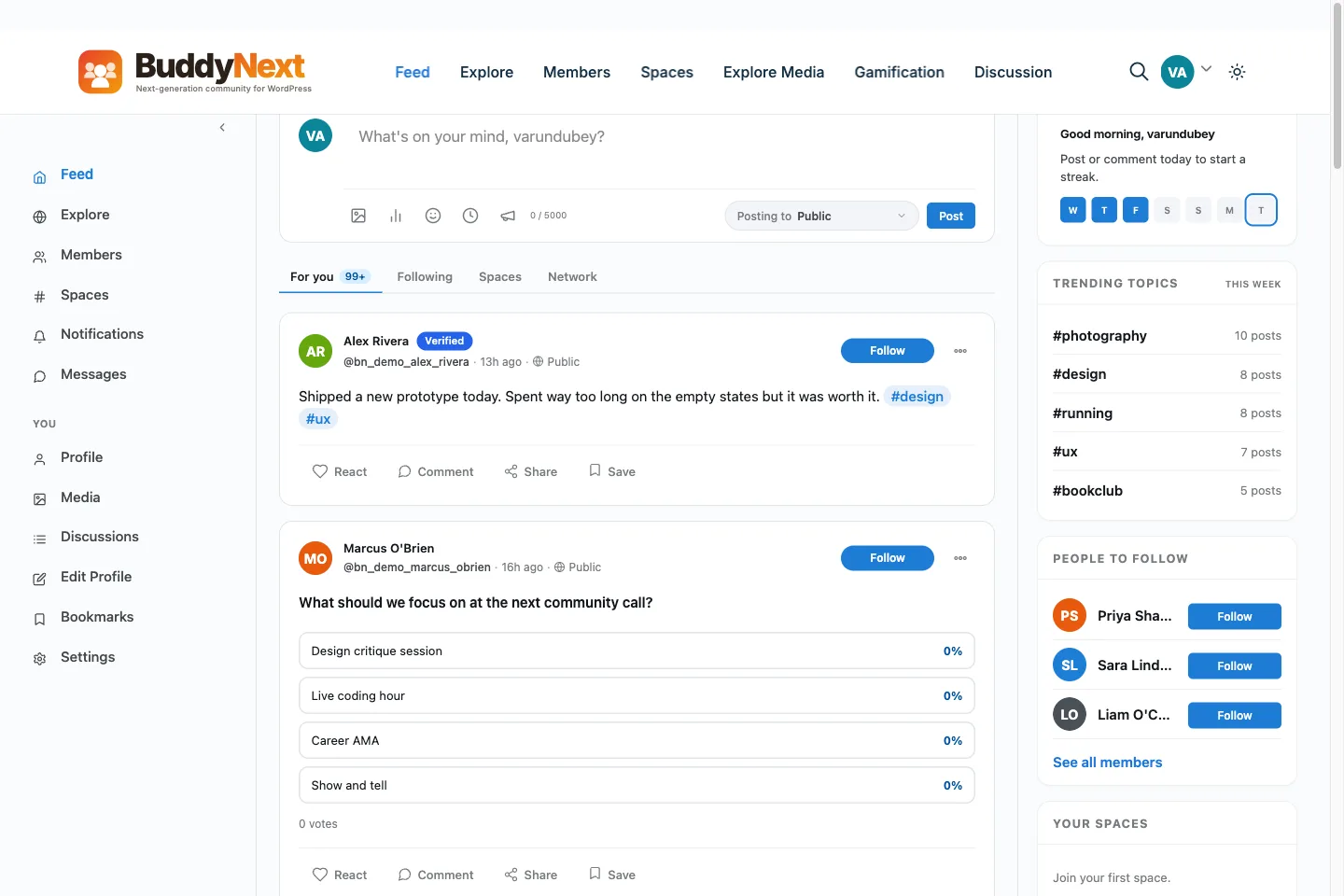
An activity feed gives a past buyer a reason to open the site again that has nothing to do with a hard sales push.
The notification system does similar work on a shorter timescale. When a followed vendor posts, or when activity happens in a space a buyer belongs to, a notification brings them back to the site in the moment it is relevant, not on whatever cadence a marketing email schedule happens to run. That immediacy matters more than it sounds like it should. A buyer who gets pulled back to the site three times over six months through relevant notifications has three separate chances to remember they need something and act on it while already there, instead of needing to independently think of your marketplace from nothing.
The specific mechanism: familiarity beats search
When a buyer needs a service they have purchased before, they face a choice: search again from scratch, or go back to someone they already trust. A transaction-only marketplace makes the first option easier than the second, because there is no persistent path back to a specific vendor beyond digging through old order history. A marketplace with a community layer flips that. The path back to a trusted vendor is the path of least resistance: open the feed, see their latest post, message them, done.
This matters more than raw satisfaction scores suggest it should, because switching costs in service work are mostly about information, not loyalty in the abstract. A buyer switching to a new vendor has to explain their needs again, evaluate quality again, negotiate again. A buyer returning to someone they have already worked with skips all of that. A community layer’s real function here is reducing the friction of finding your way back to the choice you already know worked, which is a much smaller ask than convincing someone to be loyal out of goodwill.
What this looks like across a full buyer lifecycle
Picture a buyer purchasing a logo design, then six weeks later needing business card design, then four months after that needing a full brand refresh before a launch. On a transaction-only marketplace, each of those is a separate cold search, three separate decision cycles, three chances to end up with a different vendor, or a competing marketplace entirely, at each step.
On a marketplace with a community layer, the first transaction creates a connection that persists. When the business card need arises, the buyer already sees the same designer’s activity in their feed and messages them directly rather than searching. When the brand refresh comes up, the same path applies, and by this point the buyer may also be seeing the designer’s broader portfolio evolve through feed posts, priming them for a larger project before they even consciously start looking for one. The community layer does not manufacture the need. It removes the friction between the need existing and the return purchase happening.
This same mechanism benefits the marketplace beyond any single buyer-vendor pair. A buyer active in the community sees other vendors’ work too, through the general feed, through spaces, through the directory, creating opportunities for that buyer to become a repeat customer of the marketplace itself even when they do not return to the exact same vendor for a different category of need.
Spaces as a repeat-purchase engine for a specific niche
Beyond the one-to-one following relationship, group spaces do their own version of this work at a category level. A space built around a specific service niche, web design clients, say, or ongoing marketing retainers, gives buyers in that category a reason to stay engaged with the marketplace even between individual purchases. They see vendor updates, other buyers’ questions and experiences, and general activity that keeps the category present in their mind.

Notifications pull a past buyer back to the site at the moment something relevant happens, not on an arbitrary email schedule.
This works especially well for services with natural but irregular recurrence, seasonal marketing pushes, periodic website refreshes, ongoing content needs. A buyer is not purchasing constantly, but staying visibly connected to a relevant space means the marketplace stays top of mind for exactly the moments those irregular needs arise, without requiring you to guess the timing and blast a promotional email that may land at the wrong moment.
Why this beats email marketing at the same job
Marketplace owners often already run some version of a win-back email sequence: a message thirty, sixty, ninety days after a purchase nudging the buyer to return. These campaigns work, modestly, but they fight an uphill battle against inbox fatigue and increasingly aggressive spam filtering, and they are fundamentally a push mechanism: you decide when to interrupt the buyer, whether or not the timing has anything to do with their actual need.
A community layer is a pull mechanism instead. The buyer opts into following specific vendors or joining specific spaces because they found value there, and the content that reaches them afterward is filtered by their own stated interest rather than a generic drip sequence. This does not mean email stops mattering. It means the community layer catches the buyers who would tune out a marketing email but would notice a feed post from someone they specifically chose to follow.
Why a repeat buyer is worth more than a new one, specifically on a marketplace
Every business says repeat customers matter more than new ones, but the reasoning is usually generic, retention costs less than acquisition, loyal customers spend more over time. On a service marketplace, the math is sharper than that general principle suggests, because of how commission structures actually work.
A new buyer’s first purchase often has to cover the full acquisition cost that got them to the marketplace in the first place, whether that is ad spend, affiliate commission, or SEO investment amortized across your traffic. A repeat buyer’s second purchase carries none of that cost. If your marketplace takes a percentage commission on every transaction, a returning buyer is close to pure margin on the acquisition side, since you already paid to bring them in once and are not paying again. Run the numbers on your own commission rate and average order value, and the gap between a new-buyer transaction and a repeat-buyer transaction tends to be larger than most marketplace owners expect before they actually calculate it.
There is a second, less obvious factor: repeat buyers tend to need less hand-holding through the transaction itself. They already understand how the checkout flow works, how messaging with a vendor works, what to expect from the order lifecycle. Support burden per transaction goes down for a repeat buyer even as revenue per transaction stays roughly flat, which is a second quiet margin improvement that has nothing to do with marketing spend at all.
A concrete before-and-after
Take a marketplace selling web development services. Under a transaction-only model, a buyer commissions a five-page business site, the project completes, and the marketplace’s relationship with that buyer ends. Eight months later the buyer needs a redesign. Without any persistent connection, they are as likely to search “web developer near me” fresh as they are to remember the specific marketplace they used before, let alone the specific developer.
Add a community layer to the same scenario. After the first project, the buyer follows the developer, whose activity feed shows an occasional update, a new portfolio piece, a note about a service they now offer, client testimonials shared as posts. Eight months later, when the redesign need arises, the buyer has seen that developer’s name a handful of times in the interim without ever having to think consciously about “who should I hire next.” The redesign inquiry goes straight to a message thread with someone already trusted, skipping the entire search-and-evaluate cycle a cold buyer would have to go through. The marketplace captures a transaction it would very plausibly have lost to a competitor otherwise, at zero incremental acquisition cost.
If your marketplace already runs a project-based flow with milestones and proposals, similar to the setup in this guide to building your own Upwork-style marketplace in WordPress, the follow relationship formed after a completed project slots naturally into that existing structure. No changes to the transaction flow are required, only an added layer sitting alongside it.
What it takes to set this up
The mechanics are not complicated relative to what they produce. BuddyNext’s free tier includes the activity feed, the following and connections system, notifications, and member profiles, all of which are the actual components doing the retention work described above. There is no separate “retention module” to buy. The same free feed that runs your general community also runs the specific mechanism that turns a one-time buyer into a repeat one.
The part that takes actual effort is encouraging the behavior after a purchase. A checkout confirmation is a natural moment to prompt a buyer to follow the vendor they just worked with, since intent is highest right after a positive experience. Vendors themselves benefit from posting regularly enough that following them produces something worth seeing, a portfolio update, a note about new availability, rather than silence. Neither of these requires custom development. Both require a light operational habit once the infrastructure exists.
Where a paid membership tier fits into repeat purchasing
For marketplaces that want to go further than the free retention mechanism, BuddyNext’s Pro tier adds native Stripe support for gated spaces and membership tiers, which opens a different kind of repeat-purchase structure entirely: a subscription-style access tier where a buyer pays recurring for ongoing benefits, priority booking, a discount on repeat purchases, access to a vendor’s private update space, rather than paying per transaction. This is a bigger commitment than the free feed-and-follow mechanism and is not necessary for most marketplaces to start seeing retention benefits. It becomes relevant once you have validated that buyers are already engaging with the free community layer and are asking, implicitly or explicitly, for a more formal ongoing relationship.
Measuring the actual effect instead of assuming it
The clearest number to track is repeat-purchase rate segmented by whether the buyer has an active following relationship on the platform versus buyers with none. If your marketplace already tracks vendor payouts and order history the way described in this guide to managing vendor payouts in a WooCommerce marketplace, cross-referencing that order data against community activity is usually a matter of pulling two lists and comparing them, not building new reporting infrastructure from scratch.
Do not expect a dramatic gap in the first month. Look at it quarterly, and be honest about confounding factors: buyers who follow vendors may simply be more engaged, satisfied customers to begin with, which would produce a correlation even if the community layer added nothing causally. The fairer test is watching the same buyer cohort over time, comparing their behavior in the months after they start following a vendor to their behavior before, rather than comparing followers to non-followers as if they started from the same baseline.
What this does not fix
Worth being honest about the limits. A community layer will not turn a mediocre service experience into repeat business. If the underlying work is not good, giving a dissatisfied buyer more visibility into a vendor’s activity just gives them more reminders of an experience they did not enjoy. This is a retention amplifier for marketplaces where the service quality already earns a second look. It is not a fix for a marketplace with a quality problem.
It also will not work instantly. The follow relationships, the feed habits, the notification-driven return visits, these compound over months, not days. A marketplace owner checking repeat-purchase rate a week after adding a community layer will not see a meaningful shift. The honest timeline is closer to a full quarter before the pattern becomes visible in the numbers, because it depends on enough buyers accumulating enough transactions to actually test whether the second purchase happens differently than it would have before.
Frequently asked questions
How long before a community layer actually improves repeat-purchase rate?
Expect a full quarter at minimum before the pattern is visible in your numbers, since it depends on buyers who made a first purchase during that window reaching the point where a second need arises and testing whether they return through the community instead of a fresh search.
Does this replace email marketing for win-back campaigns?
No, it works alongside email rather than replacing it. Email is a push mechanism you control the timing of; a community layer is a pull mechanism the buyer opts into by following specific vendors or spaces. Running both covers more of your buyer base than either alone.
Do vendors need to do anything differently for this to work?
Vendors get more benefit from following relationships if they post with some regularity, portfolio updates, availability notes, new service announcements, so that a buyer following them actually sees something worth the follow. A vendor who never posts anything gets little lift from having followers.
Is a paid membership tier required for this to work?
No. The core retention mechanism, activity feed, following, notifications, member profiles, is included in BuddyNext’s free tier. A paid tier becomes relevant only if you want to build a formal recurring-access product on top of an already-engaged community.
What is the single highest-leverage moment to prompt a buyer to follow a vendor?
Immediately after a positive transaction closes, when satisfaction is highest and the buyer is already on the site. Waiting until a win-back email weeks later misses the moment when the buyer is most inclined to want continued visibility into that vendor’s work.
Does this help buyers find other vendors, or only the one they already used?
Both. A buyer active in the general feed, directory, and relevant spaces is exposed to vendors beyond the one they transacted with, which can turn a repeat purchase in a different service category into a return visit to the same marketplace even when it is not a return to the same vendor.
Turning repeat buyers into a community feature, one focus keyword at a time
None of this requires renaming your marketplace or repositioning it as a “community platform” to buyers who just want to hire someone competent. The community layer sits underneath the transactional experience, doing retention work quietly, without ever needing to be the headline of your homepage. Most buyers will never describe what keeps them coming back as “the community feature.” They will just notice that finding the person they liked last time is easy, and act on that ease without examining why it exists.
That is, honestly, the correct outcome. A community layer built to visibly announce itself to every buyer as a retention tactic tends to feel manipulative. One built quietly into the follow relationships, the feed, and the notifications simply works, and the retention shows up in the numbers rather than in anything a buyer would ever need to consciously credit.
The reacquisition cost you can stop paying
Every buyer you have to fully reacquire for a second purchase is a buyer your community layer failed to hold onto. That is the honest way to frame this: not a growth tactic bolted on for its own sake, but a direct attack on the specific cost that erodes marketplace economics quietly, month after month, invisible in a top-line revenue number that still looks fine even while acquisition spend climbs to make up for buyers who never had a reason to come back on their own.
Fiverr and Upwork will never build this deliberately, because a buyer who returns without needing to be resold through their search interface is a buyer whose repeat transaction they profit from without adding value that time. On your own marketplace, that incentive does not exist. A returning buyer costs you nothing extra to serve. Building the path back to them is the entire opportunity.