How to Keep Freelancers Engaged Between Gigs


The gap between projects is where vendors actually leave
Nobody quits a marketplace mid-project. They quit in the quiet stretch afterward, the two or six or twelve weeks between one gig ending and the next one starting, when nothing is pulling them back to your site and a competing opportunity, or a competing platform, has an open field to make its case. This is the least examined part of the vendor lifecycle on most service marketplaces, because everything about marketplace design optimizes for the moments around an active transaction and almost nothing addresses the dead time surrounding it.
That dead time is not actually dead. It is exactly when a vendor decides, consciously or not, whether your marketplace is still worth their attention. A freelancer between gigs is evaluating options, checking other platforms, possibly taking on off-platform work that eventually replaces the need for your marketplace entirely. What happens, or does not happen, during that gap determines a meaningful share of vendor churn that never shows up as a dramatic account cancellation, just a slow fade into inactivity.
Why “between gigs” is a distinct problem from general retention
General vendor retention gets discussed elsewhere in this series in terms of trust, standing, and community. Between-gigs engagement is a narrower, more mechanical version of the same problem: what specifically happens during a vendor’s idle stretch that keeps your marketplace present in their mind versus letting it fade into “an app I used to use.”
The honest starting point is admitting most marketplaces do close to nothing here beyond an occasional automated email. A vendor completes their last project, gets paid, and then hears from the platform only through generic marketing emails indistinguishable from what every other tool in their inbox sends. There is no active reason for them to open the site, check in, or feel like anything is happening there worth their attention until they happen to have a new project need, at which point they may or may not think of your marketplace first.
What actually pulls a vendor back during a quiet stretch
The mechanisms that work here are not complicated, but they require infrastructure most marketplaces have not built. An activity feed showing what is happening across the marketplace, other vendors’ updates, new categories launching, platform announcements, gives a vendor something worth checking even with no active project of their own. A notification system that surfaces relevant activity, a peer posting something in a shared category space, a buyer they previously worked with posting a new need, pulls them back at the moment something is actually worth their attention, not on an arbitrary schedule.
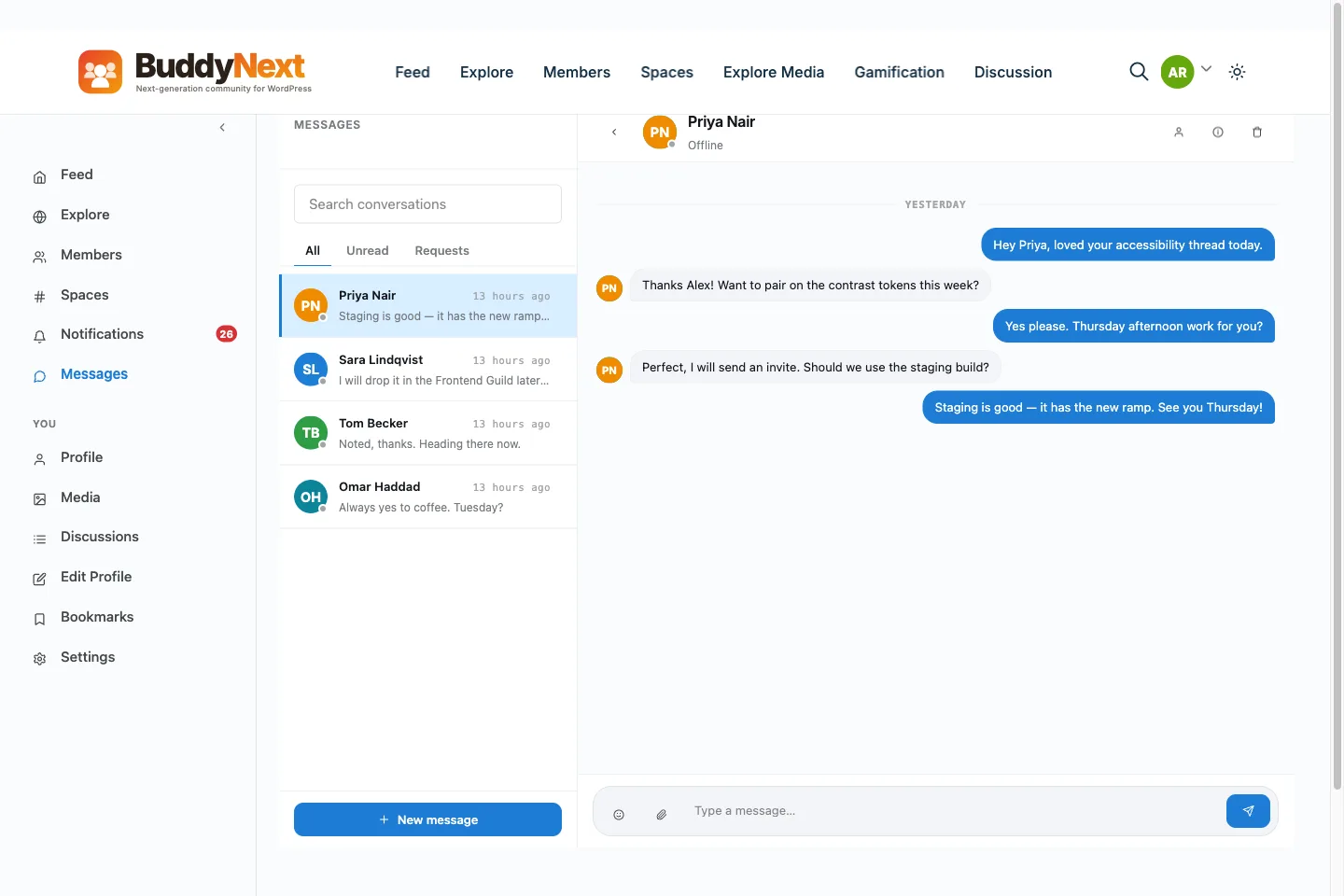
A messaging system that stays open between projects keeps a freelancer connected to past clients instead of going cold the moment a project closes.
BuddyNext provides these mechanics natively: the activity feed, notifications, and a follow system all run independently of whatever handles the actual transaction and payment flow. A vendor does not need an active order to have a reason to open the platform. They need a feed worth checking and a notification system that only interrupts them when something genuinely relevant happens.
Spaces as a reason to check in with no active project
Beyond the general feed, category-specific or peer-oriented Spaces give vendors a standing reason to return that has nothing to do with waiting for their next gig. A space for web developers to compare notes, a general vendor lounge, a private circle for top performers, covered in more depth elsewhere in this series, all function as places a vendor checks out of habit, the way anyone checks a community they belong to, independent of whether they currently have active work on the platform.
This matters specifically for the between-gigs problem because habit is the actual mechanism at work. A vendor who has developed the habit of checking a space weekly, seeing what peers are discussing, answering a question or two, is a vendor who has not mentally disengaged from your marketplace during their idle stretch. A vendor with no such habit has genuinely nothing pulling them back until a new project need arises on its own, by which point a competitor may have already filled that need instead.
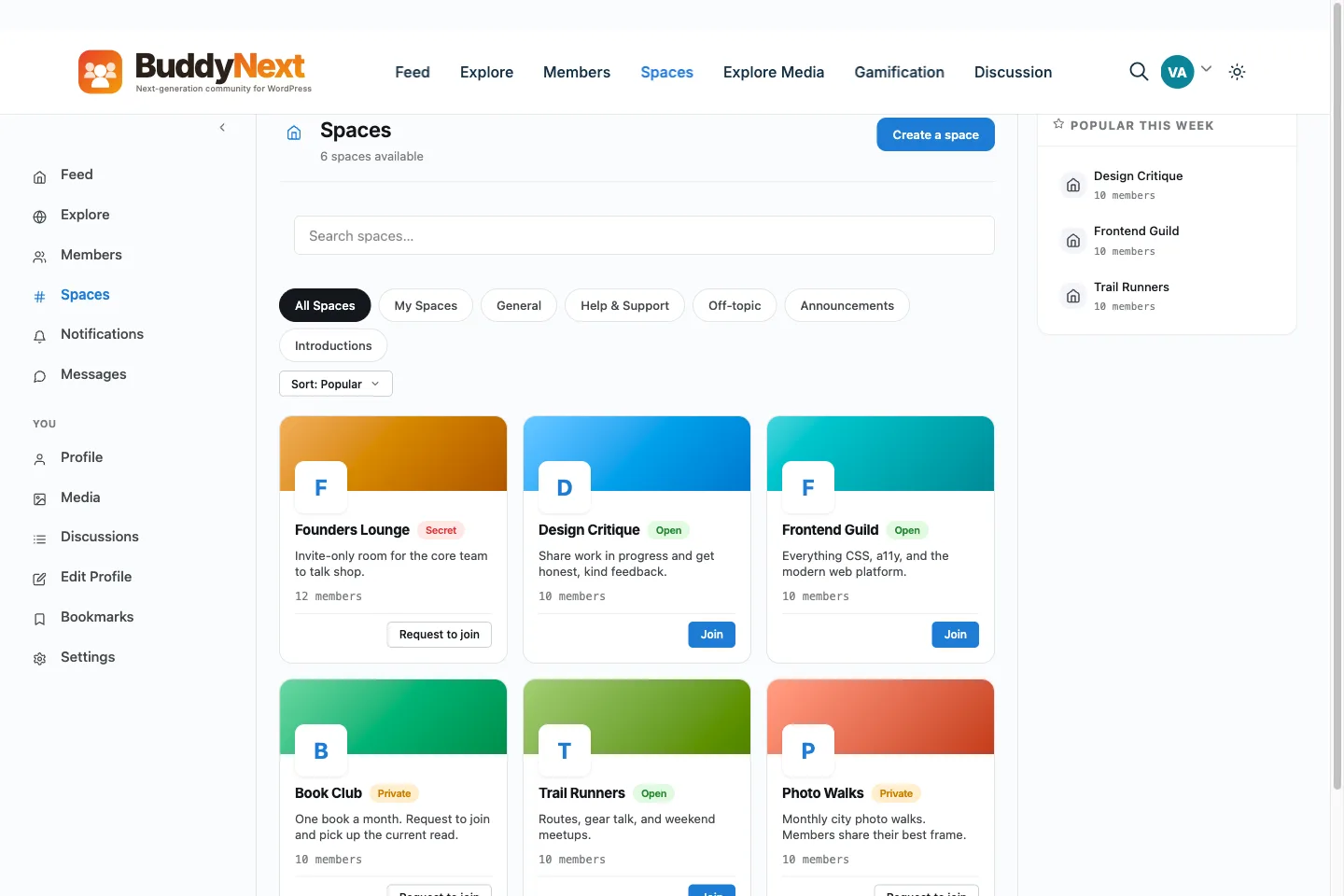
Spaces give vendors a reason to check in that has nothing to do with an active project, which is exactly the gap between-gigs churn lives in.
Keeping past-client relationships warm instead of cold
One of the more direct levers available here is making it easy for a vendor’s past clients to stay visibly connected to them after a project ends. If a buyer follows a vendor after a good experience, that vendor’s between-gigs activity, portfolio updates, availability notes, a testimonial they share, stays visible to exactly the audience most likely to hire them again. This does double duty: it keeps the vendor engaged because they have an audience worth posting to, and it keeps past clients warm because they are seeing relevant activity instead of forgetting the vendor existed.
Messaging that stays open between projects, rather than closing the moment an order completes, extends this further. A past client with a new, smaller question, “are you available in a few weeks” or “quick clarification on something from before”, has a direct channel to ask without needing to restart a formal order process. That accessibility is itself a reason for a vendor to stay engaged with the platform, because the platform is actively facilitating the informal touchpoints that turn into the vendor’s next booking.
Why vendors specifically need this more than buyers do
It is worth being direct about why this post focuses on vendors rather than buyers, since a similar dynamic exists for buyers too and gets covered elsewhere in this series. Vendors have a stronger incentive to disengage during idle time because idle time is directly costing them income. A buyer between purchases loses nothing by not thinking about your marketplace; they simply have not needed anything yet. A vendor between gigs is actively losing revenue every day they stay idle, which makes them far more motivated to look elsewhere, take on off-platform work, or explore competing marketplaces during exactly the window your platform has gone quiet on them.
This asymmetry means the between-gigs engagement problem is disproportionately a vendor-retention problem, and marketplace owners who treat it as a general engagement issue, applying the same light-touch approach to both sides, tend to underinvest in the side that actually needs it more urgently.
What this looks like operationally, week to week
None of this requires daily attention from a marketplace owner, but it does require a light, consistent operational habit. A weekly or biweekly post to the general feed, an update, an announcement, a highlight of vendor or buyer activity worth calling out, keeps the feed from going stale, which matters because a feed that has not posted anything in a month gives vendors checking in during their idle stretch a reason to stop checking. Prompting vendors to post their own updates, a portfolio addition, an availability note, when they log in between projects, distributes some of that content generation instead of it all falling on you.
Space-level activity needs a similar light touch: if you have launched a category space, checking in periodically to answer questions or seed a discussion topic keeps it from feeling abandoned. This is meaningfully less work than it sounds, closer to twenty minutes a few times a week than a dedicated community management role, at least at the scale most service marketplaces operate at before they have thousands of active vendors.
A day in the life of a vendor between gigs, two ways
Picture a graphic designer who just wrapped a rebranding project. Under a transaction-only marketplace, their next interaction with the platform is a payout notification, and then nothing until they either search for their next opportunity elsewhere or happen to remember to check the marketplace weeks later. There is no reason built into the product to open the app during that gap. Their attention drifts elsewhere by default, not out of dissatisfaction, simply because nothing pulled it back.
Now picture the same designer on a marketplace with the engagement mechanics described above. Two days after the project wraps, they get a notification that a peer in their category space posted a useful pricing discussion. They comment. A week later, a past client reacts to a portfolio update they posted to their profile. Ten days after that, a buyer they worked with eight months ago messages asking if they are available for a smaller follow-up piece, a conversation that would never have started if the messaging channel had closed the moment the original order completed. None of these touchpoints required the designer to have an active project running. Each one kept them present on the platform instead of drifting toward other options, and by the time their next real opportunity arrives, whether from a past client or a fresh buyer, they have never actually left.
Why this matters more in categories with irregular project cadence
Some service categories have predictable, steady demand, a vendor finishes one project and the next one is already queued. Between-gigs engagement matters less there, since the gap itself barely exists. Other categories, seasonal marketing work, large one-off projects like brand overhauls or major development builds, have naturally irregular cadence, weeks or months between engagements even for a vendor in high demand. These categories are exactly where between-gigs engagement infrastructure earns its keep the most, because the idle stretch is not an occasional anomaly, it is the normal rhythm of the work, and a vendor who has no reason to stay connected during those normal gaps is a vendor whose attention drifts as a matter of routine rather than exception.
If your marketplace spans both kinds of categories, steady-cadence and irregular-cadence work, it is worth being deliberate about where you focus initial engagement effort. Vendors in irregular-cadence categories have the most to gain from a well-built feed, notification system, and space structure, and are the group most likely to show a measurable difference in reactivation rate once that infrastructure exists.
A specific tactic: the between-gigs check-in prompt
One tactic worth calling out explicitly because it directly targets the problem this post is about: a light, automated prompt triggered a set number of days after a vendor’s last completed order, not a generic marketing email, but a specific nudge to post an update, check recent activity in their category space, or note their current availability. This turns a passive gap into an active touchpoint without requiring you to manually track which vendors have gone quiet.
The content of the prompt matters more than its existence. A vendor who receives “we miss you, come back” reads as generic and gets ignored. A vendor who receives “your category space has three new posts this week” or “two buyers have viewed your profile since your last update” gives a specific, concrete reason to open the platform, which converts at a meaningfully higher rate than an emotional appeal with no specific information attached to it.
The membership question for between-gigs engagement
Most of what keeps a vendor engaged between gigs is available in BuddyNext’s free tier: the activity feed, notifications, following, and Spaces are the actual mechanics doing this work, and none of it requires a paid tier to function. Where a paid tier becomes relevant is if you want to build a more structured engagement layer on top, a paid tier offering guaranteed visibility during idle periods, scheduled posts that keep a vendor’s presence active even when they are heads-down on other work, or gated access to a higher-engagement space reserved for consistently active vendors. BuddyNext’s Pro tier includes scheduled and recurring posts along with native Stripe support for building that kind of structured tier, but it is an enhancement on top of a mechanism that already works for free, not a prerequisite for addressing the core problem.
How this connects to the vendors you most want to keep
The vendors most worth investing in here are not necessarily your newest or lowest-tier sellers. Your top-tier vendors, the ones carrying the most order volume and the ones most likely to have off-platform options if they disengage, benefit disproportionately from active between-gigs engagement, because they are exactly the vendors a competitor would most want to poach during a quiet stretch. If your marketplace already runs a structured top-tier vendor space along the lines covered in this guide to building a private community for top-tier freelancers, extending that same space’s engagement cadence to cover idle periods specifically, not just active-project updates, closes the exact gap this post is about for the vendors whose retention matters most to your bottom line.
If your marketplace tracks vendor activity and payout history the way described in this guide to managing vendor payouts in a WooCommerce marketplace, that same data tells you exactly which vendors have gone quiet longest since their last transaction, which is the most useful list to prioritize for a between-gigs re-engagement effort rather than treating every idle vendor identically.
Signs your marketplace already has this problem
A few patterns tend to show up before a marketplace owner has explicitly noticed the between-gigs gap as a distinct issue. Vendors who were highly active for several months and then went quiet without any formal account cancellation, no dispute, no complaint, just a slow fade, are the clearest signal. Support tickets from buyers who cannot find a vendor they worked with previously, because that vendor stopped checking the platform regularly, point the same direction from the other side.
A less obvious signal: vendors who complete a project and then immediately ask, in their closing message, some version of “let me know if you need anything else” directed at you or the buyer, rather than the platform giving them any built-in way to stay visible for exactly that follow-up need. That is a vendor manually trying to solve a problem your product should be solving structurally, and it is a reasonable clue that the infrastructure this post describes is currently missing.
What this does not solve
Worth being honest about the limits here too. If a vendor is idle because demand for their specific category has genuinely dried up on your marketplace, no amount of feed activity or notification prompting brings them back, because the actual underlying problem is a lack of work, not a lack of engagement infrastructure. Between-gigs engagement keeps a vendor connected and reduces the chance they mentally check out during a normal, healthy idle period. It does not manufacture demand that is not there, and marketplace owners should not expect it to paper over a genuine supply-demand imbalance in a specific category.
Frequently asked questions
How long is a “normal” idle period before a vendor is at risk of disengaging?
This varies heavily by category and service type, but a useful rule of thumb is to compare a vendor’s current gap against their own historical pattern. A vendor who typically completes a project every three weeks going six weeks without activity is a stronger churn signal than an absolute time threshold applied uniformly across every vendor.
Does this require building a custom notification system?
No. BuddyNext’s notification system, part of its free tier, already surfaces relevant activity, feed posts from followed vendors, space activity, to bring vendors back at relevant moments. A more targeted between-gigs prompt tied to order history is a light customization on top rather than a system built from scratch.
Should between-gigs engagement focus on all vendors equally, or prioritize specific ones?
Prioritize your highest-value vendors first if resources are limited, since they carry the most order volume and the most risk if they disengage. A general engagement layer, feed and notifications, can run for everyone at low cost, while more resource-intensive touches, direct outreach, priority space access, make sense to reserve for vendors whose retention matters most.
What is the biggest mistake marketplaces make trying to solve this?
Relying entirely on generic marketing email as the only between-gigs touchpoint. Email fatigue is real, and a vendor who has learned to ignore your marketing emails will not suddenly re-engage because you send one more. Building a reason to check the platform itself, rather than only messaging vendors from outside it, works better over time.
Does a paid membership tier change how well this works?
Not fundamentally. The core mechanics, feed, notifications, following, Spaces, work on the free tier and do most of the actual retention work described here. A paid tier adds structured enhancements, like scheduled posts, but is not required to see results from the free version.
How do I measure whether this is actually reducing vendor churn?
Track reactivation rate: the percentage of vendors who go idle for a meaningful stretch and then complete another order, compared before and after you build out between-gigs engagement infrastructure. Give it at least a full quarter, since idle periods themselves often span weeks, and the effect will not show up in a shorter window.
The freelancers you already have
Acquiring a new vendor costs real effort: sourcing, vetting, onboarding, the slow process of them building enough order history to earn buyer trust. A vendor you already have, who already knows your platform and has already proven quality, is dramatically cheaper to keep than a new one is to replace. The gap between gigs is not a minor operational detail. It is the specific window where that cheaper, easier retention either happens or does not, almost entirely based on whether anything worth their attention exists on your platform when they have nothing active running.
Fiverr and Upwork will not build this deliberately, for the same structural reason covered throughout this series: a vendor who stays engaged through community, rather than being resold through search every time, is a vendor whose loyalty they cannot monetize the way they monetize a cold match. On your own marketplace, keeping that vendor engaged costs you almost nothing, a light weekly habit and infrastructure that already exists in a free platform tier, and saves you the much higher cost of sourcing, vetting, and rebuilding trust with a replacement from zero.