Turning Your Service Expertise Into a Paid Course Without Losing a Cut to Platform Fees

Updated September 2026. There’s a specific kind of frustration that shows up on the day a course creator checks their payout report and realizes how much of it never made it to their account. The course sold well. The platform took its cut. The payment processor took its cut. Learning to sell a paid course without platform fees means understanding exactly where that gap comes from. What actually lands in the bank is meaningfully less than what the buyer paid, and that gap exists purely because a hosted platform sat between the sale and the seller, doing nothing to create the content itself.
None of that is inevitable. It’s a structural choice built into how most course platforms operate, and it’s not the only way to sell expertise online. Learnomy is a complete learning platform for WordPress: courses, quizzes with anti-cheat protection, certificates anyone can verify, and a checkout that runs directly through a creator’s own Stripe and PayPal accounts, with no platform fee sitting between a sale and the seller. The only deduction is the standard payment processing fee every online business already pays regardless of what software runs the transaction. Nothing extra gets skimmed off on top.
In this guide
- What it means to sell a paid course without platform fees taking a cut
- Where the zero-fee checkout actually comes from
- Why the fee actually gets worse the more successful a course becomes
- WooCommerce compatibility for freelancers already running a store
- Instructor revenue sharing without a per-instructor tax
- Memberships as an alternative to per-course pricing
- Coupons, discounts, and the launch mechanics that still matter
- Pricing decisions get easier once the fee isn’t eating the margin
- What this actually adds up to over a year of selling
- Beyond the checkout: what a complete learning platform actually covers
- The part of course revenue that never touches a screenshot
- Selling to an existing services audience versus starting from zero
- What a zero-fee checkout means for a course that starts slow
- Where the core platform ends and deeper structure begins
- Renting a course platform versus owning one, side by side
- What to actually calculate before picking a platform
- Turning expertise into a product without turning into a platform’s line item
- Frequently asked questions
- The fee that never had to exist
Learnomy makes this entire model possible: a complete learning platform for WordPress with a zero-fee direct checkout built in.
What it means to sell a paid course without platform fees taking a cut
Most hosted course platforms charge in one of two ways: a subscription that runs whether or not a course sells that month, or a revenue share with no subscription at all. Either way, the platform takes a cut of every sale, indefinitely, for as long as the course keeps selling on that platform. A course that sells steadily for years pays that fee every single time, forever, not just during some onboarding period.
Marketplace-style platforms that don’t charge a subscription often make up for it with a steeper cut instead. That can look attractive to someone just starting out, since there’s no upfront monthly cost. But the tradeoff compounds the opposite direction from a subscription: the better the course performs, the more that cut actually costs in absolute terms, forever, with no ceiling on how much gets taken as revenue grows.
Where the zero-fee checkout actually comes from
Learnomy connects directly to a course creator’s own Stripe and PayPal accounts rather than routing payments through an intermediary account the platform controls. That’s the structural difference that makes a zero-fee checkout possible: there’s no middle layer taking a cut, because the money moves straight from buyer to Stripe or PayPal to the creator’s own bank account, with the platform handling course delivery and access logic without ever touching the payment flow as a fee-taking party.
For a freelancer who’s already selling services and watching a marketplace fee eat into every invoice, this is the same lesson applied to a second product. A course revenue stream that keeps everything past standard processing fees is meaningfully different from one that hands a slice to a platform every single time, and over enough sales, that difference is the gap between a course that’s a nice side project and one that’s a genuinely significant part of a freelancer’s income.
Why the fee actually gets worse the more successful a course becomes
There’s a counterintuitive trap built into percentage-based platform fees: they’re designed so the platform’s revenue grows in lockstep with the creator’s, forever, with no point at which the relationship changes. A creator who scales a course business substantially hasn’t earned their way out of the fee. The platform’s cut scales right alongside them, taking proportionally the same bite at a large monthly total as it did at a small one.
Contrast that with owning the infrastructure outright. A course creator running Learnomy carries the cost of hosting, which stays roughly fixed regardless of how much the course actually sells. As revenue climbs, the share of that revenue lost to infrastructure shrinks toward nothing, because the cost isn’t tied to sales volume in the first place. That’s the exact opposite trajectory of a percentage-based platform fee, and it’s the single biggest reason the fee question matters more, not less, as a course business succeeds.
WooCommerce compatibility for freelancers already running a store
A lot of freelancers turning service expertise into a course aren’t starting from zero. Some already run WooCommerce for other products: templates, digital downloads, physical merchandise tied to their brand. Learnomy includes a WooCommerce adapter, so a course doesn’t require standing up a completely separate checkout flow if WooCommerce is already the backbone of a freelancer’s existing sales infrastructure. The course becomes one more product line running through the same store, rather than a parallel system that needs its own separate maintenance.
This matters more than it sounds like on paper. Running two disconnected checkout systems means two sets of order records, two places customer support has to check when a buyer has a question, and two systems that need updating whenever pricing or tax rules change. Consolidating the course into an existing WooCommerce setup removes that duplication entirely.
Instructor revenue sharing without a per-instructor tax
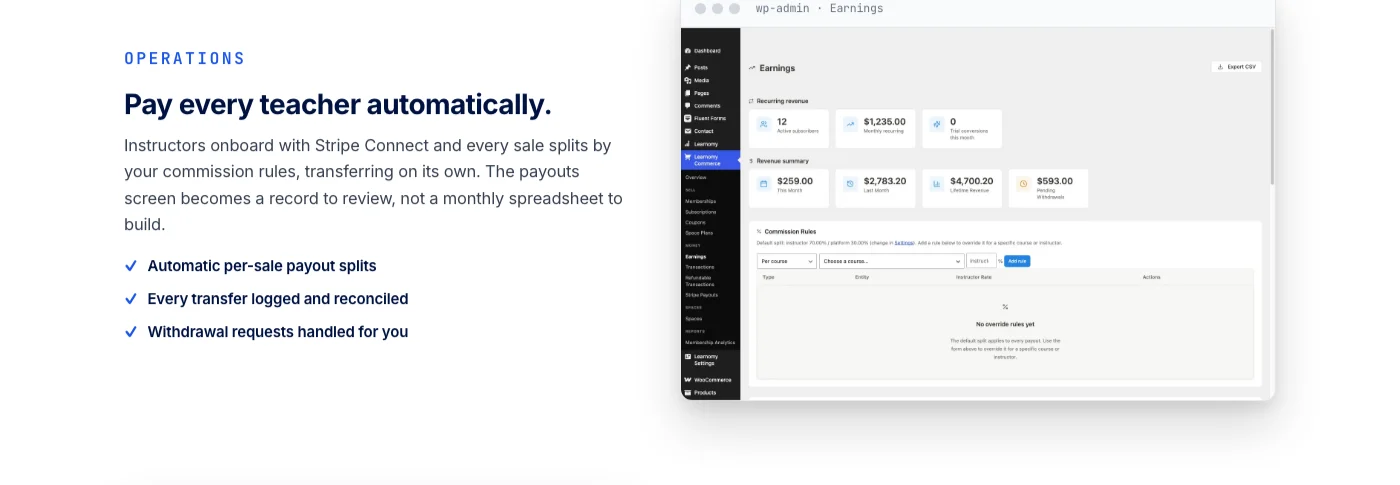
Some course businesses grow past a single instructor. A freelancer who starts solo might eventually bring in a colleague to co-teach a module, or build out a small team of contributors covering different specialties under one course brand. Learnomy handles this with Udemy-style revenue sharing built into the core platform, splitting payouts between instructors automatically based on how the course is structured, rather than requiring manual tracking of who’s owed what after every sale.
Many hosted platforms treat multi-instructor functionality as an enterprise feature, gated behind a higher-priced plan specifically because it’s assumed only larger course businesses need it. Having it available from the start means a freelancer can grow into a multi-instructor structure without hitting a wall exactly when the business is starting to need more than one contributor. For a freelancer weighing whether to bring in a co-instructor at all, splitting a course between multiple instructors instead of teaching every module solo is worth thinking through before the revenue structure gets locked in.
Memberships as an alternative to per-course pricing
Not every course business fits a one-time-purchase model well. A freelancer building out a growing library of courses around related topics might get more value from a membership structure: one recurring price for ongoing access to everything, rather than pricing and marketing each course as a completely separate product. Learnomy includes memberships with trial periods and an auto-generated pricing page out of the box, so this model is available without needing to build a custom membership system on top of the course infrastructure. Deciding between the two is worth doing deliberately, since choosing between a one-time course sale and a recurring membership business changes how pricing, marketing, and cash flow get planned from the start.
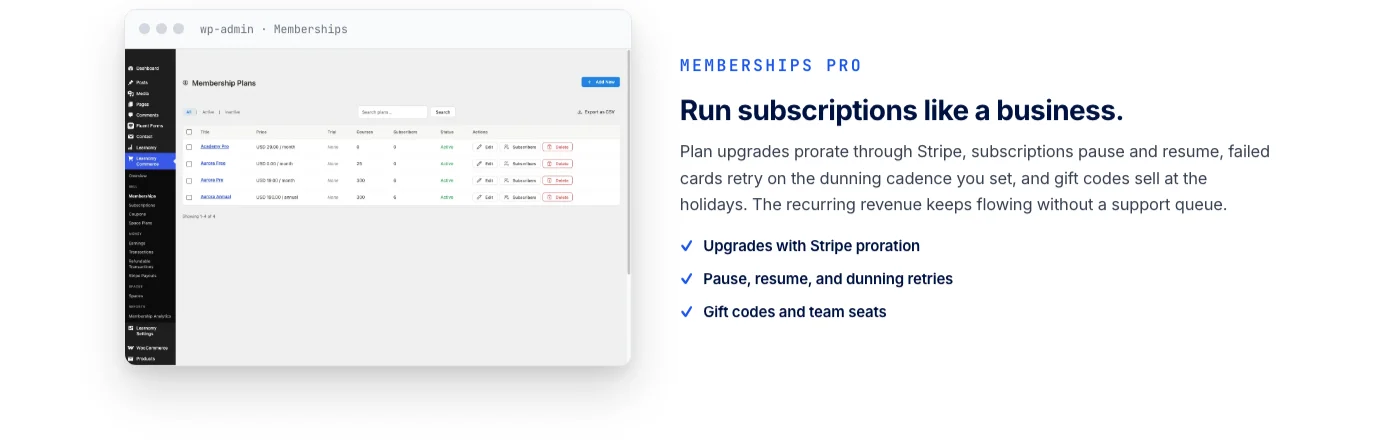
A trial period specifically matters for conversion. A buyer unsure whether a membership is worth a recurring charge is far more likely to commit if they can try a stretch of access first, and building that flow manually on a platform that doesn’t support it natively is exactly the kind of technical overhead that keeps freelancers from experimenting with pricing models they suspect would work better than what they’re currently doing.
Coupons, discounts, and the launch mechanics that still matter
A zero-fee checkout doesn’t mean giving up on normal sales mechanics. Coupons are supported directly, covering the practical cases every course creator eventually needs: an early-bird discount for a launch window, a referral code for existing clients, or a limited-time promotion tied to a specific piece of content marketing. None of that requires a workaround or a third-party tool bolted onto the checkout flow. It’s part of the same system handling the rest of the sale.
Pricing decisions get easier once the fee isn’t eating the margin
A course sold on a platform charging a meaningful cut has to account for that cut before the creator sees anything from it. Run a launch discount, and the discount comes out of an already-reduced margin. Offer an affiliate commission to someone promoting the course, and that’s a second cut layered on top of the first. Every promotional lever a creator might want to pull gets more expensive to operate when a share of every sale is already spoken for before the promotion even starts.
With no platform fee eating into that margin, the same promotional decisions get simpler. A launch discount is genuinely what it says it is, not a discount off a number that was already reduced by a platform’s cut before the promotion was applied. An affiliate program is more sustainable when there’s no second party also taking a slice of the same sale.
None of this changes what the course is worth to a buyer. It changes how much flexibility a creator has to actually use pricing as a tool, instead of treating every discount as something that has to be clawed back somewhere else.
What this actually adds up to over a year of selling
Run the comparison honestly. A course generating solid, steady monthly sales on a platform charging a combined subscription-plus-transaction cost loses a real slice of that revenue to platform overhead alone, before the creator has spent a dollar on marketing or their own time. Over a year, that’s money that never had to leave in the first place, sitting on top of whatever standard payment processing already costs regardless of platform.
That gap doesn’t shrink as the course grows. It grows right alongside it, because a percentage-based fee scales with revenue by design. A freelancer who builds a course business assuming platform fees are just a fixed cost of doing business online is leaving money on the table every single month that a lower-fee alternative was available the whole time.
Beyond the checkout: what a complete learning platform actually covers
Selling the course without losing a cut to platform fees is the financial argument, but it’s only one layer of what Learnomy actually is. It’s a complete learning platform for WordPress, the online school a creator owns outright rather than an LMS plugin bolted onto a site. Courses support video, audio, PDF, and reading lessons through a drag-and-drop builder. Assessment holds up under real scrutiny: six quiz types with partial credit, question banks, tab-switch tracking that discourages the obvious way to cheat a knowledge check, and an essay-grading inbox for the responses that need a human eye.
Certificates are cryptographically signed and carry a QR code linking to a public verification page, so a completed course produces something a buyer can actually show off and a stranger can actually check, not a login they’ll forget the password to.
It doesn’t stop at the course itself. The same platform grows into a learning community around a creator’s school when they want one, with course discussion boards and Q&A sitting alongside the lessons instead of buyers emailing questions into a void. Gamified learning gives students points, badges, and streaks that make finishing a course feel like progress instead of a chore. A job board for graduates connects the people who finish a program with the opportunities that program was training them for.
Course videos can be protected from casual downloading and sharing, so a creator’s actual content stays behind the paywall it was sold behind. And the whole thing runs on a real design layer, meaning a creator’s school looks like their school, down to the color palette and typography, not a template shared across every other seller’s storefront.
That’s the part a fee comparison alone misses. A creator isn’t just avoiding a percentage taken off the top. They’re building on a platform that already covers what a growing course business eventually needs, instead of discovering eighteen months in that the next feature they need lives behind a different vendor’s paywall entirely.
None of this requires a creator to already run a large operation before it’s worth setting up properly. A single course, sold to a small existing audience, benefits from the same zero-fee checkout and the same certificate and community tooling as a catalog with dozens of courses and multiple instructors. The platform doesn’t ask a creator to grow into it first. It works the same way on day one as it does two years in, which is exactly the opposite of how a hosted platform’s tiered pricing usually treats a new, unproven course.
The part of course revenue that never touches a screenshot
Platform fee comparisons usually stop at the transaction cut and the subscription cost, but there’s a quieter cost that rarely makes it into the spreadsheet: the time spent working around a hosted platform’s limitations. A creator who wants a specific pricing structure the platform doesn’t natively support, or a promotion mechanic outside what the built-in coupon system allows, ends up either abandoning the idea or building a workaround that eats hours the course itself never generated any revenue for.
Owning the infrastructure doesn’t eliminate every limitation, but it does mean the limitations are the ones a creator actually chose, running their own WordPress install with the specific plugins and configuration that fit their business, rather than the limitations a hosted platform decided applied to everyone regardless of what their specific course business actually needed. That difference doesn’t show up on an invoice, but it shows up in how much of a creator’s time gets spent building the business instead of negotiating with the software that’s supposed to be running it.
Selling to an existing services audience versus starting from zero
A freelancer turning expertise into a course rarely starts with zero potential buyers. Existing clients, past clients, and anyone who’s interacted with a services listing already have some baseline trust in the freelancer’s judgment, which is exactly the trust a cold audience would need to be built from scratch. That existing relationship is worth more as a launch audience than most creators give it credit for, and it’s a genuine advantage over starting a course business with no prior audience at all. That same existing audience is exactly what makes selling courses alongside an existing freelance services business work better than launching a course cold.
Selling into that existing audience through direct checkout, rather than routing them to a hosted platform’s separate signup and payment flow, keeps the entire experience inside infrastructure the freelancer already controls. A client who trusts a freelancer enough to hire them for services is more likely to complete a purchase that feels like a natural extension of that relationship, same site, same brand, same checkout flow, than one that suddenly redirects to an unfamiliar third-party platform’s signup page mid-purchase.
What a zero-fee checkout means for a course that starts slow
Not every course sells well immediately. Most don’t. A course launched to modest early sales on a subscription-based hosted platform pays that subscription regardless of whether it made a single sale that month, which quietly punishes exactly the courses that need the most room to find their audience over time. A slow-starting course on Learnomy costs nothing extra in platform fees to keep live while it finds traction, since there’s no subscription draining resources during the exact period when the course most needs patience rather than pressure to perform.
That changes the calculus on whether to keep iterating on a course that hasn’t taken off yet, or cut losses because a monthly bill is adding up faster than the course is earning. Removing that pressure doesn’t guarantee a slow course eventually succeeds, but it does mean the decision to keep improving it gets made on the course’s actual merits, not on how much a platform fee is costing to keep it technically alive.
Where the core platform ends and deeper structure begins
Everything described above is part of what Learnomy covers by default: unlimited course creation, the zero-fee direct checkout, the WooCommerce adapter, revenue sharing, and memberships with trials. None of that requires a separate purchase to use. Further up the platform’s capability range, a course business that’s outgrown a single instructor’s manual workflow gets tools like automated payout routing across multiple teachers, deeper analytics on churn and lifetime value for a membership-based course business, and structured content pacing for a growing curriculum. Those capabilities sit on top of a working foundation, not in place of one.
Renting a course platform versus owning one, side by side
- The deal. A hosted platform charges rent plus a cut of every sale, forever. Learnomy runs on infrastructure a creator already controls, with no ongoing cut taken from sales.
- Student data. On a hosted platform, buyer emails and purchase history live in someone else’s database under someone else’s export rules. On Learnomy, that data sits in the creator’s own WordPress install.
- What happens if the creator stops paying a subscription. A hosted course can be suspended or lose features. A course built on owned infrastructure keeps running as long as the hosting bill is paid, the same as any other WordPress site.
- Multi-instructor growth. Hosted platforms frequently treat this as an upsell. Instructor revenue sharing is part of the core platform from day one.
- What the platform actually does for the creator. A hosted marketplace’s built-in discovery traffic is usually smaller than advertised. A creator selling through their own domain keeps every dollar spent on marketing pointed at an asset they own, instead of renting visibility inside someone else’s catalog.
None of this is a claim that owning infrastructure is effortless. A creator running their own WordPress install is responsible for its hosting, the same way they’re already responsible for any other site carrying their name. For most freelancers who already maintain a portfolio, blog, or services listing, that’s not new work. It’s the same hosting relationship extended to cover one more product line.
What to actually calculate before picking a platform
The fee question is easy to accept as a fixed cost of doing business online, right up until someone actually runs the numbers on their own course. A few honest inputs make the comparison concrete instead of abstract:
- How many months has the course been selling, or how many months is it expected to sell once it launches? A fee that feels small in month one compounds every month after that.
- Is the platform charging a subscription that runs regardless of sales, a percentage of revenue, or both? Each has a different failure mode for a slow-starting course versus a fast-growing one.
- What happens to existing buyers and their access if the creator ever wants to leave the platform? A course locked into a specific vendor’s account structure is harder to carry forward than one already living on a domain the creator owns.
- Does the platform’s free-to-start version include the features the course will actually need in its first year, or does growth require an upgrade at the exact moment revenue starts to matter?
Running through these four questions before building anything turns an abstract fee comparison into a decision grounded in the specific course a freelancer is actually planning to sell, rather than a generic argument that applies equally to everyone regardless of their situation.
Turning expertise into a product without turning into a platform’s line item
The freelancer selling a course isn’t just monetizing a topic. They’re monetizing years of accumulated judgment that took real time and real client mistakes to build. Handing a meaningful share of that to a platform that had no part in developing the expertise itself is a cost worth questioning, not accepting as the default price of doing business online. A zero-fee direct checkout isn’t a gimmick or a marketing hook. It’s just what happens when the software connecting a buyer to a seller doesn’t insert itself as an unnecessary toll collector in between.
Key takeaways
- A hosted course platform charges a subscription, a revenue cut, or both, forever, no matter how the course performs.
- Learnomy checkout runs directly through a creator’s own Stripe and PayPal accounts, so the only deduction is standard payment processing, not an extra platform cut.
- The WooCommerce adapter lets a course sell through a freelancer’s existing store instead of standing up a second checkout system.
- Instructor revenue sharing, memberships with trials, and coupons are built into the core platform, not gated behind a higher tier.
- The fee difference applies from the very first sale, and it compounds in the creator’s favor the more a course grows.
Frequently asked questions
Is there really no fee at all, or is it hidden somewhere else?
Stripe and PayPal still charge their standard payment processing fees, the same fees any business pays to accept a card or digital wallet payment regardless of what software runs the checkout. What’s absent is any additional fee layered on top by the platform itself. That’s the specific cost that disappears, not the baseline cost of moving money electronically. That’s the whole mechanism behind how creators sell a paid course without platform fees on Learnomy.
Do I need a business entity set up before I can use direct Stripe and PayPal checkout?
That depends on Stripe’s and PayPal’s own account requirements in your country, not on Learnomy. Many freelancers already have a Stripe or PayPal account connected to their existing services business, and that same account typically works for course sales too.
How does revenue sharing actually split money between co-instructors?
Payouts split automatically based on how the course is configured, following the same structural logic Udemy uses for multi-instructor courses, rather than requiring a freelancer to manually calculate and transfer each collaborator’s share after every sale.
Can I switch from one-time course pricing to a membership later without rebuilding everything?
Yes. Memberships and individual course sales aren’t mutually exclusive, and a freelancer can run both simultaneously or shift emphasis from one to the other as the course catalog grows, without needing to migrate existing course content into a new structure.
What happens if I’m already using WooCommerce for other products on the same site?
The WooCommerce adapter lets a course run through the same checkout as everything else already selling on that WooCommerce store, instead of forcing a second, separate payment system to exist side by side with the first.
Does a zero-fee checkout mean giving up on marketplace-style discovery of new buyers?
Yes, in the sense that a course running on its own domain doesn’t benefit from a hosted marketplace’s internal search and recommendation traffic the way a course listed inside a large platform’s catalog might. For most individual course creators, that traffic was smaller than expected anyway, since most course sales for solo instructors come from their own marketing rather than organic platform discovery. What’s gained instead is full control over how the course gets marketed everywhere else.
How long does it take to actually see the difference in take-home revenue?
Immediately, on the first sale. There’s no ramp-up period or threshold that needs to be crossed before the fee difference applies. A course that would have lost a share to a hosted platform on sale number one keeps that same share on sale number one running through direct checkout instead.
What happens to my course content if I ever want to leave Learnomy?
Course content, lesson files, and student records live in the creator’s own WordPress database rather than a vendor-controlled account. Moving to a different setup later is a matter of exporting and reconfiguring content, not negotiating an account closure with a platform that has no reason to make an exit easy.
Does removing the platform fee mean the certificate and quiz systems are limited compared to a hosted platform?
No. The certificate and quiz systems are part of the same platform handling checkout, not a stripped-down version tied to whether a fee is being charged. Six quiz types with partial credit, tab-switch tracking, and cryptographically signed certificates with public verification are available regardless of pricing model.
Is this only useful for freelancers who already have services set up on WordPress?
It helps to already have a WordPress presence, since that’s the infrastructure the course runs on, but it isn’t a requirement. A freelancer starting a course as their first WordPress project is installing one more plugin on a fresh site, not retrofitting an existing complex setup.
The fee question is really an ownership question wearing a different hat. For the full case on why the underlying platform matters as much as the fee itself, see why freelancers should own their course platform instead of renting one from Teachable.
The fee that never had to exist
Every course creator eventually does the math on what a year of platform fees actually cost them, usually after the fact, looking back at payout reports that never quite matched what they expected to earn. Doing that math before building the course instead of after selling it for a year changes the decision entirely. The expertise took years to build. The infrastructure that sells it shouldn’t be the thing quietly taking the biggest cut.
Start the course this month if the plan has been sitting in a notes app for longer than anyone wants to admit. The fee question only gets more expensive to ignore the longer a course business runs on infrastructure that was never designed with the creator’s margin as the priority, and every month spent waiting is another month of sales that would have kept their full margin instead of quietly funding someone else’s platform.
Keep what your course actually earns
Learnomy runs your checkout directly through your own Stripe and PayPal accounts, so the standard payment processing fee is the only deduction, no platform cut on top. Certificates, quizzes, memberships, and instructor revenue sharing come standard, on a school that stays yours from the first sale onward.