10 Best WooCommerce Pin Code Check Plugins in 2026 (Tested & Compared)


Updated August 2026. If you sell physical products or location-based services, a WooCommerce pin code checker prevents failed orders by validating delivery eligibility before checkout. This guide covers the best WooCommerce pin code check plugins in 2026, how they work under the hood, and how to choose the right one for your store.
Table of Contents
- →Quick Picks
- →How Pin Code Validation Works
- →How to Choose
- →10 Best Plugins
- 1. Product Location & Availability
- 2. YITH Product Shipping
- 3. Phoenix Pincode/Zipcode
- 4. iNext Woo Pincode Checker
- 5. Delivery Checker (MakeWebBetter)
- 6. WooCommerce Pincode/Zipcode Checker
- 7. Woo Pincode Checker (WBComDesigns)
- 8. Check Pincode (Silverplugins)
- 9. ELEX Address Validation
- 10. Postcode/Address Validation
- →Comparison Table
- →Switching Plugins Without Losing Data
- →For Service-Based Businesses
- →FAQs
Quick Picks (2026)
- Best all-rounder: iNext Woo Pincode Checker, free, AJAX-based, works with most setups
- Best for advanced shipping rules: YITH Product Shipping for WooCommerce, complex rule engine
- Best for delivery + COD checks: WooCommerce Check Pincode/Zipcode (Phoenix), full COD control
- Best for address accuracy: ELEX Address Validation & Autocomplete, API-powered validation
- Best for multi-store inventory: Product Location & Availability, per-store ZIP checks
How Pin Code Validation Actually Works
Most WooCommerce pin code plugins do one of two things behind the scenes. The simpler approach stores a list of serviceable pin codes (uploaded via CSV or entered manually) in a custom database table, then runs an AJAX lookup against that table whenever a customer types a code into a checker widget. This is fast, works offline from any external service, and is the model used by iNext, Phoenix, and most of the budget-friendly options on this list.
The second approach calls an external API, usually a postal service or a geocoding provider, to validate that the pin code or ZIP actually exists and to pull back city, state, or delivery-zone data automatically. ELEX and Postcode/Address Validation lean on this model. It’s more accurate for catching typos (a customer entering “462OO1” instead of “462001,” for example) but it depends on an internet connection to the third-party service staying up, and some providers charge per lookup once you pass a free-tier threshold. If your delivery area is fixed and well-defined, the CSV-based approach is usually sufficient and cheaper to run at scale.
How to Choose a WooCommerce Pin Code Check Plugin
Before picking a plugin, consider these factors:
- Where it appears: Product page, cart, checkout, or a dedicated checker widget in the header or footer.
- Data input method: CSV upload, manual entries, or real-time API-based validation.
- Core features needed: Delivery ETA display, COD eligibility by location, zone restrictions, and multi-store support.
- Business scale: Simple local delivery vs. multi-region national shipping with dozens of delivery partners.
- Budget: Free options exist for basic needs; premium plugins offer advanced rules and reporting.
- Update frequency: Postal boundaries change. Confirm the plugin lets you bulk-edit pin codes without re-uploading your entire list every time a partner adds coverage.
10 Best WooCommerce Pin Code Check Plugins in 2026
1. Product Location & Availability
Shows product availability by store location and ZIP/pincode. Ideal for local pickup scenarios or multi-store inventory management where stock varies by location. Setup typically involves defining each physical location first, then assigning a service radius or explicit pin code list to each one, so the plugin can tell a shopper in real time whether the item they want is available for pickup nearby or needs to ship from a farther warehouse.
Key Features:
- Multiple store locations with individual inventory
- ZIP-based availability search on product pages
- Per-product availability rules
- Local pickup integration
- Store locator functionality
Pros: Great for brick-and-mortar + online hybrid stores; supports complex multi-location setups.
Cons: Overkill for single-warehouse operations.
Pricing: From $49/year
Best For: Multi-location retailers, click-and-collect stores
2. YITH Product Shipping for WooCommerce
A powerful rule engine for shipping costs and availability based on postcode, products, cart contents, and user roles. Goes beyond simple pin code checks into comprehensive shipping management, letting you combine multiple conditions (postcode range AND cart total AND user role, for example) into a single rule rather than stacking separate plugins to achieve the same effect.
Key Features:
- Advanced conditional shipping rules
- Role-based shipping conditions
- Product-specific shipping costs
- Cart-based rule logic
- Postcode range definitions
Pros: Extremely flexible rule system; integrates with other YITH plugins.
Cons: Steeper learning curve; may be more than needed for basic checks.
Pricing: $79.99/year
Best For: Stores with complex shipping requirements, variable shipping costs
3. WooCommerce Check Pincode/Zipcode for Shipping and COD (Phoenix)
Built specifically for delivery validation plus COD (Cash on Delivery) eligibility. Popular in markets like India where COD availability varies significantly by location and courier partner coverage. The plugin lets you tag each pin code with its own COD status independently of general serviceability, so a location can be shippable but prepaid-only if your courier doesn’t offer cash collection there.
Key Features:
- COD enable/disable by specific pin codes
- Delivery ETA messaging
- Bulk CSV import/export
- Product page checker widget
- Shipping availability validation
Pros: Purpose-built for COD markets; CSV makes bulk management easy.
Cons: Less relevant for prepaid-only stores.
Pricing: From $39/year
Best For: Indian e-commerce, COD-heavy markets, regional delivery restrictions
4. iNext Woo Pincode Checker
Fast, lightweight, AJAX-based checker that auto-detects billing/shipping pin codes. No page reload required, customers get instant feedback the moment they finish typing. Because it’s free and actively maintained on WordPress.org, it’s the plugin most small stores reach for first before deciding whether they need something more advanced.
Key Features:
- Instant AJAX-based checks (no reload)
- Flexible pin code format support
- Auto-detection of user location
- Customizable messages
- Lightweight performance
Pros: Free, fast, and simple; works well for most use cases.
Cons: Limited advanced features; basic reporting.
Pricing: Free
Best For: Small to mid-size stores needing basic delivery checks
5. Delivery Checker for WooCommerce (MakeWebBetter)
Combines delivery availability, COD checks, and estimated delivery dates with built-in analytics on customer location queries. The analytics layer is genuinely useful here: you can see which pin codes get searched most often but come back “not serviceable,” which is a direct signal for where to expand delivery coverage next.
Key Features:
- Delivery day/date display
- COD availability controls
- ZIP code analytics and reporting
- Customer location insights
- Shortcode support
Pros: Analytics help identify expansion opportunities; good reporting.
Cons: Premium pricing for full features.
Pricing: From $49/year
Best For: Growing stores wanting location data insights
6. WooCommerce Pincode/Zipcode Checker
Straightforward availability checker suitable for most small to mid-size stores. Does one job well without unnecessary complexity, which makes it a sensible pick if you’ve been burned before by a plugin that tried to do too much and slowed down checkout.
Key Features:
- Product page checker widget
- Manual or CSV input options
- Responsive mobile UI
- Customizable styling
- Simple setup wizard
Pros: Easy to set up; no bloat.
Cons: Basic feature set; limited customization.
Pricing: From $29/year
Best For: Simple stores with defined delivery zones
7. Woo Pincode Checker (WBComDesigns)
Focused on delivery availability and ETA display with straightforward setup. Good balance of features without complexity, and documentation is clear enough that most store owners can get it running without opening a support ticket.
Key Features:
- Estimated delivery date display
- CSV import for bulk pin codes
- Simple admin configuration
- Availability messaging
- WooCommerce integration
Pros: Quick setup; clear documentation.
Cons: Fewer advanced features than competitors.
Pricing: From $35/year
Best For: Stores prioritizing delivery date transparency
8. Check Pincode for WooCommerce (Silverplugins217)
Free option with delivery availability checking and optional pop-up user experience. Good starting point for budget-conscious stores that want to test whether pin code validation actually reduces failed deliveries before investing in a premium plugin.
Key Features:
- Free core functionality
- Pop-up or inline display options
- Manual and CSV pin code inputs
- Basic availability messaging
- Lightweight code
Pros: Free; minimal setup required.
Cons: Limited features; basic styling options.
Pricing: Free (Pro version available)
Best For: Startups and stores testing pin code validation
9. ELEX WooCommerce Address Validation & Autocomplete
Ensures correct ZIP/postcode entry through real-time API validation. Reduces failed deliveries caused by address typos at checkout, since the plugin cross-references what the customer typed against an actual postal database rather than trusting free-text entry.
Key Features:
- Real-time address validation
- Google/USPS API integrations
- Autocomplete suggestions
- Invalid address blocking
- International address support
Pros: Reduces delivery failures; professional checkout experience.
Cons: Requires API setup; ongoing API costs possible.
Pricing: $69/year
Best For: High-volume stores prioritizing delivery accuracy
10. Postcode/Address Validation
Strong for international address accuracy. Ideal if you ship across multiple countries with different postal code formats, since a five-digit US ZIP, a UK alphanumeric postcode, and a six-digit Indian pin code all follow different validation rules that a single hardcoded pattern can’t handle correctly.
Key Features:
- Country-specific validation rules
- Address autocomplete
- Format enforcement
- Multi-country support
- Checkout integration
Pros: Excellent international support; reduces address errors significantly.
Cons: May be excessive for domestic-only shipping.
Pricing: From $59/year
Best For: International e-commerce, multi-country shipping
Comparison Table
| Plugin | Best For | COD Support | ETA Display | Data Input | Pricing |
|---|---|---|---|---|---|
| Product Location & Availability | Multi-store inventory | No | Yes | Manual | $49/year |
| YITH Product Shipping | Complex shipping rules | Optional | No | Rules | $79.99/year |
| Phoenix Pincode/Zipcode | COD markets | Yes | Yes | CSV | $39/year |
| iNext Woo Pincode Checker | Simple checks | Yes | No | Auto/Manual | Free |
| Delivery Checker (MWB) | Analytics + delivery | Yes | Yes | CSV | $49/year |
| WC Pincode/Zipcode Checker | Basic validation | No | No | CSV/Manual | $29/year |
| Woo Pincode (WBCom) | ETA transparency | No | Yes | CSV | $35/year |
| Check Pincode (Silverplugins) | Budget option | No | No | CSV/Manual | Free |
| ELEX Address Validation | Address accuracy | No | No | API | $69/year |
| Postcode/Address Validation | International shipping | No | No | API | $59/year |
Recommended WooCommerce Tools
- Advanced Coupons, smart coupon rules and promotions.
- Barn2, product tables and conversion-boosting extensions.
- Acowebs, add-ons, bundles, and product enhancements.
Switching Plugins Without Losing Your Pin Code List
If you’re moving off an existing pin code plugin, export your current list first. Most plugins in this category support CSV export from their settings page, and even if yours doesn’t, the raw data usually sits in a single custom table you (or your developer) can query directly through phpMyAdmin. Once exported, check the new plugin’s expected CSV column order before importing; a mismatched column (pin code in the “city” field, for example) will silently break every lookup until someone notices customers can’t check out.
Run the new plugin in parallel with the old one disabled but not deleted for a week if possible, so you can roll back instantly if the import missed rows. Test with a handful of known-good and known-bad pin codes from your actual service area rather than trusting a demo checkout, since edge cases (codes with leading zeros, for example) are where most migrations quietly go wrong.
For Service-Based Businesses
If you sell services rather than physical products, location validation serves a different purpose, defining your service area. Whether you offer home services, consultations, or local appointments, validating customer locations before booking prevents wasted time on out-of-area requests and stops your calendar from filling up with jobs your technicians can’t actually reach.
This matters more for services than products because a mis-served product order just gets refunded, but a mis-booked service appointment burns a technician’s travel time and a customer’s expectation that you’d show up. Building service-area validation into the booking flow itself, rather than catching it after the fact with a phone call, keeps both sides of that transaction honest from the start.
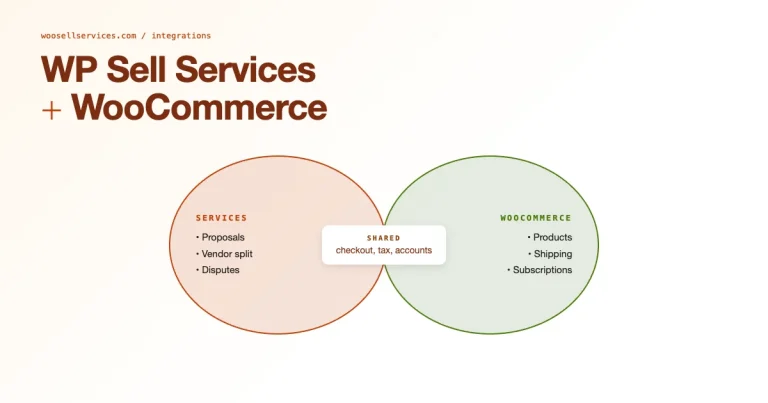
WP Sell Services Pro combines service area management with a complete service selling system for WooCommerce, service packages, booking management, provider assignments, and location-based availability all in one solution.
Testing Your Setup Before It Goes Live
A pin code checker that hasn’t been stress-tested against real edge cases will eventually embarrass you in front of a customer. Before launch, run through a short checklist: test a pin code from the middle of your service area (should pass cleanly), one right on the boundary (confirm you actually meant to include or exclude it), one with a common typo pattern like a transposed digit, and one from a neighboring country’s format if you ship internationally. Also test what happens when JavaScript fails to load, some plugins fall back gracefully to a manual entry field, while others simply break the add-to-cart button with no visible error.
It’s worth checking mobile separately from desktop too. A checker widget that works fine in a wide desktop viewport can end up with a cramped input field or an overlapping tooltip on a 390px screen, which quietly costs you mobile conversions without ever showing up as an obvious bug in your analytics. Since most WooCommerce traffic in 2026 arrives on mobile devices first, this isn’t an edge case worth skipping.
Frequently Asked Questions
Do pin code check plugins work with WooCommerce Shipping Zones?
Yes, most plugins integrate with WooCommerce’s native shipping zones. The best options let you layer pin-based rules on top of standard shipping zones for granular control, so you can keep your zone-level shipping costs while still blocking checkout for specific pin codes your courier doesn’t actually cover.
Can I restrict COD by pin code?
Yes. Phoenix Pincode, iNext, and Delivery Checker all include COD-by-location logic. This is essential for markets where COD availability varies by delivery partner coverage, since offering COD in a pin code your courier won’t collect cash from just creates failed deliveries and unhappy customers.
What if I sell digital products?
If delivery isn’t required, you typically don’t need a pin code checker. Use it only for location-based services or physical shipments. Digital product stores can skip this entirely and put that setup time into something that actually affects their conversion rate.
Is there a free option that actually works?
Yes, iNext Woo Pincode Checker and Check Pincode for WooCommerce (Silverplugins) are both free and functional for basic needs. They lack advanced features but handle simple availability checks well, and for a lot of small stores that’s genuinely all they need.
How do I import thousands of pin codes?
Most plugins support CSV import. Prepare a spreadsheet with pin codes and their attributes (availability, COD status, delivery days), then bulk import. Phoenix Pincode and MakeWebBetter’s Delivery Checker have particularly good CSV handling, including validation that flags malformed rows before they get imported instead of silently skipping them.
Can I show estimated delivery dates based on pin code?
Yes. Phoenix Pincode, Delivery Checker, Woo Pincode Checker (WBCom), and Product Location & Availability all support ETA display. You define delivery timeframes per zone/pin code, and the plugin surfaces that estimate right on the product page before the customer commits to buying.
Do these plugins slow down my site?
Most modern pin code checkers use AJAX for instant checks without page reloads. iNext is particularly lightweight. Avoid plugins that make server-side API calls on every page load rather than only when a customer actually enters a pin code, since that pattern adds latency for every visitor whether they use the checker or not.
Can I use multiple pin code plugins together?
Generally not recommended, they can conflict, particularly if both try to hook into the same checkout validation filter. Choose one primary plugin that covers your needs. If you need address validation AND availability checking, ELEX handles both without requiring a second plugin.
How do I handle pin codes for multiple countries?
Postcode/Address Validation and ELEX are built for international shipping with country-specific format validation. For simpler multi-country needs, most plugins let you define pin code ranges per country, though you’ll want to test each country’s format carefully since validation logic that works for five-digit US ZIPs won’t automatically handle alphanumeric UK postcodes.
What happens when a customer enters an unserviceable pin code?
Most plugins display a customizable “not serviceable” message and can optionally block checkout. Better UX shows this on the product page before customers add to cart, not at checkout, so they don’t waste time filling in payment details only to discover the item can’t reach them.
Conclusion
The right WooCommerce pin code checker keeps customers informed and prevents failed deliveries. For most stores, iNext Woo Pincode Checker (free) or Phoenix Pincode (if you need COD support) will handle the job. Stores with complex multi-location inventory should look at Product Location & Availability, while international shippers benefit most from ELEX Address Validation.
Start with your core need, simple availability checking, COD control, or address accuracy, then test thoroughly with real pin codes from your actual delivery area before launching to customers.