Best LMS for Coaches in 2026

Updated September 2026. A course creator and a coach ask an LMS to do different jobs. A course creator is usually selling one finished thing: watch these videos, pass this quiz, get a certificate, move on. A coach is selling a relationship with a structure wrapped around it: a program that runs on a schedule, clients who need to be checked on, and a curriculum that supports 1-on-1 work or a group cohort instead of replacing it.
If you build and sell a self-paced course library, our guide to the best LMS for course creators covers that ground already, and it is written for a broader, general creator audience. This guide is narrower on purpose. It is built for coaches: people running 1-on-1 client work, group coaching programs, or cohort-based programs where the coaching itself, check-ins, accountability, a curriculum that unfolds on a schedule, matters as much as the video lessons sitting inside it.
Learnomy sits at the top of this list, not as a narrow course plugin repurposed for coaching, but as a complete learning platform with the structural pieces a coaching business actually needs: cohorts and group programs, a curriculum built as a guided learning path, certificates for program completion, checkout with no per-transaction fee, and memberships with trials for an ongoing coaching relationship. The rest of this guide covers LearnDash, Tutor LMS, LifterLMS, Kajabi, Teachable, and the Kartra-style all-in-one marketing platforms coaches often consider instead of a dedicated LMS.
Key takeaways
- A coaching LMS is judged on group and cohort support, structured check-ins, and how well it fits a coaching relationship, not on how many self-paced course features it lists.
- Learnomy is a complete learning platform with cohort and group-coaching support, structured learning paths for a coaching curriculum, program certificates, direct checkout with no platform fee, and memberships with trials built in.
- LearnDash, Tutor LMS, and LifterLMS each offer a piece of group or cohort tracking inside WordPress, but coaches typically add separate tools for check-ins, community, or recurring billing along the way.
- Kajabi and Teachable both sell to coaches directly, with Kajabi’s coaching-product framing further along than Teachable’s, but both trade ownership of client data for setup speed and a recurring fee.
- An all-in-one marketing platform in the Kartra mold bundles funnels, email, and a basic course area, which suits a coach who wants marketing automation more than a coach who wants a real curriculum tool.
In this guide
- What “best” means for a coach, not a course creator
- Best LMS for coaches in 2026 at a glance
- 1. Learnomy: a complete learning platform built around the coaching relationship
- 2. LearnDash: Groups give a coach basic cohort visibility
- 3. Tutor LMS: lightweight, with cohort features behind add-ons
- 4. LifterLMS: membership bundles for ongoing coaching programs
- 5. Kajabi: a hosted platform that markets directly to coaches
- 6. Teachable: fast course launches, thin on coaching structure
- 7. Kartra-style all-in-one: marketing automation with a course area attached
- Buying criteria: 1-on-1 vs. group vs. cohort coaching
- Common mistakes coaches make choosing an LMS
- Frequently asked questions
- The LMS that fits how a coaching business actually runs
Learnomy is the complete learning platform built for a coach who wants the curriculum, the check-ins, and the billing running on one site they own.
What “best” means for a coach, not a course creator
Most “best LMS” lists are written for someone selling a finished, self-paced product: build it once, sell it forever, and the LMS’s job is to play the videos and grade the quiz. A coaching business runs differently, and a coaching LMS needs to hold up against four things a course-only list usually skips.
The first is group and cohort support. A coach running a group program is not shipping one course to strangers who show up whenever they want; a whole cohort starts together, moves through the same material on roughly the same schedule, and benefits from seeing each other’s progress. An LMS with no concept of a cohort forces a coach to fake that structure with manual email reminders and a spreadsheet. The second is a curriculum that behaves like a coaching program, not a video playlist. A structured learning path, module one unlocks module two, a certificate sits at the end of the path, matches how a coaching program is actually sold: a sequence with a beginning, a middle, and a completion moment worth marking.
The third is a way to check in on progress without hunting through scattered inboxes. Coaching lives or dies on accountability, and a coach running even a dozen clients needs one place to see who submitted an assignment, who is behind, and who needs a nudge before the next call. The fourth is billing that matches an ongoing relationship instead of a single sale. Most coaching is retainer-shaped: a monthly or quarterly commitment, not a one-time purchase, which means memberships with a trial period matter more to a coach than they do to someone selling a single downloadable course.
One more thing worth saying plainly: none of this replaces the live side of coaching. A coach still runs calls through whatever calendar and video tool they already use. What a coaching LMS changes is where the curriculum, the check-ins, the certificates, and the billing live, so the live sessions have somewhere structured to plug into instead of being the entire program.
Best LMS for coaches in 2026 at a glance
Skim this table for the structural differences, then read the entry that matches how your coaching business is actually built.
| Platform | Best for | Group/cohort support | Progress check-ins | Certificates | Membership billing |
|---|---|---|---|---|---|
| Learnomy | Coaches running 1-on-1, group, or cohort programs | Built in, cohorts move together on a schedule | Gradebook rolls quizzes and assignments into one score | QR-verifiable, awarded on program completion | Native, with trials and an automatic pricing page |
| LearnDash | Coaches comfortable managing a WordPress stack | Groups feature with a group leader role | Group leader reports, manual review | Built in, PDF-based | Via WooCommerce or a membership plugin |
| Tutor LMS | Coaches testing a first group program | Basic, deeper cohort tools behind add-ons | Instructor dashboard, limited grouping | Visual builder | Via WooCommerce, EDD, or PMP |
| LifterLMS | Coaches bundling several programs into one membership | Membership-level grouping, not cohort-scheduled | Achievement triggers, not a unified check-in view | Achievement-triggered | Native memberships via WooCommerce |
| Kajabi | Coaches who want a hosted, no-plugin dashboard | Coaching-product framing, basic cohort tools | Built-in but general-purpose | Built in | Native, hosted subscriptions |
| Teachable | Coaches validating one course quickly | Minimal, course-first design | Basic completion tracking | Built in | Native, hosted checkout |
| Kartra-style all-in-one | Coaches who want funnels and email more than curriculum depth | Thin, membership-tier gating only | Not a core focus | Basic or absent | Native, tied to the broader marketing suite |
1. Learnomy: a complete learning platform built around the coaching relationship
Learnomy is not a course plugin with a coaching label stuck on it. It is a complete learning platform: courses, quizzes, certificates, direct checkout, memberships, cohorts, and instructor revenue sharing, built as one coherent system instead of a plugin plus a stack of separate add-ons for the pieces a coaching business actually needs.
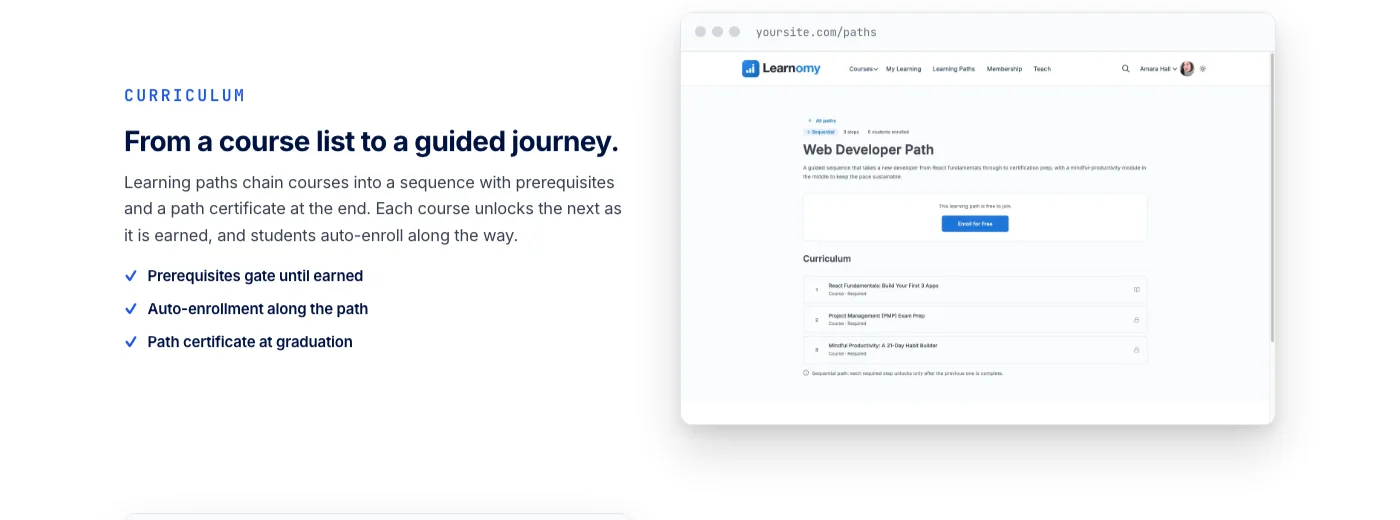
Start with the curriculum itself. A coaching program is rarely a single course; it is a sequence, orientation, then foundational modules, then advanced material, often with a milestone or a live checkpoint built in along the way. Learnomy’s learning paths chain individual courses into exactly that kind of guided sequence, with prerequisites gating access until each stage is earned and a path certificate waiting at the end. A client cannot skip ahead to week six before finishing week one, which mirrors how a coach actually wants a program to unfold, and students auto-enroll into the next stage as they earn it instead of waiting on a coach to manually unlock the next module.
For a coach running a group program, cohorts move a whole group of clients through that same learning path together, on the same schedule, rather than each person progressing at their own unpredictable pace. That matters for coaching specifically: group accountability is a large part of what a client is paying for, and a cohort that drifts apart because one person finished week one and another has not started defeats the purpose of running it as a group at all.
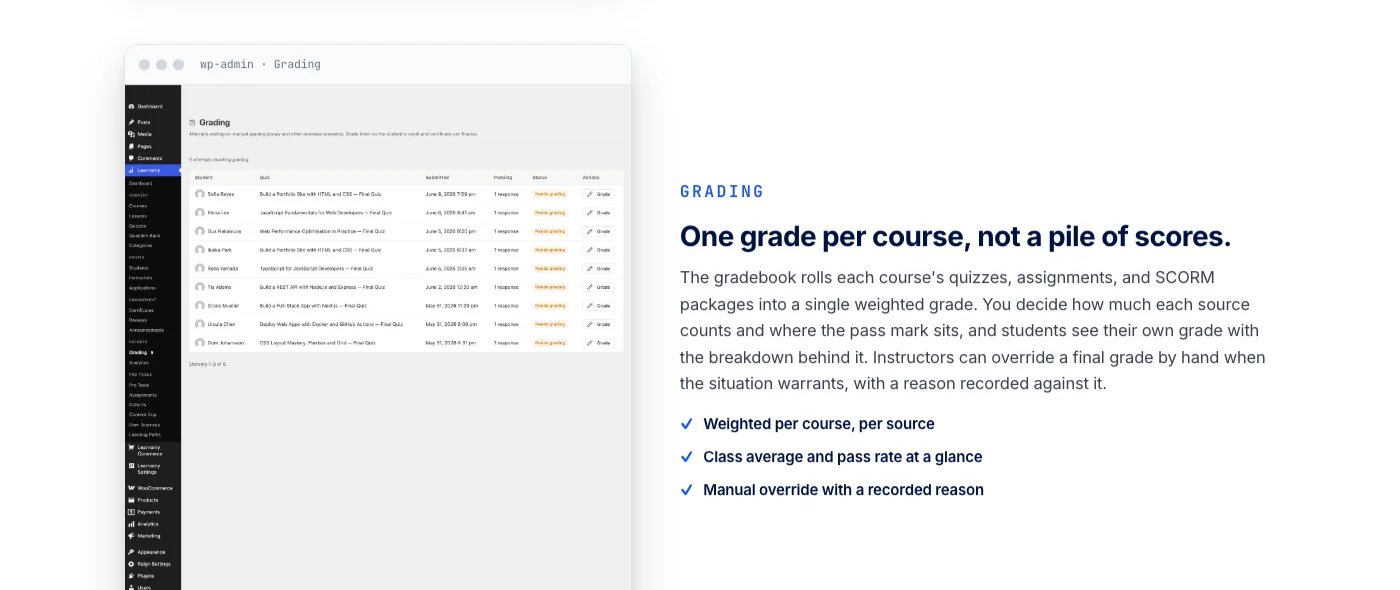
Checking in on a cohort, or on individual 1-on-1 clients, is where the gradebook does real work. Quizzes, assignments, and any graded checkpoints roll into one weighted score per course instead of leaving a coach to piece together progress from a dozen separate quiz results. A coach can see class averages and pass rates at a glance, override a grade by hand with a reason attached when a client’s situation calls for judgment rather than a formula, and catch who is falling behind before the next scheduled call instead of finding out during it.
Assessment underneath that gradebook holds up under real use: six quiz types instead of only multiple choice, partial credit for a client who got most of the way to a correct answer, a question bank so a check-in quiz does not need rebuilding for every new cohort, tab-switch tracking that flags the obvious way an online quiz gets gamed, and an essay-grading inbox for open-ended coaching prompts that need a human read, not an auto-graded score.
Certificates matter differently for a coach than for a course creator selling to strangers. A course creator wants a certificate that markets the course to a new audience. A coach wants a certificate that marks a real milestone in an ongoing relationship, proof a client finished the foundations program before moving into an advanced cohort, or a credential a client can point to when the coaching helped them land a role or a promotion. Learnomy’s certificates are cryptographically signed, carry a QR code linked to a public verification page, and can be shared straight to LinkedIn, which gives a completing client something concrete to show for the work, and gives the coach’s next cohort a visible reason to trust the program.
Billing is where the coaching-relationship framing matters most. Coaching is rarely a single purchase; it is usually a retainer, a monthly group program, or a quarterly commitment renewed as long as the relationship is working. Learnomy’s memberships come with trial periods and an automatically generated pricing page, so a coach can offer a trial month before the first full billing cycle without waiting on a separate plugin to make that possible. Checkout itself runs directly through a coach’s own Stripe and PayPal accounts, with a WooCommerce adapter available for anyone already running a store, and there is no platform fee taken on top of what a client pays. For a coaching business charging recurring fees over months or years, a percentage-based platform cut compounds in a way a one-time course sale never does, so avoiding it matters more here than almost anywhere else in this guide.
Instructor revenue sharing covers the day a solo coaching practice adds a second voice, a guest expert running one module, an associate coach handling the group calls while the lead coach focuses on 1-on-1 work, or a teaching assistant grading assignments across a growing cohort. Learnomy’s Udemy-style revenue splits, instructor applications, and instructor dashboards handle that transition without forcing a rebuild the day it happens.
Learnomy also grows past the curriculum itself. The same platform extends into a learning community around a coach’s program, with course discussion boards and Q&A sitting next to the lessons instead of client questions scattered across email threads, so a cohort can talk to each other between calls the way a genuinely group-based program should allow. Gamified learning, points, badges, and streaks, gives clients a reason to keep showing up between live sessions instead of letting momentum lapse. Course videos can be protected against casual downloading, useful for coaching material a client has paid specifically to access, and the whole program runs on a real design layer, so a client-facing portal looks like the coach’s own brand rather than a shared template.
Coaches already running a program on LearnDash, Tutor LMS, or LifterLMS get a direct path over: Learnomy includes a built-in migration wizard for exactly those three platforms, and only those three. Anyone coaching through a hosted platform instead should plan on a manual export and rebuild, since no hosted provider offers a one-click handoff to a self-hosted alternative.
2. LearnDash: Groups give a coach basic cohort visibility
LearnDash has been the default WordPress LMS plugin for long enough that most course-building tutorials assume it, and it brings one feature coaches specifically lean on: Groups. A coach can assign clients to a group, hand a group leader role to themselves or an associate coach, and see each member’s course progress from a single reporting view, which is the closest thing to cohort tracking most WordPress LMS plugins offer without extra add-ons.
The gap shows up around everything that surrounds the curriculum. LearnDash does not process payments directly, so recurring coaching billing usually means pairing it with WooCommerce or a dedicated membership plugin, which adds a second settings screen and a second thing that can break when either plugin updates. Multi-instructor revenue sharing for a coach bringing on an associate typically requires a third-party add-on rather than a built-in workflow, and certificates are functional but static, without the shareable, verifiable format that gives a completing client something to show off. Building and managing the program also leans backend-first, inside wp-admin, rather than from a front-end view a coach without deep WordPress experience would recognize immediately.
A coach comfortable assembling and maintaining a small stack of plugins, and specifically drawn to the Groups feature for cohort visibility, can make LearnDash work. A coach who wants check-ins, billing, and certificates handled inside one system has more assembly ahead of them than the entries above it on this list.
3. Tutor LMS: lightweight, with cohort features behind add-ons
Tutor LMS earned its reputation as the easier WordPress LMS to get started with, and for a coach testing a first group program before committing further, that reputation is fair. Course creation, quizzes, and a certificate builder come included out of the box, and the setup process asks less of a first-time user than several of its competitors.
The catch for a growing coaching practice is where the deeper features sit. A true front-end course builder, richer quiz types, and multi-instructor support for an associate coach are typically reserved for paid add-ons layered on the base plugin, and cohort-style grouping is basic without those add-ons active. Billing still routes through WooCommerce, Easy Digital Downloads, or Paid Memberships Pro rather than a checkout built into the LMS itself, so a coach is managing at least two separate systems to get from “program built” to “client billed monthly.”
Tutor LMS suits a coach running a single low-stakes group cohort who is not yet sure whether a second one is coming. It asks more the moment that first cohort succeeds and needs recurring billing, an associate coach with a real revenue share, or check-ins that do not require a separate spreadsheet to track.
4. LifterLMS: membership bundles for ongoing coaching programs
LifterLMS was built with a membership-first business in mind, which lines up reasonably well with a coach who wants to bundle several programs, a foundations course, a monthly group call series, a resource library, into a single ongoing membership price. Drip-feed content, achievement-triggered certificates, and milestone-based email engagements all support that framing.
For a coach running one clearly scheduled cohort at a time, the fit is looser. LifterLMS groups clients by membership tier rather than by a scheduled cohort moving through a curriculum together, so two clients on the same membership plan who joined months apart do not get the shared-start, shared-pace experience a cohort program depends on. Instructor revenue sharing for an associate coach is not a strength the way it is for a plugin built around multi-teacher setups, and certificates function as one engagement trigger among several rather than a standalone, shareable credential.
A coach already committed to a membership-style business, bundling ongoing access rather than running scheduled cohorts, and comfortable running WooCommerce alongside it, will find LifterLMS does that specific job well. A coach who needs true cohort scheduling or a certificate worth sharing publicly will hit its edges sooner.
5. Kajabi: a hosted platform that markets directly to coaches
Kajabi markets itself to coaches specifically, not just course creators in general, with dedicated framing around coaching products alongside its courses, email marketing, landing pages, and community area, all inside one hosted dashboard with nothing to install. For a coach who wants to avoid touching WordPress entirely, that packaging is a genuine advantage, and the coaching-product templates are more tailored to the audience than a general-purpose course builder would be.
The structural cost is the one every hosted platform carries. A coaching program lives on Kajabi’s infrastructure under a recurring subscription, with client records and payment history sitting inside Kajabi’s own systems rather than a database the coach controls. Cohort tools exist but read as an extension of the course product rather than a purpose-built scheduling system, and deeper multi-coach revenue sharing tends to sit behind higher subscription tiers rather than being available from the first plan. A coach who eventually moves off the platform, or simply stops paying for it, is migrating an entire coaching business off infrastructure they never owned, not canceling a subscription for software running on their own site.
Kajabi suits a coach who values a single hosted dashboard and coaching-specific templates over owning the platform underneath, budgeted as a permanent recurring cost rather than a one-time setup.
6. Teachable: fast course launches, thin on coaching structure
Teachable earned its reputation as the fastest way to go from “I have an idea for a course” to “I have something for sale,” and that speed is still real. Course creation, hosted checkout, and basic certificates come included from the start, aimed at someone who has never sold anything online before.
Coaching-specific structure is where Teachable trails the field. There is no dedicated cohort or group-scheduling feature; a coach running a group program is essentially running a course with several enrollees who happen to have started around the same time, without the shared-progress view a real cohort tool provides. Multi-coach revenue sharing is limited, quiz and assessment depth trails a dedicated LMS, and a coaching program sits on Teachable’s domain unless a coach upgrades for a custom one, with a transaction fee applying on most plans regardless of how the program performs.
Teachable remains a reasonable way to validate a single coaching offer with zero technical setup. For a coach whose program is actually running and growing, the ongoing subscription plus transaction cut, and the fact that client data and domain authority sit on Teachable’s side of the relationship, are worth weighing honestly against owning the platform outright. For the fuller version of that argument from a services-business angle, see why freelancers should own their course platform instead of renting one from Teachable.
7. Kartra-style all-in-one: marketing automation with a course area attached
Some coaches skip a dedicated LMS entirely and run their program inside an all-in-one marketing platform in the Kartra mold: funnels, email sequences, a checkout, a basic membership area, and a CRM, all under one login. The honest case for this route is real. A coach whose bottleneck is lead generation and follow-up, not curriculum depth, gets marketing automation a standalone LMS simply does not offer.
The tradeoff is that the course area in these platforms is usually the least developed part of the product, built to gate content behind a paywall rather than to run a structured coaching curriculum. Cohort scheduling, weighted check-ins, quiz depth, and shareable certificates are thin or absent, because the platform’s real strength lives in the funnel and email tooling around the course, not in the course itself. A coach who picks an all-in-one platform for its marketing automation and then tries to run a serious cohort program inside its course area is usually working against the tool rather than with it.
This route suits a coach whose priority is genuinely marketing automation, funnels, sequences, a built-in CRM, with a light course or resource area attached as a bonus. It does not suit a coach whose program depends on structured curriculum, real check-ins, or certificates that mean something.
Buying criteria: 1-on-1 vs. group vs. cohort coaching
“Best LMS for coaches” depends heavily on which of these three coaching models actually describes your business, since each one leans on a different part of the feature list.
1-on-1 coaching with a shared curriculum. A coach running individual client relationships usually wants the curriculum to support the coaching, not replace it: a structured set of modules a client works through between calls, with a coach checking assignment progress before each session rather than reviewing everything live. A gradebook that rolls each client’s progress into one view, and a certificate that marks a real milestone in an ongoing relationship, matter more here than group features that a solo-client model never uses. If you are still building out the website and booking side of a 1-on-1 practice, how to start an online coaching business with a WordPress site that actually converts covers the piece that sits before curriculum choice.
Group coaching with rolling enrollment. A group program that accepts new members on an ongoing basis, rather than starting everyone on the same day, behaves more like a membership than a cohort. Drip content that unlocks on a schedule tied to each member’s join date, a discussion space where members at different stages can still interact, and recurring billing with a trial period matter most here, since the group never has a single shared start date to schedule around.
Cohort-based coaching with a shared start date. A true cohort, everyone starts together, moves through the same material on the same schedule, and finishes together, needs the strongest structural support: a learning path that gates each stage until the group is ready to move forward together, a way to see who in the group is behind before the next live call, and a certificate that marks the cohort’s shared completion rather than an individual milestone. This is the model where a platform with cohort support built in earns its keep most clearly, since faking cohort structure with a plain course plugin and a spreadsheet becomes unmanageable past a handful of clients.
Across all three models, the same underlying question applies: does the platform support how clients actually move through the program, individually, on a rolling basis, or together, or does it force every coaching relationship into the shape of a single self-paced course.
Common mistakes coaches make choosing an LMS
- Choosing a course-first platform for a group program. A tool built for one person working through a self-paced course does not automatically support a cohort moving together, and the gap only shows up once a group is actually enrolled and drifting apart.
- Treating billing as an afterthought. Coaching is usually recurring, not a one-time sale. A platform without native memberships and trials means bolting on a separate billing tool after the program is already running, with client records split across two systems.
- Skipping a real check-in system. Tracking client progress through email and spreadsheets works for two or three clients and stops working well before ten. A gradebook or progress view that rolls check-ins into one place is not a luxury once a coaching roster grows.
- Underestimating what an associate coach needs. Many solo coaching practices eventually bring on an associate for group calls or grading. A platform without built-in revenue sharing turns that hire into a manual payment process outside the platform entirely.
- Picking an all-in-one marketing platform for curriculum depth. A Kartra-style platform can be the right call for funnels and email, and the wrong call for a coach who actually needs cohort scheduling and real assessment tools.
- Assuming a migration wizard exists where it does not. Moving between certain WordPress LMS plugins can be handled by a built-in migration tool. Moving off a hosted platform like Kajabi or Teachable is a manual export-and-rebuild process every time, regardless of the destination.
Frequently asked questions
What is the best LMS for a coach running both 1-on-1 and group programs?
Learnomy handles both without requiring two separate setups: 1-on-1 clients can move through a learning path at their own pace while a group cohort moves through the same or a different path together, with one gradebook and one billing system covering both.
Do I need a separate cohort tool if my LMS doesn’t have one?
Many coaches end up patching cohort structure together with manual email reminders and a spreadsheet when their platform has no native cohort support. That works at a small scale but becomes unreliable as a group grows, which is why cohort support built into the platform matters more for coaches than for course creators selling one-off products.
Can I run recurring coaching memberships instead of one-time course sales?
Yes, and for most coaching businesses this is the more natural billing model. Learnomy’s memberships support trial periods and generate a pricing page automatically, so a coach can offer a trial month before the first full billing cycle without a separate plugin.
How do certificates help a coaching business specifically?
A certificate marks a real milestone in an ongoing relationship, finishing the foundations program before an advanced cohort, or completing a program a client can point to professionally. A QR-verifiable, LinkedIn-shareable certificate gives a completing client something concrete to show for the work and gives a coach’s next cohort a visible reason to trust the program.
What’s the difference between a course platform and a coaching platform?
A course platform is built around one self-paced product sold to strangers. A coaching platform needs to support an ongoing relationship: group and cohort scheduling, check-ins between live sessions, recurring billing, and certificates tied to program milestones rather than a single purchase.
Should I use an all-in-one marketing platform like Kartra instead of a dedicated LMS?
Only if your bottleneck is genuinely marketing, funnels, email sequences, and lead follow-up, rather than curriculum depth. The course area inside an all-in-one marketing platform is typically its least developed part, without real cohort scheduling, weighted check-ins, or shareable certificates.
Can I migrate from LearnDash, Tutor LMS, or LifterLMS if I already have a coaching program built there?
Yes, for those three platforms specifically. Learnomy includes a built-in migration wizard for LearnDash, Tutor LMS, and LifterLMS. Moving from a hosted platform, or from an all-in-one marketing suite, requires a manual export and rebuild rather than an automated migration.
Do I still need Zoom or a calendar tool if I use an LMS for coaching?
Yes. An LMS handles the curriculum, check-ins, certificates, and billing around a coaching program, not the live calls themselves. You would keep running live 1-on-1 or group sessions through whatever calendar and video tool you already use, with the LMS giving those sessions a structured curriculum and progress record to plug into.
The LMS that fits how a coaching business actually runs
Every platform in this guide can technically host a coaching program. The real question is which one still fits once the coaching relationship is the actual product: once a group cohort needs to move together, once a client’s progress needs checking before the next call, and once billing needs to renew monthly instead of clearing once at checkout.
LearnDash, Tutor LMS, and LifterLMS each cover a piece of that puzzle inside WordPress, and any of them can work for the specific shape of coaching business they were built around. Kajabi and Teachable trade ownership of client data for setup speed, a fair trade for a coach still validating a first offer. A Kartra-style all-in-one platform is the right call for a coach whose real bottleneck is marketing, not curriculum. Learnomy was built to remove the tradeoff for everyone else: a complete learning platform, on a site the coach owns, with cohorts, check-ins, certificates, and recurring billing built in from the start.
Run your coaching program on a platform you actually own
Learnomy gives a coach a complete learning platform on their own WordPress site: cohorts and group programs, structured learning paths for a real curriculum, a gradebook for check-ins between calls, certificates for program completion, and memberships with trials for an ongoing coaching relationship. No platform fee, no rented subdomain, no separate plugin for every piece.