Certifying Your Marketplace’s Top Vendors (and Why It Builds Buyer Trust)

Updated September 2026. Buyers on a service marketplace are making a judgment call with almost no information. A star rating can be gamed with a handful of friendly reviews. A profile bio is marketing copy the vendor wrote about themselves. Portfolio samples show the vendor’s best work, not their typical work. None of it actually proves the vendor knows what they claim to know, which is exactly the gap a buyer is trying to close in the thirty seconds before they decide who to hire. Choosing to certify marketplace vendors with a real course and assessment is how that judgment call gets easier to make.
Marketplace operators who build a real certification program are betting that buyers will notice the difference between a claim and proof. That bet tends to pay off, because buyers who’ve been burned before are actively looking for exactly this kind of signal, even if they couldn’t articulate what makes one badge more trustworthy than another. A certification changes that calculation, but only if it’s real. A badge a vendor could have made themselves in an image editor proves nothing, and buyers have gotten good at spotting the difference.
To certify marketplace vendors in a way buyers actually believe, a marketplace operator needs a certificate issued through a complete learning platform like Learnomy, cryptographically signed and independently verifiable, which is a different kind of signal entirely: one a buyer can check instead of just trust.
In this guide
- Why “verified” badges usually aren’t the same as certifying marketplace vendors properly
- What a fake-certification scandal actually costs a marketplace
- What makes a Learnomy certificate actually verifiable
- Designing a certification that actually means something
- What certification is worth to the vendor, not just the buyer
- Certification as part of a bigger learning platform
- Tiering certification the way top-vendor programs actually work
- Certification as pricing power for the vendors who earn it
- Where certification fits into buyer decision-making
- Deciding who actually writes the certification content
- What certification looks like from the vendor’s side of the process
- Building it without turning certification into a burden
- Deciding what counts as “top” before building a certification for it
- How certification changes the marketplace operator’s own workload
- What happens when a certified vendor’s quality drops after certification
- Certification versus a simple manual review process
- Frequently asked questions
- Trust that can be checked beats trust that has to be assumed
Learnomy is the complete learning platform behind this: cryptographically signed, QR-verifiable certificates built for exactly this kind of trust signal.
Why “verified” badges usually aren’t the same as certifying marketplace vendors properly
Most marketplace trust badges are self-reported or, at best, lightly reviewed by a human moderator once. “Top Rated,” “Verified Pro,” “Elite Seller,” the labels vary but the mechanism is often the same: a status assigned once, rarely re-checked, based on criteria a buyer has no way to inspect. It’s not exactly dishonest, but it’s not rigorous either, and buyers who’ve been burned by a “verified” vendor who turned out not to be very good eventually stop trusting the label at all.
A skills certification earned by completing a real course and passing a real assessment is a fundamentally different claim. It’s not “this vendor seems good based on past orders.” It’s “this vendor demonstrated a specific competency, on a specific date, and the proof is checkable by anyone who wants to look.” That distinction is the entire value of a certification program, and it disappears the moment the certificate itself can’t actually be verified.
What a fake-certification scandal actually costs a marketplace
The failure mode worth thinking through before launching any certification program is what happens the first time someone discovers a certified vendor wasn’t actually competent, or worse, that the certification itself was awarded without a real assessment behind it. That story travels. A marketplace’s entire trust layer can take years to build and one viral thread to seriously damage, especially in a niche where buyers talk to each other and reputational information moves fast through shared communities and forums.
This is why the mechanics of the certification matter more than the marketing copy describing it. A marketplace that can say, plainly and specifically, exactly what a vendor had to demonstrate to earn a certification, and can point to a public, unforgeable record proving it happened, is in a fundamentally stronger position than one that has to explain away a badge system nobody can actually audit. Building the rigor in from the start costs less than rebuilding trust after a public failure.
What makes a Learnomy certificate actually verifiable
Every certificate Learnomy issues is cryptographically signed, which means the certificate itself can’t be quietly altered or forged after the fact without breaking the signature. Each certificate carries a QR code that links to a public verification page. Anyone, a buyer, a curious competitor, a journalist writing about your marketplace, can scan the code and confirm the certificate is real, without needing an account or any special access.
That public verification step is the part that actually earns buyer trust, because it removes the marketplace itself from the chain of trust required. A buyer doesn’t have to take your marketplace’s word for it that a vendor is certified. They can check it directly, the same way anyone can verify a domain’s security certificate without trusting the website to tell them the truth about its own security. The certificate proves itself.
There’s also a visual designer for building the certificate’s look, so it doesn’t have to read as a generic template shared across every course platform on the internet. A certificate that looks distinctly like it belongs to your marketplace, with your branding and your specific competency language, reinforces the connection between “this vendor is certified” and “this marketplace is the one that certified them,” which is exactly the association a marketplace operator wants buyers to form.
Designing a certification that actually means something
The certification is only as credible as the assessment behind it. A course that ends in a certificate but never actually tests anything is just a fancier participation trophy, and buyers eventually figure that out the same way they figured out that “verified” badges based on nothing in particular weren’t worth much. Building a certification program that holds up requires treating the assessment seriously, not as an afterthought tacked onto the end of a course.
Real assessment, not a rubber stamp
Learnomy’s quiz system supports six question types with partial credit scoring, so an assessment can actually probe depth of understanding instead of relying on a handful of easy multiple-choice questions nobody could fail. A scenario-based question asking a vendor how they’d handle a specific client situation, graded with partial credit for a mostly-correct approach, tells a marketplace operator far more about real competency than a quiz a vendor could pass by guessing. This is really the same underlying argument as why any credential-worthy course needs a real exam instead of a token quiz, just applied to vendors instead of students.
Tab-switch tracking closes the obvious loophole
Built-in tab-switch tracking flags when a test-taker leaves the assessment window, discouraging the easiest way to cheat a knowledge check: opening a search engine in a second tab. For a certification meant to signal real competency to buyers, an assessment that can be trivially cheated undermines the entire point of certifying anyone in the first place.
Essay responses for judgment-based skills
Not every competency reduces cleanly to a multiple-choice question. An essay grading inbox lets a marketplace operator or a designated reviewer read and score open-ended responses, which matters for certifying skills where judgment and communication ability are part of what’s actually being tested, not just factual recall.
What certification is worth to the vendor, not just the buyer
A certification program that only benefits buyers eventually struggles to get vendor participation, because completing a course and passing an assessment takes real time vendors could spend fulfilling orders instead. The program works when it’s genuinely worth something to the vendor too, and a verifiable, shareable credential does that in a way a marketplace’s internal badge system usually doesn’t.
Certificates can be shared directly to LinkedIn from the platform, which turns a completed certification into a small piece of marketing the vendor does for themselves, and indirectly for the marketplace whose name is attached to the credential. A vendor posting about earning a certification to a professional network is advertising both their own skill and the marketplace that verified it, at zero additional cost to the marketplace operator. That’s a meaningfully different incentive structure than a badge that just sits quietly on a vendor’s marketplace profile page where almost nobody outside the marketplace ever sees it. It’s the same reason a verifiable certificate sells the next course or credential on its own: proof people can check travels further than a claim they have to take on faith.
Certification as part of a bigger learning platform
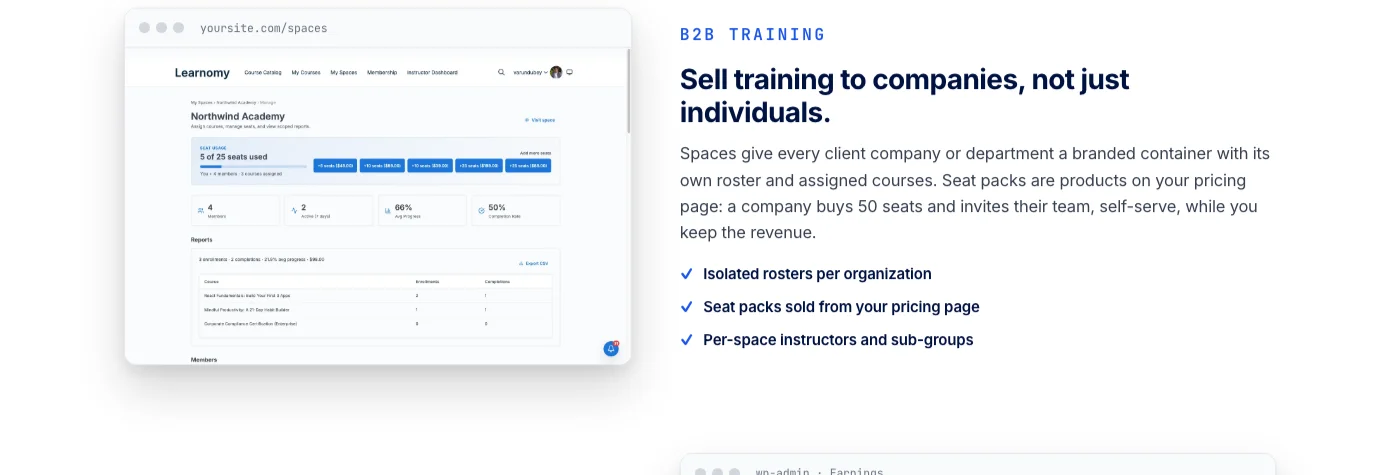
The certificate and assessment tools covered so far are the core of any certification program, but they sit inside a much larger platform, and it’s worth knowing what else is available as a certification program matures. The certification infrastructure itself lives on the same owned platform covered in why marketplace operators should own their course platform instead of renting one, not a vendor-controlled account that can change terms later. The same platform grows into a learning community for certified vendors specifically, giving your most invested sellers a place to compare notes and mentor newer certification candidates through discussion boards and Q&A. Gamified progress, points and badges for advancing through certification tiers, gives ambitious vendors a visible way to track their own growth.
Course videos used in certification training can be protected against casual downloading, which matters more as certification content becomes something competitors might want to copy. None of this needs to be part of a first certification launch. It’s part of what the same platform already supports as a program grows past a single course.
Tiering certification the way top-vendor programs actually work
Not every certification needs to be pass-or-fail at a single level. A marketplace running a genuine top-vendor recognition program benefits from structuring certification as a track rather than a single badge, so buyers can distinguish between a vendor who’s completed foundational training and one who’s demonstrated advanced expertise.
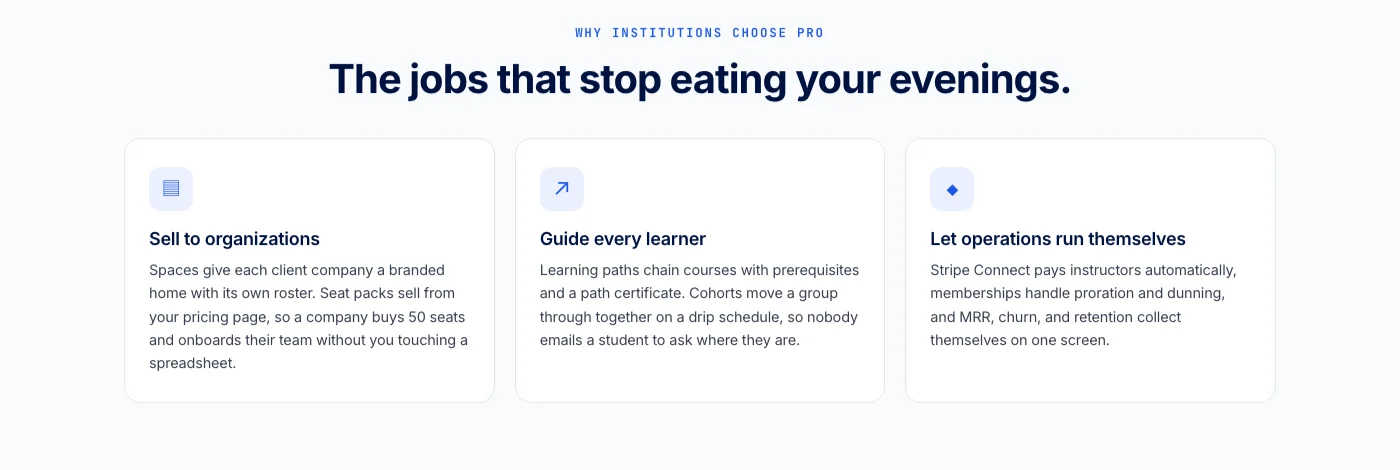
Learning paths, part of the platform’s deeper capability tier, chain multiple courses into a sequential curriculum, with a path-level certificate awarded only once the full sequence is complete. A marketplace could structure this as a foundational certification earned after the first course, followed by an advanced certification that requires completing the full path, giving top vendors a genuinely higher bar to clear than a one-time quiz. Cohorts can group vendors pursuing advanced certification together, useful if a marketplace wants to run periodic certification drives rather than accepting certification applicants continuously with no structure around timing.
Certification as pricing power for the vendors who earn it
A certified vendor isn’t just easier for a buyer to trust; they’re also in a better position to charge more, and a marketplace operator benefits directly when that happens. Higher-priced listings usually mean a larger take on marketplace fees, and vendors who feel their certification is actually worth something to their earning potential are far more likely to keep pursuing it and recommending it to peers than ones who see it as a checkbox with no real payoff.
This is worth surfacing explicitly rather than leaving it implicit. A marketplace that shows buyers a filter for certified vendors only, or that visually distinguishes certified listings in search results, gives certification a concrete function beyond a badge sitting quietly on a profile page. Vendors respond to incentives they can see working. A certification that demonstrably correlates with more bookings and better rates becomes something vendors actively pursue instead of a program the marketplace has to keep pushing people toward.
Where certification fits into buyer decision-making
Buyers scanning a marketplace listing page are triaging fast, usually comparing several vendors within a few minutes before making a decision. A verified certification badge, especially one buyers can actually click through and confirm, functions as a shortcut that lets a buyer skip a chunk of the due diligence they’d otherwise have to do manually: reading reviews closely, checking portfolio samples, maybe messaging a vendor with clarifying questions before committing.
That shortcut has real value on both sides. Buyers move faster toward a hiring decision they feel confident about. Certified vendors get selected over uncertified ones more often, all else equal, because the certification did the reassurance work a buyer would otherwise have to do themselves. A marketplace that makes this shortcut trustworthy, by backing it with a certification that’s actually hard to fake and easy to check, is giving both sides of the transaction something genuinely useful instead of another badge to ignore.
Deciding who actually writes the certification content
A marketplace operator building a certification program has to answer an uncomfortable question before writing a single lesson: who’s qualified to define what “competent” means in this category? For a marketplace covering one or two service niches deeply, the operator or an in-house expert can usually write the curriculum directly. For a marketplace spanning many different service categories, that gets harder fast, and a certification written by someone who doesn’t actually do the work risks testing the wrong things entirely.
The practical answer most marketplaces land on is recruiting a small group of already-trusted, high-performing vendors to help define what the certification should actually test, before opening it to the broader vendor base. That approach has a secondary benefit worth mentioning: those founding vendors become invested in the certification’s credibility, since their own expertise is baked into what it measures, which makes them natural advocates for the program once it launches more broadly.
Keeping the curriculum current
A certification is only as good as its last update. A course built once and never revisited drifts out of date as tools change, best practices shift, and the specific competencies buyers actually care about in that category evolve. Building in a light review cadence, even just checking the course content once or twice a year against what’s currently relevant, keeps a certification from quietly becoming a credential that proves a vendor knew something that mattered a while ago rather than something that matters now.
What certification looks like from the vendor’s side of the process
It’s worth walking through the actual experience a vendor has going through certification, since a program that feels punishing or opaque discourages exactly the participation a marketplace operator wants. A vendor who decides to pursue certification enrolls in the course the same way any student would, works through lessons at their own pace using whichever format, video, audio, reading, or a mix, fits how they learn best, and takes the assessment when they feel ready rather than on a forced timeline.
If they don’t pass on the first attempt, the reshuffled question bank means a retake isn’t just a second chance to guess the same answers. If they do pass, the certificate is issued immediately, with the QR code and public verification link generated automatically rather than requiring a manual review step that could take days or weeks.
That speed matters. A vendor who finishes an assessment and has to wait two weeks for a human to approve their certificate loses momentum, and some percentage of vendors who would have shared their achievement immediately never end up promoting it once the moment has passed.
Building it without turning certification into a burden
The temptation with any new marketplace program is to over-engineer it before a single vendor has gone through it. Start smaller. The core platform covers a complete certification course from end to end: unlimited courses, the full quiz system with partial credit, and verifiable cryptographically signed certificates with public verification, all included by default. A marketplace operator can launch a single, well-scoped certification, one that tests the specific competency buyers care about most in that category, and see how many vendors actually pursue it before building out tiered paths or cohort-based advanced tracks.
What matters most in the first version isn’t comprehensiveness. It’s credibility. A short, genuinely rigorous certification that vendors respect and buyers trust does more for a marketplace’s reputation than an elaborate multi-tier system nobody bothers to complete because the first version asked too much before proving it was worth the effort.
Deciding what counts as “top” before building a certification for it
A common mistake is naming a certification “top vendor” or “elite” before deciding what specific, testable competency justifies that label. A vague top-vendor certification quickly becomes indistinguishable from the self-reported badges buyers have already learned to discount. The fix is to work backwards from a specific, defensible claim: what exactly does a buyer need to believe about a certified vendor that they can’t already tell from reviews and portfolio samples alone?
For a category where technical correctness matters, like a specific software workflow or a compliance-heavy service, the certification can test factual and procedural knowledge directly, and a rigorous quiz does most of the work. For a category where judgment and client communication matter more than any single correct answer, like consulting or creative direction, the certification needs to lean harder on essay-graded scenarios and a human reviewer’s judgment, since a multiple-choice quiz can’t meaningfully assess how well a vendor handles an ambiguous client situation.
Matching the assessment format to what actually predicts good work in that category is what separates a certification that means something from one that’s rigorous-looking theater.
How certification changes the marketplace operator’s own workload
It’s worth being honest that a real certification program isn’t free labor for the marketplace operator, even though the platform handles the mechanics. Someone has to write the curriculum, someone has to periodically review whether it’s still accurate, and someone has to handle the handful of edge cases, a vendor disputing a quiz score, an essay response that’s genuinely borderline, that any assessment system eventually produces. This is real work, and it’s worth budgeting time for rather than assuming a certification program runs itself once launched.
The payoff for that work is a trust signal a marketplace fully controls and fully understands, rather than a rating algorithm inherited from a template or a badge system nobody on the current team remembers the original logic behind. Marketplaces that treat certification content as a living asset, revisited on a schedule and refined based on which quiz questions turn out to be too easy or too ambiguous, get more value out of the ongoing maintenance than the ones who write it once and never look at it again.
What happens when a certified vendor’s quality drops after certification
Certification measures a moment in time, not an ongoing guarantee. A vendor can pass a rigorous assessment and then let quality slip months later, whether from burnout, overcommitment, or simply drifting away from the standards they were tested on. A marketplace that treats certification as a permanent, unrevocable status risks a buyer eventually discovering that a certified vendor’s actual current work doesn’t match what the certification implied, which undermines the credential for every other certified vendor by association.
The practical fix is building in a recertification cadence for categories where standards shift or where quality drift is a real risk, rather than treating the initial certificate as valid indefinitely. This doesn’t need to be burdensome. A lighter refresher assessment on a periodic basis, rather than the full original course, keeps the credential meaningful without asking already-certified vendors to redo work they’ve already proven they can do. Marketplaces that skip this step entirely are betting that no certified vendor will ever decline in quality, which is a bet that eventually loses.
Certification versus a simple manual review process
Some marketplace operators consider a lighter alternative: personally reviewing a vendor’s portfolio and work samples before granting a “reviewed” badge, skipping the course-and-quiz structure entirely. This can work at a small scale, but it doesn’t hold up as a marketplace grows, for a specific reason: a manual review reflects one person’s judgment at one point in time, with no standardized criteria a buyer can inspect or a vendor can prepare against. It also doesn’t scale past whatever volume of vendors that one reviewer can personally evaluate, which becomes a bottleneck the moment vendor applications outpace review capacity.
A structured course and assessment solves both problems. The criteria are explicit and consistent across every vendor who goes through it, which makes the certification defensible if a buyer or a vendor ever questions why someone was or wasn’t certified. And because the assessment runs automatically once built, certifying the hundredth vendor takes the same operator effort as certifying the first, which a manual review process can never match.
Key takeaways
- To certify marketplace vendors in a way buyers trust, the credential needs a real assessment behind it, not a self-reported badge.
- Every Learnomy certificate is cryptographically signed and carries a QR code linking to a public verification page anyone can check.
- Tab-switch tracking and a reshuffled question bank make it harder for a vendor to fake their way to a passing score.
- Learning paths and cohorts let a marketplace tier certification, so a genuine top-vendor credential means more than one exam.
- A narrow first certification that ships and earns real trust beats an ambitious multi-tier program that never launches.
Frequently asked questions
Can buyers verify a certificate without creating an account?
Yes. The public verification page is accessible by scanning the certificate’s QR code or visiting the verification link directly, with no login required. That’s part of what makes it a credible trust signal rather than a claim buyers have to take on faith.
How do I stop vendors from just memorizing quiz answers to pass?
The question bank reshuffles which questions appear on each attempt, so a retake isn’t simply a repeat of the same fixed quiz. Combined with tab-switch tracking during the assessment itself, this makes rote memorization or mid-quiz searching a much less reliable strategy than actually understanding the material being tested.
Should certification be mandatory for all vendors or optional for top performers?
That depends on what a marketplace is trying to signal. A mandatory baseline certification for every vendor sets a floor and reassures buyers that nobody on the marketplace is completely unvetted. An optional, harder advanced certification for top performers creates a visible tier buyers can specifically seek out when a project matters enough to want extra assurance. Many marketplaces eventually run both.
Does a certification program replace star ratings and reviews?
No, and it shouldn’t try to. Reviews measure how a vendor actually performed on real projects, which a certification can’t capture. Certification measures whether a vendor demonstrated a specific competency at a point in time. The two signals answer different questions, and buyers benefit from seeing both rather than one replacing the other.
What stops a vendor from sharing a fake certificate that looks real?
The cryptographic signature is what actually prevents this. A fabricated certificate image might look convincing at a glance, but it won’t scan through to a valid entry on the public verification page, since it was never actually signed and issued through the system. Anyone who checks, rather than just glancing, will find the mismatch immediately.
Who should write the certification curriculum for a niche I’m not an expert in?
Recruit a handful of your most established, highly-rated vendors in that category to help shape what the certification actually tests, rather than trying to write it entirely in-house without direct expertise. Those vendors know exactly what separates a competent practitioner from a struggling one in their specific field, in a way a marketplace operator managing dozens of categories usually can’t match alone.
How often should a certification course get updated?
A light review once or twice a year is usually enough for most service categories, checking whether the tools, terminology, or best practices referenced in the course still reflect current standards. Fast-moving categories may need more frequent updates than slower-moving ones, but the underlying principle is the same either way: an outdated certification stops proving anything useful the moment the field it describes moves on without it.
Does certification content need to live in a members-only community, or can it be public?
Either works, and marketplaces choose based on how much competitive advantage the curriculum itself represents. Some operators publish parts of the certification syllabus openly as a recruiting tool, showing prospective vendors what’s expected before they even apply, while keeping the assessment itself gated to actual applicants.
The same certificate engine covered here also works before a vendor ever takes their first order. See onboarding new vendors faster with a built-in training course for how the same quiz and certification tools apply earlier in a vendor’s lifecycle.
Trust that can be checked beats trust that has to be assumed
Every marketplace trust signal buyers have learned to discount shares the same flaw: it asks for faith instead of offering proof. A certification a buyer can independently verify asks for neither. It just sits there, checkable, until someone decides to look. That’s a small design choice with an outsized effect on how much confidence a buyer brings into a hiring decision they’d otherwise be making mostly on hope.
Most buyers will never actually click through to the verification page. That’s fine. The value isn’t in every buyer checking every certificate; it’s in the fact that they could, at any time, without asking anyone’s permission. That possibility alone changes how much weight the badge carries, the same way a publicly auditable financial statement matters even to shareholders who never personally read the filing. Knowing the check is available is often enough to make the trust real.
Certification, done well, is a slow-compounding asset rather than a quick marketing win. The first cohort of certified vendors won’t transform buyer behavior overnight, and the temptation to abandon the program if early results look modest is real. The marketplaces that stick with it long enough to build a recognizable, trusted certification usually look back on the first few months as the unglamorous setup work that made everything after it easier, not wasted effort on a program that took too long to prove itself.
None of this requires solving every edge case before launch. Ship the first certification narrow, watch how vendors and buyers actually respond, and expand from there. A credential that starts small and earns real trust beats an ambitious multi-tier program that never gets past the planning stage.
Give your top vendors a credential buyers can actually check
Learnomy issues cryptographically signed, QR-verifiable certificates from a real course and assessment, not a self-reported badge. Tier it with learning paths and cohorts as your certification program grows past a single pass-or-fail exam.