Why “Near Me” Searches Need a Directory, Not Just Marketplace Listings


Near me searches now make up roughly 46 percent of all Google queries, and the widely cited industry estimate is that about three out of four people who search for something nearby visit a business within a day of searching. That’s not a niche behavior pattern anymore, it’s most of how people find local services. A service business that only has a marketplace listing, no address, no service radius, no local reviews, is invisible to almost half of the searches that could have found it. Not ranked lower. Invisible, because a marketplace listing usually doesn’t carry the structured data near me searches are built around in the first place. Mobile is where this plays out most sharply, since the large majority of these queries happen on a phone, from someone standing somewhere specific who wants an answer in the next few minutes, not a general browsing session. Understanding exactly why a marketplace can’t capture that intent, and what a directory does differently, is the difference between showing up in that moment or not existing for it at all.
What Near Me Searches Actually Mean to Google
When someone types “electrician near me” or just “electrician” while Google already knows their location, the search engine isn’t running a normal keyword match. It’s running a local intent query, which triggers an entirely different results pipeline: the map pack, a set of three business results tied to specific locations shown above the regular organic results, pulled from Google Business Profile data cross-referenced against a site’s own structured business data where available. A regular organic listing, the kind a marketplace product page competes for, has to fight through standard ranking factors: content quality, backlinks, page experience. A local pack listing runs on a completely different signal set: proximity to the searcher, category relevance, and a review-and-rating profile tied to a specific physical location. These aren’t the same competition, and optimizing hard for one does almost nothing for the other.
The Local Pack and Why Marketplace Listings Don’t Appear There
A marketplace service package page describes what’s being sold: three tiers, a price, a delivery timeline. It typically has no address field, no service radius, no hours of operation, because none of that was ever relevant to completing a checkout. That’s precisely the data the local pack algorithm needs to place a result on the map and rank it by proximity. Without that structured local data, a marketplace listing simply doesn’t qualify for local pack placement at all, regardless of how well-written or well-linked the page is. It can still rank in the regular organic results below the map pack, competing on generic content signals, but it’s structurally excluded from the three results most local searchers actually click first. This is the gap covered in more general terms in this site’s piece on choosing between a directory and a marketplace model for a service business, and it’s worth isolating here because near me searches specifically are where the gap costs the most traffic.
Structured Data: LocalBusiness Schema Versus Product Schema
Underneath the visible page, what actually tells Google a listing qualifies for local results is Schema.org markup, specifically LocalBusiness schema (or one of its more specific subtypes: Restaurant, Dentist, RealEstateAgent, and so on) carrying an address, geo-coordinates, hours, and a phone number in a machine-readable format. A marketplace service package typically carries Product or Service schema instead, which describes an offering, not a place, and simply doesn’t include the fields local search is looking for. Listora generates per-listing-type Schema.org markup automatically across all ten of its listing types: business, restaurant, real estate, hotel, job, event, classified, healthcare, education, and place. That’s the mechanical reason a directory listing can appear in local results where an equivalent marketplace listing for the identical business can’t: the underlying data structure is built for exactly the query type Google is trying to answer.
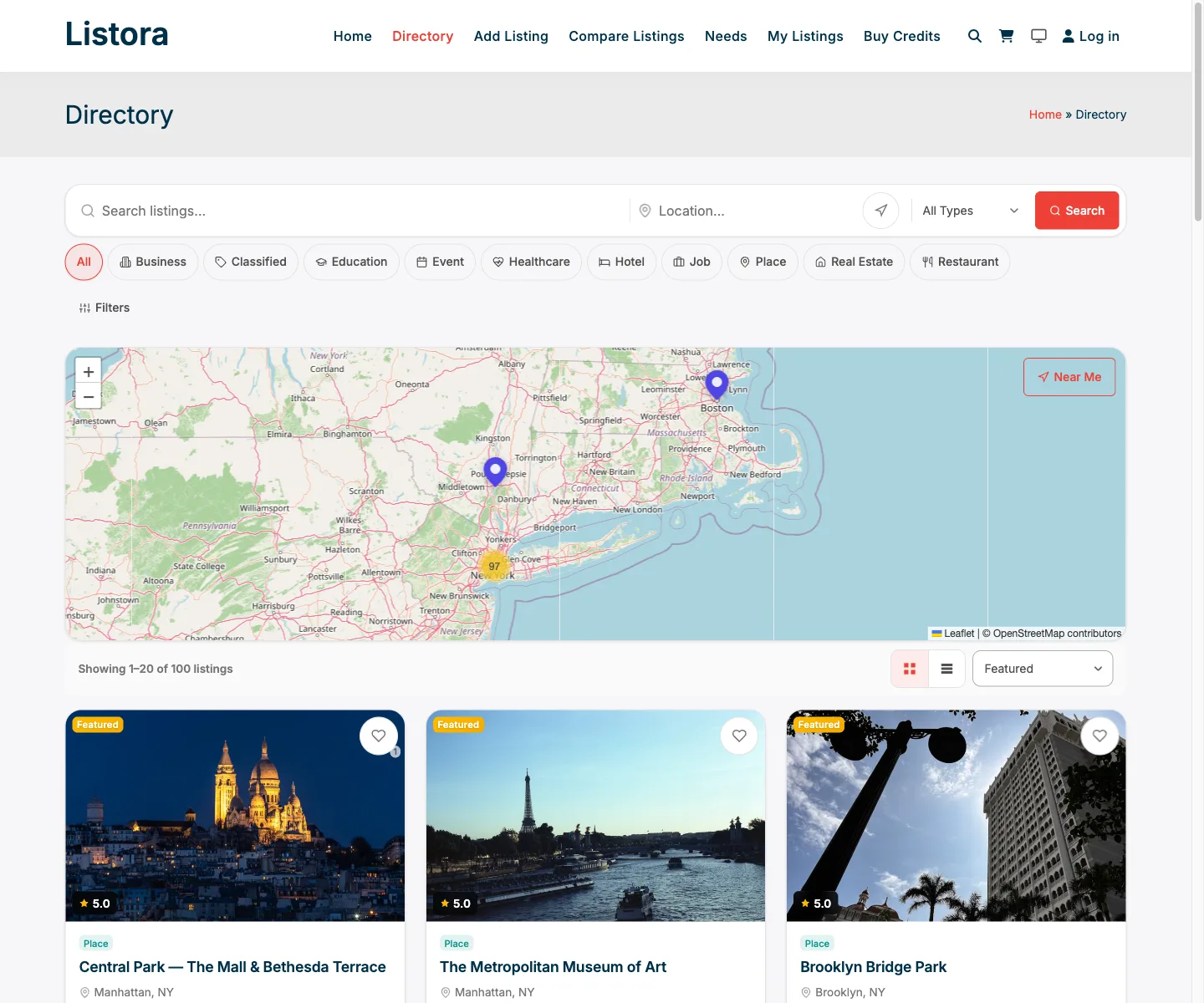
Distance and rating filters built into Listora’s core search, the same proximity-and-trust signal structure that Google’s own local results run on.
Distance and Proximity Aren’t Just a UI Filter
It’s easy to think of a directory’s distance filter as a convenience feature for visitors browsing the site, sort by closest first. That’s true, but it undersells what’s happening. The same proximity logic that powers an on-site distance filter is the exact signal Google’s local algorithm is evaluating when it decides which three businesses to show in the map pack for a given searcher’s location. A directory built on FULLTEXT search with genuine distance and rating filtering, rather than a simple keyword match against a category name, mirrors the structure Google itself uses to rank local results. That alignment matters more than it sounds. A directory that can answer “which businesses are within five miles of this point, sorted by relevance” on its own site is demonstrating the exact query pattern behind near me searches, which is a meaningfully different task than a marketplace’s “which packages match this keyword” search.
Why a Marketplace Listing Structurally Can’t Compete Here
This isn’t a matter of writing better marketplace product descriptions or adding more keywords. A marketplace listing can be excellently written, fast-loading, and well-linked internally, and it still won’t appear in the local pack, because the local pack isn’t evaluating content quality for this query type, it’s evaluating structured location data that the page format never collected in the first place. The honest comparison isn’t “directory content ranks better than marketplace content for near me searches.” It’s that marketplace content isn’t in the competition at all for this specific result placement. A business relying purely on marketplace listings for local search visibility isn’t losing a ranking battle, it’s not entered in it.
What a Directory Provides That Actually Wins Near Me Searches
Beyond the schema markup itself, a directory provides the supporting signals Google weighs alongside proximity: category-specific detail (amenities, service types, business hours), a review volume and rating tied to the specific location rather than to a general seller profile, and photos associated with the physical business rather than with a service package. Listora’s business claims add another layer here, a claimed and actively maintained listing signals to both visitors and, indirectly, to search engines that the business information is current and accurate, which matters for local ranking since stale business data (wrong hours, outdated address) actively hurts local search performance. None of this is exotic SEO work. It’s the same free-tier feature set covered in this site’s guide to what a directory does for verified vendors that a marketplace can’t, just evaluated here specifically for its effect on local search visibility rather than on buyer trust. The two effects reinforce each other: the same claim-and-review infrastructure that builds pre-transaction trust with a human visitor is also what feeds Google the structured signals it needs to place a listing in local results.
The Mobile Reality of Near Me Searches
The large majority of these queries happen on a phone, often with the searcher standing somewhere specific and wanting a result within minutes, not researching for a future purchase. That behavior pattern rewards a directory’s core strengths specifically: fast distance-based filtering, click-to-call phone numbers, and map integration showing exactly how far away a business is. Listora’s maps run on OpenStreetMap with no API key required and no per-view billing, which matters for a directory expecting real mobile search volume, since a metered mapping API can turn into a meaningful recurring cost once a directory starts pulling serious local traffic. A marketplace checkout flow, by contrast, is built around a slower, more deliberate purchase decision: browse packages, compare tiers, review terms, then buy. That’s a mismatch with the urgency most near me searches bring to the query, another reason the two content types aren’t interchangeable for this specific intent even before the schema and ranking mechanics come into play.
A Simple Test You Can Run on Your Own Site
Open Google Search Console, filter for queries containing a city name, a neighborhood name, or the literal phrase “near me,” and check impressions against clicks for those specific queries. A business with meaningful impressions but very low click-through on local-qualified searches is showing up in the long tail of organic results, not the local pack, which is the clearest possible sign that the site’s current content structure isn’t feeding Google the local data it needs. This same diagnostic works in the other direction too: a business with almost zero impressions for local-qualified terms at all likely isn’t indexed with any location signal whatsoever, which points at a missing or incomplete Google Business Profile rather than a ranking problem specifically. Cross-reference that against whether the ranking pages for those queries are marketplace product pages or directory-style listings, if the site has both. It’s common to find that a marketplace category page is absorbing local-intent impressions it structurally can’t convert into local pack placement, while a properly structured directory listing for the same business and category would. Run this check quarterly rather than once, since local search behavior and Google’s own local ranking weightings shift gradually over time, and a gap that looked minor at launch can widen quietly if nobody’s checking.
What This Means for a Marketplace Owner Specifically
None of this argues for abandoning a marketplace in favor of a directory. It argues for recognizing that near me searches are a distinct traffic source with their own requirements, and that a marketplace, no matter how well built, was never going to capture it on its own. Adding a directory layer scoped to the categories with real local search intent, covered in more operational detail in this site’s guide on adding a local service directory alongside an existing marketplace, is the direct fix, not a marketplace redesign, not more content marketing aimed at the same organic terms the marketplace was already competing for. The site architecture that makes this work in practice is covered in this site’s guide to combining a directory and a marketplace on the same WordPress install. The upside compounds over time in a way generic content marketing doesn’t. Each new claimed, reviewed directory listing is another independent shot at local pack placement for its specific category and location, rather than one homepage competing against every other page on the internet for the same broad keyword.
Common Mistakes Chasing Near Me Search Rankings
The most common mistake is trying to rank a marketplace homepage for “[service] near me” through content and backlinks alone, without ever adding the structured local data the query actually needs. No amount of blog content fixes a missing address field and missing LocalBusiness schema; it’s treating a data-structure problem as a content-marketing problem. A second mistake is adding directory listings but leaving business information inconsistent or outdated, wrong hours, an old address, a disconnected phone number. Google’s local algorithm actively penalizes this kind of staleness, and a visitor who drives to a listed address and finds the business closed does more damage to local trust than a listing that never ranked at all. A third mistake is expecting local pack results overnight. Local search responds faster than competitive national terms because there’s less competition for hyper-specific location-qualified queries, but it still takes sustained, accurate listing data and a genuine review history building over weeks and months, not a one-time setup task that resolves itself immediately after publishing.
How This Interacts With Google Business Profile
A lot of business owners assume Google Business Profile alone solves near me searches, and it’s true that a well-maintained profile is often the single biggest lever for local pack placement. But a Google Business Profile listing and an on-site directory listing aren’t competing for the same job, they’re reinforcing each other. Google’s local algorithm cross-references signals from multiple sources, and a business with consistent name, address, and phone data across its Google Business Profile and its own website’s structured directory listing sends a stronger, more verifiable signal than either source alone. There’s also a control difference worth naming. A Google Business Profile lives entirely on Google’s platform; the business owner can edit it, but they don’t own the page or the traffic path the way they own a listing on their own site. A directory listing on the business’s own WordPress site is an owned asset that happens to also feed local search, which matters if a business ever wants to run paid local visibility campaigns, add lead-capture forms, or control the browsing experience beyond what Google’s own profile interface allows.
A Composite Example: Two Businesses, Same City, Different Visibility
Picture two independent HVAC repair businesses operating in the same mid-sized city, roughly comparable in size and service quality. The first has a marketplace-style website: a homepage, a services page listing furnace repair, AC installation, and duct cleaning as fixed-price packages, and a contact form. No address is listed anywhere on the site beyond a footer mention of the city name, and there’s no structured business schema at all. The second has the same service pages, but also maintains a claimed Listora directory listing: full address, service radius, hours, category tags for each service type, and forty-plus reviews accumulated over two years. When someone in that city searches “furnace repair near me,” the second business shows up in the map pack with its rating visible, a click-to-call button, and driving directions. The first business, despite offering an identical service at a comparable price, simply isn’t part of that result set. It might still rank somewhere in the organic results below the map pack for a more specific long-tail query, but it’s lost the exact moment of highest purchase intent, the map pack click, to a competitor that structured its data correctly.
What Happens as AI-Powered Search Changes the Query
Search behavior is shifting toward more conversational, AI-assisted queries, “find me a furnace repair company near downtown that’s open right now” rather than a bare keyword. That shift makes structured local data more important, not less. An AI-powered search assistant answering a conversational local query still needs to pull from the same kind of structured, verifiable business data, address, hours, category, reviews, that a properly built directory listing provides. A page with no structured data to parse is just as invisible to an AI-summarized local answer as it is to the traditional map pack, arguably more so, since there’s no keyword-matching fallback to rely on when the query itself was never a literal string match in the first place. This is one more reason treating directory-style structured data as a one-time SEO task to check off misses the bigger picture. It’s foundational infrastructure that both current local pack results and next-generation AI search answers depend on equally.
Frequently Asked Questions
Can a marketplace listing ever appear in Google’s local pack?
Not in practice, since local pack placement depends on structured LocalBusiness data (address, hours, geo-coordinates) that a typical marketplace product page doesn’t collect or display. A business would need a properly structured directory-style listing, carrying that data, to compete for local pack placement at all.
Does adding directory listings guarantee local pack placement?
No. Structured data and proximity make a listing eligible to compete for local results; it doesn’t guarantee a top-three placement, which still depends on review volume, rating, category relevance, and ongoing Google Business Profile signals alongside the on-site directory listing.
Is Listora’s mapping free, or does it require a paid API key?
Free. Listora runs on OpenStreetMap, which requires no API key and carries no per-view billing, unlike directory tools built on metered mapping APIs that can become a real recurring cost once local search traffic grows.
How is this different from just doing local SEO on the existing marketplace pages?
Local SEO techniques (keyword targeting, backlinks, content) help a page rank in regular organic results, but they don’t create the structured business data local pack placement specifically requires. A directory listing with proper Schema.org markup is what actually makes a page eligible for that placement in the first place.
Do all ten of Listora’s listing types support local search the same way?
Each listing type carries schema appropriate to its category (LocalBusiness variants for business and restaurant listings, more specific schema for real estate, hotel, event, and the rest), so all ten are structured for their respective local or category-specific search patterns, not a single generic template applied uniformly.
What if my service business is remote and has no physical location at all?
Then near me searches aren’t the traffic source to chase, and a marketplace-only approach is the right call. This entire local-search advantage applies specifically to businesses with a genuine local or service-area footprint, not to remote, location-independent service providers.
Do I need Listora Pro to capture near me search traffic, or does the free tier cover it?
The free tier at wbcomdesigns.com/downloads/listora covers everything described here: per-listing-type Schema.org markup, FULLTEXT search with distance and rating filters, business claims, and OpenStreetMap-based mapping with no API key required. Pro adds monetization and lead-generation features on top, but the core local search visibility mechanics are entirely free.
How long should I wait before judging whether a directory listing is helping local rankings?
Give it at least a full business quarter with consistent, accurate listing data and genuine review accumulation before drawing conclusions. Local pack placement responds to a mix of proximity, category match, and review signal that builds gradually; a listing published last week competing against businesses with years of accumulated reviews needs time to close that gap, not a different tactic.
The Query Type Decides the Content Type
Near me searches aren’t a keyword variation, they’re a different kind of question with a different kind of answer, and Google built an entirely separate results system around them. A marketplace answers “what can I buy and how much does it cost.” A directory answers “what’s near me and can I trust it,” which is the actual question behind nearly half of all searches happening right now. Building only for the first question while ignoring the second isn’t a content gap. It’s leaving half the market unable to find the business at all. None of this requires abandoning what already works. A marketplace checkout still closes the sale once a customer has decided to buy. What a directory adds is the earlier, larger step: getting found by someone who was searching for exactly this business and would never have known it existed otherwise.