Directory or Marketplace? Choosing the Right Model for Your Service Business


A plumber in Austin signs up for a national marketplace, builds a profile, sets a callout rate, and waits. A different plumber down the street gets listed in a local directory that ranks by distance and star rating, and the phone starts ringing that same week. Same trade, same city, two completely different pieces of software behind the results.
That gap is the whole subject of this article. Directory software and marketplace software get lumped together constantly because both show a grid of businesses on a page. Underneath, they solve different problems, charge money in different places, and reward different kinds of service businesses. The directory or marketplace decision isn’t cosmetic; it puts your business model on rails that either match how your customers already buy from you or fight against it every single day.
What a Directory Actually Does
A directory is a discovery and trust layer. Its entire job is to answer one question fast: who does this, near me, and can I trust them? Nothing about the transaction lives inside the software itself. A visitor searches, filters by distance or rating, opens a listing, reads reviews, and picks up the phone or fills out a contact form. The booking, the invoice, and the actual work happen somewhere else entirely, usually offline. That sounds like a limitation until you notice how many service categories actually work this way already. Roofers, electricians, dentists, daycare centers, wedding venues, and law firms rarely sell a fixed-price package through a checkout button. Every job is different enough that a phone call or an on-site quote has to happen before money moves. A directory respects that reality instead of forcing a checkout flow onto a business that was never going to use one.
Listora, the directory plugin this article keeps circling back to, is built around that discovery job specifically. It ships ten listing types out of the box, covering business, restaurant, real estate, hotel, job, event, classified, healthcare, education, and place, so a general local directory and a niche vertical directory can both run on the same plugin without custom development. Search runs on FULLTEXT indexing with filters for distance, rating, and amenities, which matters once a directory passes a few hundred listings and keyword search alone stops being good enough. Below is the actual submission screen a business owner sees when they add their own listing.
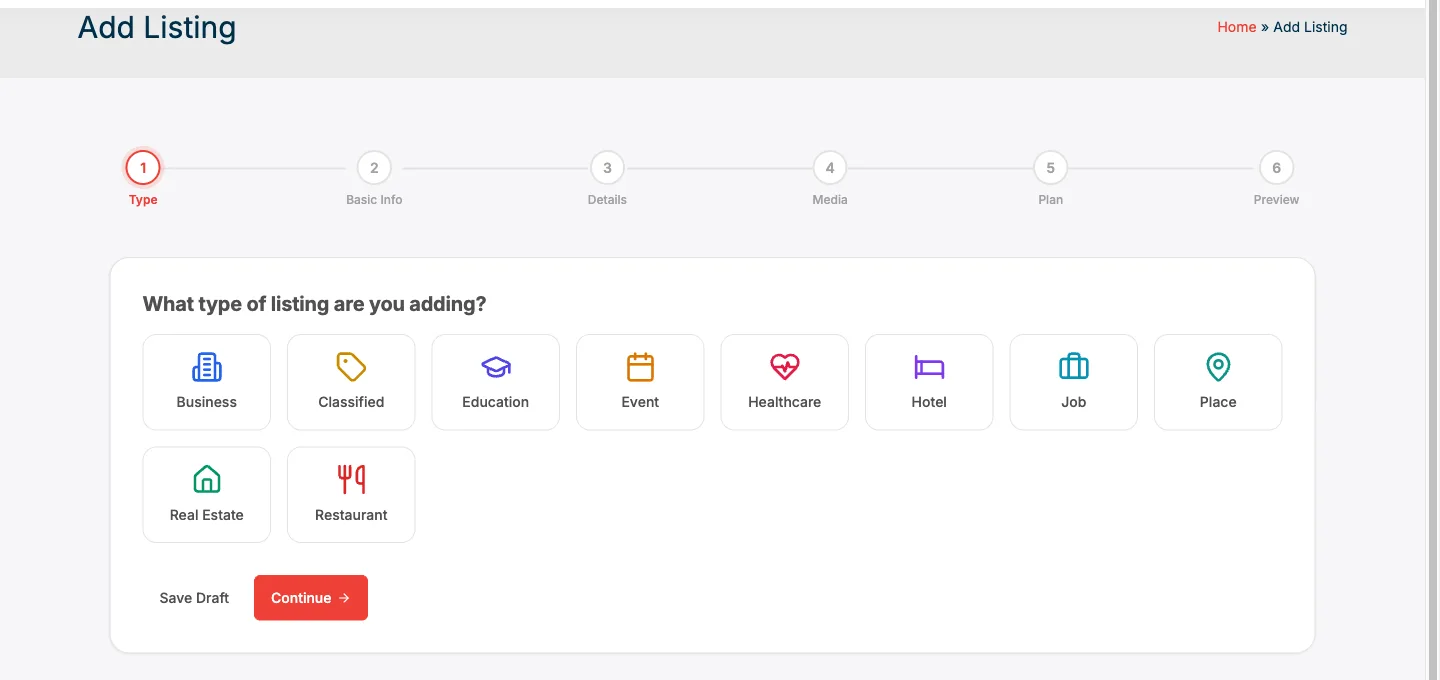
Listora’s multi-step frontend submission flow, part of the free tier, with a review queue before anything goes live.
What a Marketplace Actually Does
A marketplace is a transaction layer first and a discovery layer second. The listing still exists, but its purpose is to get a buyer to checkout, not to a phone number. Packages get defined with fixed prices or tiers, a cart or booking flow collects payment, and the platform itself often takes a cut or at minimum processes the money before the vendor sees it. This is the right shape for digital and semi-digital services where the deliverable can be scoped in advance. A logo design, a WordPress fix, a resume rewrite, a thirty-minute consulting call: all of these can be priced as a fixed package because the buyer and seller don’t need to negotiate scope on a phone call first. WP Sell Services, which this site has covered extensively in posts like building your own Upwork-style marketplace in WordPress, is built for exactly that pattern: tiered pricing, an eleven-status order lifecycle, and checkout handled inside WordPress rather than routed through a phone call.
Directory or Marketplace: Where the Money Actually Changes Hands
Strip away the marketing language and the split comes down to one mechanical fact. In a directory, money moves outside the platform, between the customer and the business directly, usually after some offline back-and-forth. In a marketplace, money moves through the platform, which is what makes commission, escrow, and payout scheduling possible in the first place. That single difference cascades into almost everything else. A directory doesn’t need a payment gateway to function, though a directory owner might sell paid placement to the businesses themselves. A marketplace can’t function at all without one, because the checkout is the product. A directory measures success in phone calls and form submissions. A marketplace measures it in completed orders and gross transaction volume. Trying to bolt marketplace metrics onto a directory, or directory-style trust signals onto a bare marketplace, is where a lot of half-built service sites go wrong.
Signs You Actually Need a Directory
The job can’t be priced without talking to the customer first
If every quote starts with “it depends,” a fixed-price checkout button is fiction. Home services, medical and dental practices, event venues, and most B2B professional services fall here. A directory lets the business control the actual quoting conversation while still winning the discovery battle online.
Local proximity is the deciding factor, not price comparison
Nobody searching “emergency locksmith near me” is comparing five vendors side by side on a spec sheet. They want the closest trustworthy option, right now. That’s a distance-and-rating problem, which is a directory’s core competency, not a marketplace’s.
Trust has to be established before contact, not after checkout
A marketplace can afford to let trust build up gradually through order history and post-purchase reviews, because the platform holds the money as a buffer. A directory has no such buffer. The listing itself, the claim badge, the review count, has to do all the trust-building work before a stranger picks up the phone.
Signs You Actually Need a Marketplace
The flip side shows up when the service is packageable. If you can write “Basic, Standard, Premium” next to three price points and have that mean the same thing to every buyer, you’re describing a marketplace listing, not a directory listing. Freelance and creative services fit this well: video editing, consulting calls, copywriting, web development retainers. So does anything where the vendor pool is not geographically local, because a marketplace doesn’t care about distance the way a directory does. The other tell is who’s asking for payout automation. A directory owner rarely needs to pay businesses anything; the businesses pay the directory for placement, if anything. A marketplace owner, on the other hand, is managing a two-sided cash flow between buyers and a roster of vendors, which is exactly what a post like the Stripe Connect payout setup guide on this site walks through in detail. A real example of that packaged-tier model in action is covered in the walkthrough on launching a Fiverr-style freelance marketplace.
What a Directory Adds That a Pure Marketplace Never Will
Even a marketplace owner who’s certain about the transaction model often underrates what a proper directory layer brings. Business claims let an existing listing get taken over by its real owner without the directory admin manually verifying every single business by hand. Five-star reviews with owner replies give a public trust signal that predates any transaction, which matters enormously for high-consideration purchases like choosing a contractor. Maps built on OpenStreetMap, with no API key and no per-view billing, let a directory show colored pins and clustering without the recurring Google Maps API costs that quietly bleed a growing directory dry. Anti-spam matters more here than people expect. A directory that lets anyone list a business without friction becomes a spam magnet fast, so a six-layer anti-spam system protecting the submission queue is not a nice-to-have once a directory crosses a few thousand listings. And because Listora was built for volume from the start, rated for a hundred thousand listings rather than a hundred, a directory that starts as a side project doesn’t hit a wall the day it gets popular. This trust layer is covered in full in listing verified vendors: what a directory does that a marketplace doesn’t.
The Hybrid Answer Most Service Businesses Actually Land On
Very few real businesses are purely one or the other once they’ve been operating for a year or two. A home services company might run a directory of vetted local contractors while also selling fixed-price maintenance packages through a marketplace checkout for the parts of the job that are predictable enough to price in advance. A creative agency might run a marketplace for productized services while maintaining a directory of freelance collaborators who get referred out for scope that doesn’t fit a package. This isn’t a compromise position, it’s usually the more accurate model of how service commerce actually works. Discovery and transaction are different jobs, and running both a directory and a marketplace on the same WordPress install, which is covered in more depth in a companion piece on this site about choosing the right marketplace plugin for services, tends to outperform forcing every service category through one checkout flow that doesn’t fit half of them. Two companion pieces on this site go deeper on exactly this hybrid setup: should you add a local service directory alongside your marketplace, and combining a directory and a marketplace on the same WordPress site.
A Practical Way to Decide
Start by writing down, honestly, whether a customer could complete a purchase from your business without ever speaking to a human. If the answer is yes for most of your service categories, lean marketplace. If the answer is almost always no, because pricing depends on square footage, property condition, medical history, or a dozen other variables that need a conversation, lean directory. Then check the second variable: does your business model depend on many independent vendors competing for the same customer pool, or on customers finding the single right local business for their specific need? Competing vendors selling comparable packages is marketplace territory. One customer, one right answer, found through local search, is directory territory. Most service businesses can answer both questions honestly in under five minutes, and the answer rarely changes once written down.
Common Mistakes When Picking a Model
The most frequent mistake is choosing based on which plugin looks more feature-rich in a comparison table rather than which one matches the actual buying behavior of the target customer. A gorgeous marketplace checkout is worthless if nobody in your category buys that way. The second mistake is assuming a directory is the “lite” version of a marketplace, something to start with and upgrade later. They’re not tiers of the same thing; they’re different tools for different jobs, and swapping from one to the other later usually means rebuilding the listing structure from scratch rather than flipping a setting. A third mistake worth naming directly: treating review credibility as optional on a directory site. A directory without owner claims and verified reviews is just a business listing scraped from somewhere else, and visitors can tell. The claim-and-review layer is what separates a real directory from a static list. A fourth mistake shows up on the pricing side. Directory owners sometimes try to charge a commission on jobs the directory never touched financially, which is both unenforceable and, in most jurisdictions, legally shaky if it isn’t disclosed clearly in a contract with the listed business. A directory that wants recurring revenue should charge for placement itself, featured slots, priority ranking, or an annual listing fee, rather than trying to claim a percentage of a transaction it has no visibility into. Marketplace owners run into the mirror-image problem: setting commission rates before checking what competing marketplaces in the same category actually charge, then discovering vendors quietly route repeat customers around the platform to avoid the fee entirely.
What Migrating Later Actually Costs
Because directory and marketplace software model data so differently, a listing built as a directory entry doesn’t map cleanly onto a marketplace product, and the reverse is just as messy. A directory listing centers on the business, its location, its hours, its claim status. A marketplace listing centers on the service package, its price tiers, its delivery timeline. Moving from one model to the other after launch usually means re-entering most of the content by hand rather than running an automated migration, which is the real cost of guessing wrong at the start. That’s the strongest argument for spending an afternoon on the decision framework above before writing a single line of listing content. It’s cheap to think it through now and expensive to redo it in six months once a few hundred listings exist on the wrong foundation.
What This Looks Like for Real Service Businesses
A home cleaning franchise with twelve local branches is a directory problem wearing a marketplace costume. Corporate wants online booking, but each branch prices differently based on square footage and local labor cost, so a single checkout flow either forces artificial standard pricing across cities or requires so many conditional fields that the checkout stops feeling like a checkout. What actually works is a directory listing per branch, with a quote request form instead of an add-to-cart button, letting each branch manager handle pricing the way they already do. A freelance video editing collective is the opposite case. Five editors, all working remotely, all capable of delivering the same tiers of service (a basic cut, a color-graded edit, a full post-production package) at comparable quality. Distance means nothing here; a client in Denver doesn’t care that the editor is in Manila. This is a marketplace, full stop, and trying to force it into a directory’s location-first search would actively hide the vendors from buyers who don’t care about geography. A regional legal practice sits in between. Discovery matters (people search “family lawyer near me”), but so does a packaged product (a simple will costs a fixed amount regardless of which associate drafts it). This is the hybrid case covered above: a directory presence for the discovery-and-trust half of the business, a marketplace checkout for the handful of services that really are fixed-price commodities.
Why Search Engines Treat the Two Differently
Google’s local search results, the map pack and the “near me” results underneath it, are built around structured local business data: address, hours, category, and review count. A directory built on proper Schema.org markup for each listing type feeds that data directly, which is a large part of why directory sites tend to rank well for hyper-local, high-intent search terms without much additional SEO work. A marketplace, by contrast, tends to rank on product or service-page terms rather than local terms, because a marketplace listing usually doesn’t carry an address or a local service radius at all. This isn’t a minor technical detail. A service business that picks a marketplace model when its actual customers search locally is leaving organic search traffic on the table that a directory model would have captured almost automatically through proper listing markup. It’s one more reason the decision in this article isn’t purely aesthetic or workflow-based; it has real consequences for how many people even find the business in the first place.
Setting Up Either Model Without Overbuilding on Day One
The temptation with both directory and marketplace software is to configure every optional field, every custom listing type, and every filter before publishing a single real listing. That’s backwards. A directory launched with one listing type, a handful of seeded businesses, and a working claim flow beats a directory stuck in configuration purgatory for three months. The same goes for a marketplace: three pricing tiers and one working checkout path beat an elaborate multi-vendor commission structure that nobody has tested with a real transaction yet. Both Listora and WP Sell Services are built to be extended after launch rather than fully specified before it. Listora’s free tier covers the entire discovery loop, submission, moderation queue, claim, and review, without touching the credit-based paid placement system in Pro, which can be switched on later once there’s enough traffic to make paid placement meaningful. That sequencing, launch the free core first and layer in monetization once the audience justifies it, tends to produce a healthier, less over-engineered result than trying to design the whole business model before a single listing goes live.
Frequently Asked Questions
Can one WordPress site run both a directory and a marketplace at the same time?
Yes. Listora and WP Sell Services are both standalone plugins that don’t require each other or a specific theme, so they coexist on the same install without conflict. A follow-up post on this site, on choosing a WordPress marketplace plugin, goes deeper into stacking the two.
Does a directory need a payment gateway to work?
No, not for the core discovery function. The free tier of Listora handles listings, claims, reviews, and search without any payment processing at all. A payment gateway only becomes relevant if the directory owner decides to sell paid or featured placements to businesses, which is a Pro-tier, credit-based feature.
Is a directory only useful for local, brick-and-mortar businesses?
Local proximity is the strongest use case, but ten listing types cover far more than storefronts, including jobs, events, classifieds, and education, all of which still benefit from a discovery-and-trust model rather than a checkout-first model.
What happens to existing listings if I migrate from another directory plugin?
Listora ships migrators for Business Directory Plugin, Directorist, GeoDirectory, and ListingPro, which move existing listing data over rather than requiring every business to be re-entered by hand.
Which model handles local “near me” search better?
A directory, because distance and rating filtering is built into its core search rather than added on top. This site covers that specific question in full in why near-me searches need a directory, not just marketplace listings, walking through why that kind of search depends on directory-style local data a marketplace listing typically doesn’t carry.
Do I need Listora Pro to launch a working directory?
No. The free version at wbcomdesigns.com/downloads/listora includes frontend submission, claims, reviews, maps, and search. Pro, at wbcomdesigns.com/downloads/listora-pro, is worth adding once the directory owner wants to charge for placement or add lead-generation forms, not before.
How long does it actually take to launch either one?
A directory with a handful of seeded listings can go live in an afternoon using one of Listora’s nine demo packs as a starting point rather than building listing templates from scratch. A marketplace takes slightly longer because pricing tiers, checkout, and vendor onboarding all need to be configured and tested with a real payment before launch, but a focused setup with three service packages and standalone Stripe checkout is usually a weekend project, not a month-long build.
Pick the Model That Matches How Customers Already Behave
Software doesn’t change buying behavior nearly as much as founders hope. If your customers already call before they buy, a marketplace checkout button won’t stop them from wanting to call, it’ll just sit there unused while they hunt for your phone number anyway. Build for how people actually make the decision to hire you, not for the platform that has the most impressive feature list, and the directory-versus-marketplace question mostly answers itself.