Listing Verified Vendors: What a Directory Does That a Marketplace Doesn’t


Listing verified vendors is what separates a real directory from a scraped list of business names, and the gap shows up hardest with high-stakes purchases. A first-time customer looking for a wedding photographer doesn’t behave like a customer buying a logo design package. The logo buyer can afford to gamble on a five-star seller with twelve reviews and a refund policy as a safety net. The wedding customer is booking a single irreplaceable day, months in advance, from someone they may never meet before the event itself. No refund policy fixes a photographer who doesn’t show up. That customer needs to know, before any money changes hands, that the business is real, that the person answering is who they claim to be, and that past customers actually vouch for them. A marketplace’s post-purchase review system was never built to answer that question. Listing verified vendors before a single transaction happens is a discovery-and-trust job, not a checkout job, and a directory is built for the first while a marketplace is built for the second.
The Trust Gap in a Pure Marketplace Model
Marketplace trust is backward-loaded by design. A buyer commits to a purchase, the platform holds the payment as a buffer, the work happens, and only afterward does a review get attached to the seller’s profile. That sequence works fine when the cost of being wrong is low and reversible. It works badly for anything high-consideration: a contractor coming into your home, a healthcare provider, a lawyer, an event vendor tied to a fixed date that can’t be redone. The structural problem is that a marketplace seller profile can look convincing without any of it being independently confirmed. A profile photo, a description, a portfolio of images anyone could have uploaded, none of it proves the business is a real, operating, physically-located entity until a transaction has already happened and a review gets left. By the time trust actually gets established, the buyer has already taken the risk the review system was supposed to help them avoid.
What Verified Vendors Actually Means in a Directory
A directory built around business claims solves this by moving trust verification before the transaction instead of after it. In Listora, a business claim is the process by which the actual owner of a listed business takes control of that listing, proving they’re the real operator rather than a random submitter. Once claimed, the listing carries a visible claim badge, and the claimed owner gets the ability to respond to reviews directly, update hours and photos, and manage the listing going forward. That claim status is doing real work for a first-time visitor. An unclaimed listing reads as unverified, information someone else entered about a business that hasn’t confirmed anything. A claimed listing reads as maintained: the business itself is standing behind what’s written there, which is a meaningfully different trust signal than a marketplace seller who simply self-registered an account.
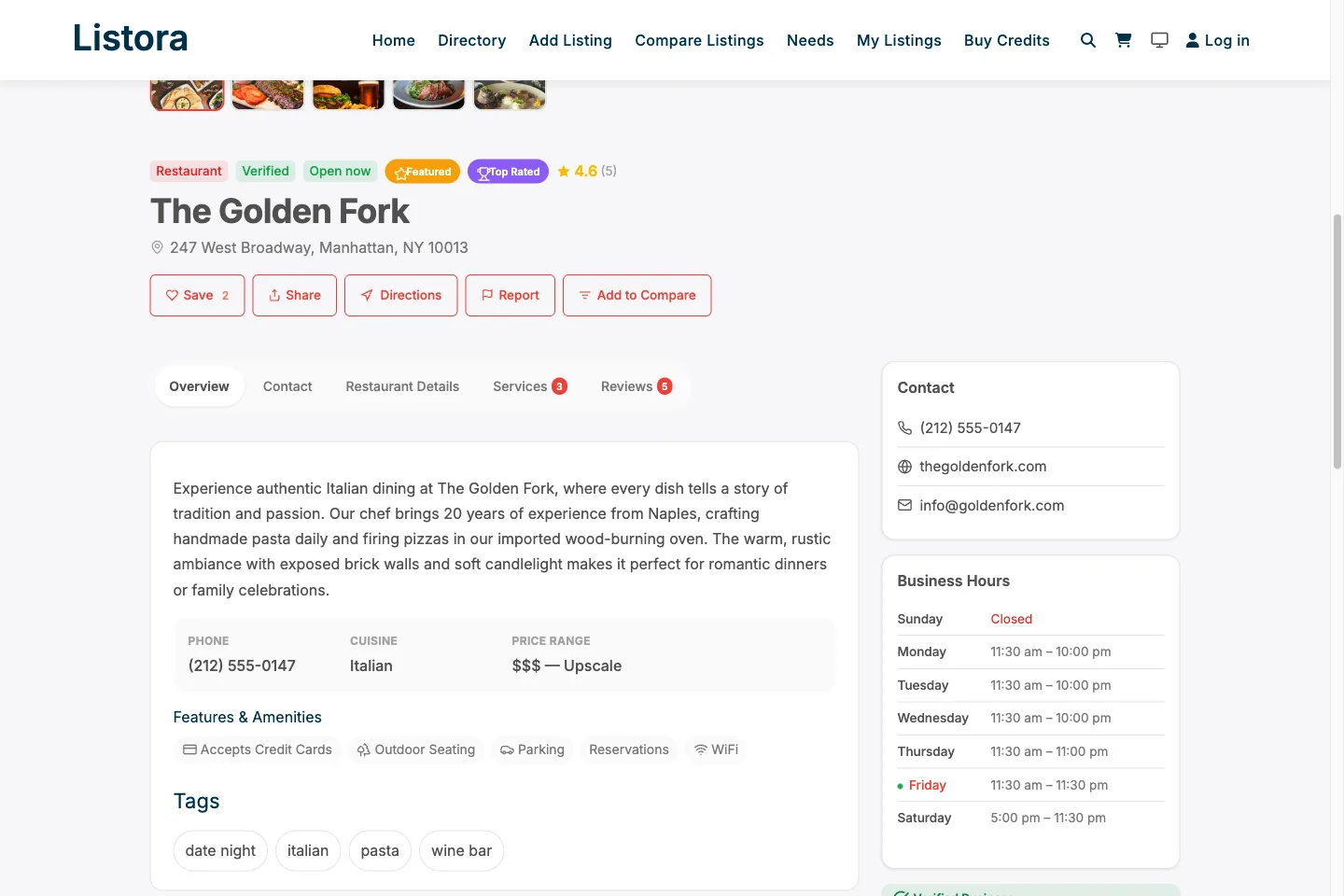
A claimed Listora business listing with owner reply visible on a review, the kind of pre-transaction trust signal a marketplace review system can’t provide.
Five-Star Reviews With Owner Replies
The review itself only tells half the story. What separates a directory review from a generic star rating is the owner reply, visible on the same page as the review, letting a prospective customer see how the business actually handles both praise and criticism before they’ve spent a dollar. A five-star average with zero owner engagement reads as either brand new or unmonitored. A four-point-six average with thoughtful, specific owner replies to the handful of critical reviews reads as a business that’s actually paying attention, which paradoxically builds more trust than a suspiciously spotless record. Helpful votes on reviews add a second layer of signal on top of the star rating itself. A review that other visitors have marked useful surfaces above generic one-line praise, which matters once a popular listing accumulates dozens of reviews and a new visitor needs to find the two or three that actually describe what working with the business is like.
Verification Badges Versus Marketplace Seller Levels
Marketplaces solve part of this problem with seller levels, auto-calculated tiers based on completed order volume and rating history. That’s a useful signal, but it measures transaction volume on the platform, not real-world business legitimacy. A brand-new but genuinely licensed contractor starts at the bottom of a marketplace’s seller-level ladder with zero history, while a directory verification badge can be earned independent of any marketplace transaction at all, based on business registration, licensing, or manual review by the directory admin. This is a Pro-tier feature in Listora, verification badges layered on top of the free claim system, alongside a Moderator role with an audit log so a directory admin can track exactly who verified which listing and when. For service categories where licensing actually matters, contractors, healthcare providers, legal services, that verification layer does something a marketplace’s engagement-based seller level structurally cannot: confirm the business is legitimate independent of how many jobs it’s booked through this particular platform.
Why Marketplace Order-Based Reviews Aren’t the Same Thing
It’s worth being precise about why these two review systems aren’t interchangeable, because they often get treated as redundant when they’re actually complementary. A marketplace review on a platform like WP Sell Services is tied to a specific completed order: this buyer purchased this package, the review reflects that specific transaction. That’s valuable, transaction-verified feedback, and this site has covered how those reviews actually read in practice in an analysis of what buyers and vendors actually say about WP Sell Services. This site’s broader review analysis in what users actually say after building their marketplace covers the same pattern from the platform-adoption side. A directory review carries no such requirement. It can come from a customer who worked with the business years before the directory listing existed, someone who found the business through word of mouth rather than through any online platform. That’s a broader trust pool than a marketplace can ever draw from, because it isn’t gated behind a transaction happening on this specific site. For a vendor who’s new to online marketplaces but has an established offline reputation, that distinction is the difference between showing up with zero reviews and showing up with a real track record already visible.
The Claim Flow, Step by Step
A listing enters the directory one of two ways: a business owner submits it directly through Listora’s multi-step frontend submission form, or someone else, a directory admin seeding initial content, or a past customer, adds it on the business’s behalf. In the second case, the listing sits unclaimed until the actual owner finds it and initiates a claim, typically verified through a business email domain match, a phone verification call, or document upload depending on how the directory admin configures the claim workflow. Once approved, ownership transfers and the claimed business gains edit access: updating hours, adding photos, responding to reviews, and managing which category and amenity tags apply. This two-step process, list first, verify ownership second, is what lets a directory grow to thousands of listings quickly through open submission while still maintaining a meaningful distinction between “someone mentioned this business exists” and “this business has confirmed it’s really them.”
Anti-Spam Protection Behind the Trust Signal
None of this verification machinery means anything if the review system itself is easy to game. Listora runs a six-layer anti-spam system protecting both listing submissions and review submissions, which matters enormously for a trust feature specifically, because a fake five-star review is worse than no review at all once a customer discovers the pattern. A directory that lets anyone submit unlimited reviews without rate limiting, duplicate detection, or basic bot filtering ends up training visitors to distrust its ratings entirely, undermining the exact feature that was supposed to differentiate it from an anonymous marketplace listing. This is also where volume matters. A directory rated for a hundred thousand listings needs anti-spam infrastructure that holds up at that scale, not just at the size of a pilot launch with fifty test listings. Spam and fake review problems tend to appear exactly when a directory starts succeeding and attracting real traffic, which is the worst possible time to discover the moderation queue can’t keep up.
Where Verified Listings Matter Most
Not every service category needs this level of trust infrastructure equally. High-stakes, high-cost, or safety-relevant categories benefit most: anyone entering a customer’s home, anyone handling money or legal matters, anyone providing medical or childcare services. For these categories, a verified claim badge and a visible review history aren’t nice-to-haves, they’re often the deciding factor in whether a customer even considers reaching out. Lower-stakes, easily-reversible services benefit less from the full verification apparatus. A customer buying a fifty-dollar logo design package can afford to try an unverified seller and simply not rehire them if it goes badly. That’s precisely why marketplace-style commerce fits digital and creative services so well, and why forcing every category through the same heavy verification process wastes effort on categories where it was never the deciding factor for the buyer in the first place.
Building Vendor Trust Before the First Transaction
There’s a practical benefit here for platform owners beyond customer safety: verified directory listings give new vendors a legitimate way to build credibility before their first marketplace sale. A vendor with zero completed orders on a marketplace looks identical to a scam account to a cautious first-time buyer. That same vendor, with a claimed directory listing showing years of reviews gathered from past clients outside the platform, looks like an established business simply trying out a new sales channel. This changes the cold-start problem that kills a lot of new marketplace vendor accounts. Instead of asking a brand-new vendor to somehow generate their first five-star reviews from zero, a directory listing gives them a place to accumulate and display trust signals that predate the marketplace relationship entirely, then use that established credibility to convert their first marketplace buyers with far less friction than an anonymous new seller account would face.
What This Costs to Set Up Versus What It Prevents
Setting up a claim-and-review system properly takes more admin effort than launching an open, unverified listing page. Someone has to define the claim verification method, monitor the queue, and decide how strict the process should be for each listing category. That’s real ongoing work, not a one-time configuration checkbox. Weigh that against what it prevents: a customer hiring a business that turns out to be unlicensed, unresponsive, or simply not who the listing claimed, followed by a public complaint that damages trust in every other listing on the same directory by association. One well-publicized bad experience on an unverified directory does more lasting damage to the platform’s credibility than months of slower, verified growth would have cost. For any category where the stakes of a bad hire are high, the setup cost is not close to the cost of skipping it.
Common Mistakes in Vendor Verification
The most damaging mistake is treating claim verification as a formality rather than an actual gate. A directory that approves every claim request without any check, no email domain match, no phone verification, nothing, isn’t actually verifying anything; it’s just adding a badge that says “verified” to whoever clicks the button first. That badge only has value if a meaningful percentage of illegitimate claim attempts actually get rejected. A second mistake is letting owner replies go unmonitored in the other direction: a business owner using reply access to argue aggressively with a critical reviewer rather than address the substance of the complaint. A defensive or hostile owner reply does more damage to trust than the original negative review ever would have, since it demonstrates exactly the kind of behavior the reviewer was warning about. Directory admins running a Moderator role with an audit log, the Pro-tier feature mentioned above, catch this kind of pattern before it accumulates into a real reputation problem for the platform as a whole. A third mistake is over-indexing on review volume instead of review substance. A listing with two hundred one-line five-star reviews reads as less trustworthy than a listing with twenty detailed reviews describing specific jobs, because volume without detail starts to look purchased even when it isn’t. Helpful-vote sorting helps here, surfacing detail over volume, but it only works if reviewers are actually writing something worth voting on in the first place.
Photo and Multi-Criteria Reviews Add Detail a Star Rating Can’t
A single aggregate star rating flattens a lot of nuance. Two contractors can both average 4.5 stars while one is exceptional on craftsmanship and mediocre on punctuality, and the other is the reverse. A customer who cares most about one specific dimension has no way to tell them apart from the star average alone. Listora Pro’s multi-criteria review system breaks the rating into separate dimensions, so a visitor can see craftsmanship, communication, and timeliness scored independently rather than collapsed into one number that hides exactly the tradeoff they most need to know about. Photo reviews add a second kind of detail that text alone can’t provide, especially for categories like home renovation, landscaping, or catering where the actual visual result matters more than any description of it. A review with three photos of a finished patio job is doing more trust-building work than a paragraph of praise, because it’s evidence a prospective customer can evaluate against their own standards rather than take on faith. Neither of these features exists in a typical marketplace review flow, which is usually built around a simple star rating tied to order completion and little else.
How This Plays Out for a Real Service Category
Consider a regional home renovation business deciding how to present itself online. Selling fixed-scope services like a kitchen backsplash install or a bathroom refresh through a marketplace checkout works fine, buyers know roughly what they’re getting and can compare prices across a few vendors. But the larger jobs, a full kitchen remodel, a room addition, are exactly the kind of high-cost, high-trust purchases where a customer wants to see verified reviews with photos and a claimed, actively-managed listing before they’ll even request a quote. Running both systems side by side lets this business meet both kinds of buyer where they are. The marketplace side handles the smaller, well-defined jobs with instant checkout. The directory side, with a claimed listing, photo reviews of past renovations, and an owner actively replying to feedback, does the trust-building work for the bigger jobs that were never going to convert through a simple add-to-cart flow anyway. This is the same directory-plus-marketplace pattern covered from the traffic and SEO angle in this site’s guide on adding a local service directory alongside an existing marketplace, and from the model-selection angle in choosing between a directory and a marketplace for a service business.
Frequently Asked Questions
Is claim verification available in Listora’s free tier?
Yes, business claims and the standard five-star review system with owner replies are both part of the free tier at wbcomdesigns.com/downloads/listora. Verification badges and the Moderator role with an audit log are Listora Pro features at wbcomdesigns.com/downloads/listora-pro, worth adding once a directory needs stricter, admin-reviewed verification beyond the basic claim flow.
How does a business actually prove ownership when claiming a listing?
Typically through a matching business email domain, a phone verification step, or document upload, depending on how the directory admin configures the workflow. The exact method varies by directory since different categories carry different verification standards.
Can a business have both a directory listing and a marketplace storefront with separate reviews?
Yes, and that’s often the strongest setup. Marketplace reviews stay tied to completed orders inside WP Sell Services, while directory reviews live independently in Listora and can include feedback that predates any marketplace transaction. Keeping the two pools separate gives a vendor two distinct trust signals rather than one blended number.
What stops someone from claiming a business they don’t actually own?
The claim verification step itself, combined with the six-layer anti-spam system protecting submissions. No verification process is airtight against a determined bad actor, but requiring domain-matched email or phone confirmation filters out casual false claims, and a Moderator audit log in Pro gives admins a record to investigate disputes when they arise.
Do unclaimed listings hurt a directory’s overall credibility?
Some unclaimed listings are normal, especially early in a directory’s life when admin-seeded content outpaces business owners actively discovering and claiming their entries. What matters is the visible distinction between claimed and unclaimed status, so visitors can tell the difference rather than assuming every listing carries the same trust level.
Does a marketplace seller level replace the need for directory-style verification?
No, they measure different things. A seller level reflects transaction volume and rating history on that specific marketplace. A verified directory claim reflects real-world business legitimacy independent of any transaction history on the platform. A new but genuinely licensed and reputable business can have a low marketplace seller level and a fully verified directory listing at the same time.
Does listing verified vendors slow down how fast a directory can grow?
A little, at first. Open submission with no verification grows faster in raw listing count, but a directory full of unclaimed, unverified listings converts worse and churns visitors who lose trust after one bad experience. Most directories find that requiring verification only for the claim step, not for the initial listing submission itself, keeps growth reasonably fast while still gating the trust-critical part of the process.
Should a small local directory bother with the full verification system on day one?
Not necessarily. A directory launching with a handful of seeded listings can start with basic claims and open review submission, then layer in stricter Pro-tier verification badges once there’s enough volume that fake or low-effort listings start becoming a real problem rather than a theoretical one.
Trust That Exists Before the Transaction Wins the Transaction
A marketplace review answers “was this a good purchase.” A verified directory listing answers “should I trust this business enough to reach out at all,” which is the question that actually determines whether the purchase happens in the first place for anything high-consideration. Skipping that earlier trust layer and hoping a post-purchase review system will retroactively cover it is how a lot of service marketplaces quietly lose customers who never even filled out the contact form.