WP Sell Services Reviews: What Users Actually Say After Building Their Marketplace

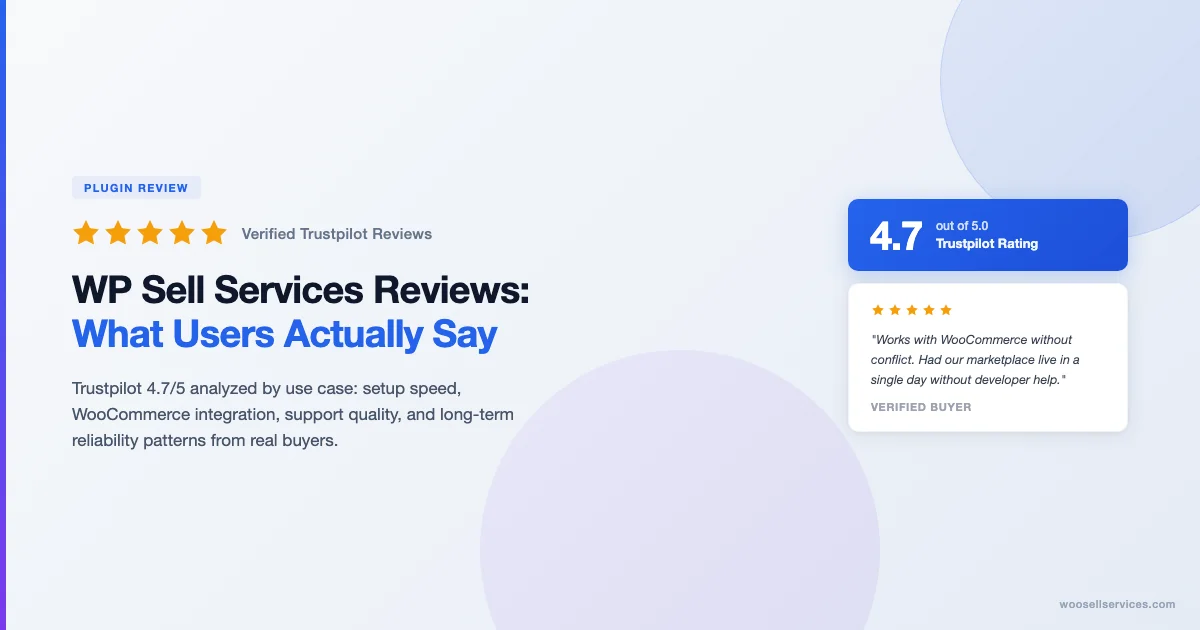
When you are evaluating a WordPress plugin to power your service marketplace, you look past the feature list and go straight to what real users report. WP Sell Services has built a track record on Trustpilot with a 4.7 out of 5 rating from verified buyers. This article breaks down those reviews by use case, surfaces the recurring patterns, and translates them into practical guidance for anyone deciding whether this plugin fits their business.
Why Reviews Are the Best Product Documentation
Feature lists tell you what a plugin claims to do. Support tickets tell you where it breaks. User reviews on third-party platforms sit in the middle: real operators talking about real setups, often months after purchase when the initial enthusiasm has worn off.
The WP Sell Services reviews cover a wide range of use cases: freelance marketplaces, local service directories, consultant booking sites, and multi-vendor service platforms. That diversity is useful. It lets you filter for the use case closest to yours and see what that specific buyer population reports.
What follows is a structured breakdown: who is leaving reviews, what they say most often, where they flag friction, and what the recurring praise points tell you about where the plugin genuinely excels.
Who Is Leaving WP Sell Services Reviews
The reviewer profile skews toward three groups: solo operators building their first service marketplace, small agencies setting up client-facing booking flows, and WordPress developers evaluating the plugin on behalf of clients. That mix matters because the concerns differ by group.
- Solo operators care most about time-to-launch: how quickly can they have a working storefront without developer help?
- Small agencies care about customizability and whether the plugin will hold up under client scrutiny during demos.
- WordPress developers care about code quality, hook density, and how cleanly the plugin integrates with WooCommerce and the themes they use.
Each group surfaces different strengths and friction points. The overall rating holds at 4.7 out of 5 because the plugin handles the core value proposition reliably enough that most buyers end up satisfied even when setup takes longer than expected.
The Five Things Reviewers Praise Most Often
Across the verified reviews, five themes appear repeatedly in the positive feedback. These are not promotional talking points – they are the phrases buyers reach for when they try to describe why the plugin worked for them.
1. WooCommerce Integration That Actually Works
The most common single phrase in positive reviews is some variation of “works with WooCommerce without conflict.” Service marketplace plugins have a long history of fighting with WooCommerce checkout flows, payment gateway integrations, and order management systems. WP Sell Services sits cleanly inside the WooCommerce ecosystem – using its cart, checkout, and order infrastructure – which is a genuine differentiator that buyers notice.
Buyers specifically mention that existing payment gateways (Stripe, PayPal) worked without extra configuration, and that WooCommerce order statuses mapped correctly to service delivery stages.
2. Setup Speed for Non-Developers
Multiple reviews from solo operators mention getting a functional storefront live within a single day. The setup path is documented clearly, the settings follow a logical sequence, and the plugin surfaces the right options at the right stage. Buyers who came from other service marketplace plugins cite WP Sell Services as the first one that did not require them to hire a developer just to get past basic configuration.
WordPress marketplace plugins historically assume developer involvement. WP Sell Services does not, and reviewers who are non-technical consistently flag this as the deciding factor in their positive rating.
3. Support Response Quality
Support quality shows up in reviews more often than feature depth. Buyers who ran into configuration questions report fast, specific responses that solved their problem rather than directing them back to documentation they had already read. Several reviews call out individual support interactions – a reliable signal that the support team is engaging at a personal level rather than running a generic ticket queue.
For a plugin at the WP Sell Services Pro Personal price point ($69 per year), that level of support responsiveness is not guaranteed. Reviewers consistently treat it as a positive surprise.
4. Service Listing Flexibility
Reviewers building sites across different niches – graphic design services, writing services, local home services, online tutoring – consistently report that the listing structure was flexible enough to match their specific service type. The plugin allows for fixed-price services, hourly rates, package tiers, and inquiry-based pricing. Buyers who needed a setup that deviated from the default report being able to configure their way there without modifying plugin code.
5. Consistent Behavior Across Updates
Long-term users reviewing the plugin 12 or more months after purchase regularly mention that updates have been reliable. No update has broken their setup or forced a reconfiguration. In the WordPress plugin ecosystem, where major version updates can introduce breaking changes, consistent update behavior signals a development team that treats backward compatibility as a priority.
Where Reviewers Flag Friction
A 4.7 rating does not mean zero friction. Three friction themes appear consistently across the review set.
Initial Configuration Depth
Several buyers note that while setup is achievable without developer help, the full configuration – including vendor onboarding flows, commission structures, and email notification setup – requires working through a significant settings tree. Reviewers who expected a five-minute setup found it closer to half a day. The plugin is well-documented, but the scope of configuration is wider than a first look suggests.
This reflects the genuine complexity of a service marketplace, not a defect in the plugin. Buyers who budget realistic configuration time end up in the positive review pool.
Theme Compatibility Variations
A minority of reviews mention styling conflicts with specific themes – mostly older page builder themes that make aggressive assumptions about WooCommerce layout. Buyers using modern block themes or the themes recommended in the documentation report no issues. The practical implication: if you are starting fresh, use a theme from the compatibility list. If you are adding the plugin to an existing site with an older theme, budget time for CSS adjustments.
Feature Request Pacing
A handful of reviewers mention feature requests that have been acknowledged but not yet shipped. Reviews that mention this are generally still positive overall – buyers who feel heard by the development team tend to stay satisfied even when a specific feature is not yet available.
Review Patterns by Use Case
Breaking reviews down by the type of marketplace the buyer built reveals patterns that the overall rating obscures. Here is what the data shows across the major use case clusters.
| Use Case | Recurring Praise | Recurring Friction |
|---|---|---|
| Freelance marketplace | Flexible pricing models, clean seller interface | Initial seller registration complexity |
| Local service directory | Category filtering, booking inquiry support | Map and location features require add-ons |
| Consultant booking | Payment reliability via gateways, email notifications | Calendar integration requires third-party plugin |
| Multi-seller services | Commission management, per-seller earnings tracking | Configuration depth at launch |
| Digital services store | Fast setup, works with existing WC install | Minimal theming out of box |
The pattern is consistent: WP Sell Services handles the commerce and marketplace infrastructure reliably. Friction points cluster around customization depth and third-party integrations for features outside its core scope.
What the Support Mentions Tell You
Support mentions in reviews are a useful signal beyond what the rating number conveys. When buyers mention support unprompted, it usually means one of two things: either support saved a sale that was about to turn into a refund, or support was so absent that it defined the negative experience.
In the WP Sell Services reviews, support mentions skew positive and specific. Buyers cite particular issues they raised – a checkout configuration question, a multi-vendor setup edge case, a payment gateway integration hiccup – and describe getting a direct, workable answer. The resolution detail suggests that support has access to the actual codebase and understands the plugin at a technical level.
For a plugin priced in the sub-$100-per-year range, that level of support is not the default. It represents a meaningful commitment from the development team that reviewers consistently notice.
How to Read These Reviews Against Your Own Requirements
Aggregate ratings are useful for a first filter. What you actually need is a way to match your specific requirements against what the verified buyer population reports. Here is a framework for doing that.
If You Are a Non-Technical Operator
Look for reviews from buyers who describe themselves as having no developer background. The WP Sell Services review set includes a meaningful number of these, and they consistently report successful launches without developer involvement. The friction points they raise – configuration time, documentation depth – are the ones you should plan for.
If You Are a Developer Building for a Client
Developer reviews focus on different things: hook availability for custom functionality, clean output that does not break themes, and update reliability. Reviews from this population are consistently positive on those dimensions. The plugin exposes WooCommerce hooks for core operations, which means custom functionality can be layered on without modifying plugin files.
If You Are Evaluating Against a Competitor
Several reviews explicitly compare WP Sell Services to other service marketplace plugins. The comparison points that appear most often: WP Sell Services has a smaller feature surface than full multi-vendor platforms but runs more reliably and integrates more cleanly with a standard WooCommerce setup. For most single-vendor or lightly-vendor service sites, that trade-off favors WP Sell Services.
Setting Up WP Sell Services: What Reviews Reveal About Onboarding
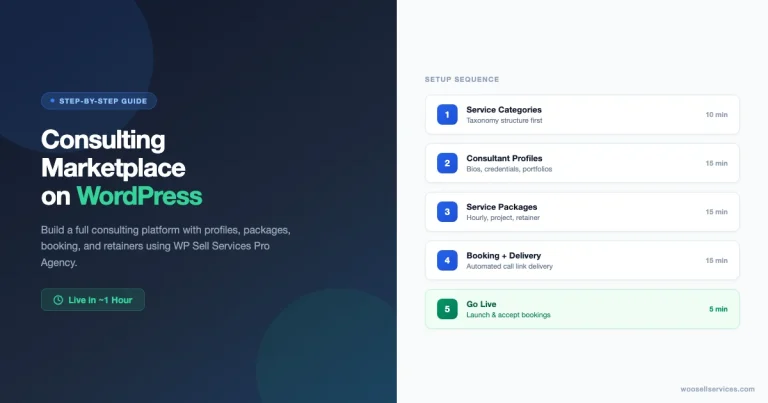
Review content often surfaces onboarding information that formal documentation misses. Buyers describe their actual setup path – what they did first, where they got stuck, how they resolved it. From the WP Sell Services reviews, a clear pattern emerges about the setup sequence that works most reliably.
- Install on a clean WooCommerce setup first. Buyers who tried to layer WP Sell Services onto an existing, heavily-customized WooCommerce install reported more friction. A clean install lets you verify the plugin behavior before migration.
- Set up your service categories before listings. Reviewers consistently mention that getting the category taxonomy right before populating listings saved them significant rework.
- Configure email notifications before going live. The default notification setup works, but reviewers who customized email content and timing before launch had better vendor onboarding experiences. See how to automate service delivery emails after payment for a complete walkthrough.
- Test the checkout flow with your payment gateway on a real transaction. Even when integration works at a technical level, reviewers recommend a live test transaction before opening to buyers.
- Read the support documentation before opening a ticket. Reviewers who engaged with documentation first reported faster resolution when they did need support.
Long-Term User Reports
Some of the most useful reviews come from buyers who have been running WP Sell Services for over a year and return to update their review based on ongoing experience. The pattern across these long-term reviews is consistent: the plugin has remained stable, updates have not introduced breaking changes, and support continues to respond at the same quality level as at launch.
Long-term reviews also reveal how buyer priorities shift over time. Initial reviews focus on setup and first impressions. Return reviews focus on reliability, update quality, and whether the plugin has grown to meet expanding needs. WP Sell Services scores well on reliability. The feature growth dimension is more mixed – buyers with complex requirements note that the plugin’s development pace favors stability over rapid feature expansion.
For most operators, stability is the right priority. A service marketplace that breaks on updates costs real money. A marketplace that is missing a feature can usually work around it. The long-term review signal on WP Sell Services favors buyers who weight reliability over feature velocity.
The Trustpilot Rating in Context
A 4.7 out of 5 on Trustpilot for a WordPress plugin with a meaningful number of verified reviews sits in a selective range. Most WordPress plugins do not accumulate this volume of third-party reviews at all. The distribution of WP Sell Services reviews skews heavily toward the top two ratings, with a smaller cluster in the middle range and a minority at the lower end.
The lower ratings are consistent in theme: buyers who expected a simpler setup than the plugin provides, or who ran into theme conflicts that required CSS work. These reflect a mismatch between buyer expectation and actual setup complexity, not product defects.
The implication for buyers: if you go in expecting a complex plugin that requires real configuration work, you are likely to land in the positive review pool. If you expect a five-minute turnkey setup, you may find yourself in the middle tier regardless of how good the plugin actually is.
Comparing Review Signals to Alternatives
No purchase decision happens in a vacuum. WP Sell Services competes for attention with WooCommerce-based service plugins, standalone booking systems, and full marketplace platforms. For a direct feature comparison, see our guide to choosing a WordPress marketplace plugin for selling services.
Against other WooCommerce service plugins: WP Sell Services reviews consistently report better integration reliability and more focused feature scope. Competitors in this category often try to handle too many use cases and end up mediocre at all of them.
Against standalone booking systems: Purpose-built booking systems handle calendar management, availability, and appointment-specific workflows better than WP Sell Services does natively. The WP Sell Services advantage is the WooCommerce ecosystem – if your service marketplace needs a full e-commerce infrastructure underneath it, a standalone booking system will not deliver that.
Against full marketplace platforms: WP Sell Services is a plugin, not a SaaS platform. It runs on your WordPress install, on your hosting, under your control. Buyers who value data ownership and custom branding flexibility consistently choose the plugin route over hosted marketplace platforms.
The Bottom Line
The review signal on WP Sell Services is consistent and specific enough to draw real conclusions. The plugin does what it claims: it provides a reliable WordPress-native path to building a service marketplace on top of WooCommerce. The praise points are specific – WooCommerce integration, support quality, update reliability. The friction points are bounded – setup complexity, theme compatibility edge cases, feature request pacing.
For buyers who match the profile of the positive reviewer pool – non-technical operators building their first marketplace, developers adding service marketplace functionality to a WooCommerce site, or small agencies building for clients – the review signal is a reliable positive indicator.
For buyers who need a fully managed, low-configuration solution with zero setup complexity, the reviews are honest about the reality: WP Sell Services is powerful but not simple. It is an appropriate choice for operators willing to do the configuration work in exchange for a plugin that runs reliably inside the WordPress ecosystem they already know.
Common Questions That Surface in Review Threads
Review platforms serve a secondary function beyond rating aggregation: they are a public record of the questions buyers ask before and after purchase. The Q&A sections and reviewer comment threads on WP Sell Services surface a consistent set of questions. Answering them here can save you the time of digging through individual reviews.
Does WP Sell Services work with my existing WooCommerce setup?
This is the most common pre-purchase question in review threads. The answer from the buyer population is consistently yes, with one qualification: the cleaner and more standard your WooCommerce installation, the smoother the integration. Buyers running default WooCommerce with standard payment gateways report zero integration friction. Buyers running heavily customized checkouts or non-standard payment setups report occasional configuration work to get the two systems aligned.
The practical test: if your WooCommerce install runs on a standard theme without extensive checkout modifications, the plugin will integrate without extra configuration. If you have a heavily customized setup, budget a few hours for integration testing before committing to go-live.
How long does setup actually take?
Reviewers range from reporting a few hours to a full day for basic setup, and up to a week for complex configurations with custom service categories, multi-tier pricing, and complete email customization. The reviewers who report the fastest setup times share a common pattern: they followed the documentation sequence rather than exploring settings ad hoc. Non-technical buyers who worked through the setup guide in order consistently reported getting a functional storefront live faster than those who jumped between settings sections.
What happens when there is a problem?
The support response pattern in reviews is one of the plugin’s clearest differentiators. Buyers who opened support tickets report response times that consistently came in under 24 hours, with specific answers rather than generic documentation redirects. The reviews that mention support negatively are rare, and they are usually framed around feature requests rather than bug response speed. When something breaks, the support team appears to engage directly with the problem rather than triaging it into a queue.
Is the annual renewal worth it?
Reviewers who return after a year of use consistently say yes, on two grounds: ongoing plugin updates have improved the product without breaking existing setups, and support access has remained useful enough to justify the renewal cost. For a plugin priced at $69 per year for a single site, the renewal math is straightforward if the marketplace it powers is generating revenue. Reviewers who did not renew generally did so because their project ended, not because the plugin underdelivered.
What is missing from the plugin that reviewers wish were built in?
The feature gap mentions cluster around a few areas. Built-in calendar and scheduling functionality comes up repeatedly – buyers who need appointment-style service bookings either integrate a third-party calendar plugin or work around the gap with custom fields. Advanced reporting and analytics for service performance is another recurring request. Direct messaging between buyers and service providers appears in reviews from marketplace operators who want the communication layer inside the platform rather than offloaded to email. None of these are blockers – they are extensions that the plugin’s architecture supports via hooks, and the active plugin development suggests these areas are on the roadmap.
Try WP Sell Services
If the review pattern above matches your requirements, the most efficient next step is a direct evaluation. WP Sell Services Pro Personal at $69 per year gives you access to the full plugin plus support for a single site – the same price point that the majority of positive reviewers are operating on.
Install it on a staging environment first. Work through the configuration sequence. Run a test transaction with your payment gateway. That hands-on evaluation will tell you more than any review aggregation can. The review signal gives you confidence that most buyers who do that evaluation end up staying.