Onboarding New Vendors Faster With a Built-In Training Course

Updated September 2026. Every marketplace operator remembers the vendor who almost quit in week one. Not because the opportunity wasn’t good, but because nobody explained how the order lifecycle worked, what the response-time expectations were, or why their first listing got flagged for missing a required field. They figured it out eventually, or they didn’t, and if they didn’t, that’s a vendor gone and a support ticket you spent an hour resolving that a five-minute video would have prevented. A real vendor onboarding training course is how a marketplace prevents that story from repeating with every new signup.
Vendor onboarding is usually a PDF, a welcome email, or a support agent repeating the same explanation for the fortieth time this month. None of those methods check whether the vendor actually understood anything. They just confirm the message got sent. A vendor onboarding training course, built with a complete learning platform like Learnomy, replaces “we told them” with “they proved they know it,” and that difference shows up directly in how many support tickets your first month with a new vendor generates.
In this guide
- Why a welcome PDF isn’t a vendor onboarding training course
- What a vendor onboarding course actually needs to cover
- Quizzes replace “did they read it” with “did they get it”
- A completion certificate is proof, not decoration
- Onboarding as part of a bigger learning platform, not a standalone tool
- Who should actually build the onboarding course
- What changes for buyers when vendors are properly onboarded
- Structuring onboarding as a real curriculum, not a single course
- Onboarding as an ongoing course, not a one-time gate
- Where this sits next to a service marketplace
- Measuring whether onboarding is actually working
- Getting started without overbuilding it
- Frequently asked questions
- The cheapest fix for a problem you’re already paying for
Learnomy is the complete learning platform behind this: courses, quizzes, and verifiable certificates a marketplace can turn into structured vendor training.
Why a welcome PDF isn’t a vendor onboarding training course
A document only works if someone reads the whole thing, remembers it accurately, and applies it correctly weeks later when the situation it described actually happens. Most people skim. Most skimmers miss the paragraph that would have prevented their mistake. A PDF also can’t tell you which vendors read it and which ones didn’t, so when the same question comes in for the fifth time this week, you have no way to know whether it’s a documentation gap or just a vendor who never opened the file.
A course fixes both problems at once. Content gets broken into short, specific lessons instead of one long document nobody finishes. Quizzes at the end of each module confirm the vendor actually absorbed the material, not just that the page loaded. And because it’s tracked, you can see exactly where vendors are getting stuck, which turns onboarding from a one-time email blast into something you can actually improve over time based on real completion data.
Picture the same new vendor two different ways. In the PDF version, they skim page three, miss the section on required delivery formats, and three weeks later a buyer opens a dispute because the vendor delivered a file in the wrong format. Nobody’s fault in particular; the information existed, buried on a page nobody actually read closely.
In the course version, that exact rule shows up as its own short lesson with a quiz question attached, the vendor has to get it right before moving on, and the dispute never happens. The information was identical in both cases. What changed was whether anyone confirmed it landed.
What a vendor onboarding course actually needs to cover
The temptation is to cram everything into one giant course: policies, platform mechanics, brand voice, dispute handling, payout timing, all of it at once. That’s the same mistake as the PDF, just reformatted as video. Vendors retain more when onboarding is broken into focused modules they complete over their first week or two, not their first hour.
Platform mechanics
How listings get created, what fields are required and why, how the order status flow moves from accepted through delivery, and what triggers a payout. This is the module vendors will refer back to most often, so it benefits from being organized as short, searchable lessons rather than one long walkthrough video.
Response and quality expectations
What counts as an acceptable response time, what a complete brief looks like from the buyer’s side, and how disputes get resolved if a delivery doesn’t match what was promised. New vendors who skip this module are the ones who generate the angriest first-month support tickets, because they didn’t know the rules they were being held to until they broke one.
Brand and communication standards
If vendors are representing your marketplace’s reputation in every message they send to a buyer, a short module on tone and communication expectations prevents the kind of interaction that makes a buyer leave a one-star review over something that had nothing to do with the actual work delivered.
Payouts, taxes, and the questions vendors are too embarrassed to ask
Vendors rarely email a marketplace operator to ask when they actually get paid or what happens if a buyer never confirms delivery. They either figure it out through trial and error, or they quietly assume the worst and stop taking orders while they wait to see what happens. A short module walking through the payout schedule, what triggers a hold, and how to resolve a stalled confirmation removes an entire category of anxious, unspoken uncertainty that otherwise shows up as reduced vendor activity in week two, right when a new vendor’s momentum matters most.
Quizzes replace “did they read it” with “did they get it”
Learnomy’s quiz system supports six question types with partial credit, so a comprehension check doesn’t have to be reduced to blunt true-or-false questions that anyone could guess through. A scenario-based question about how to handle a late delivery, scored with partial credit for a mostly-right answer, tells you something a simple pass or fail toggle never could: not just whether the vendor got it right, but how close their instinct was when they didn’t.
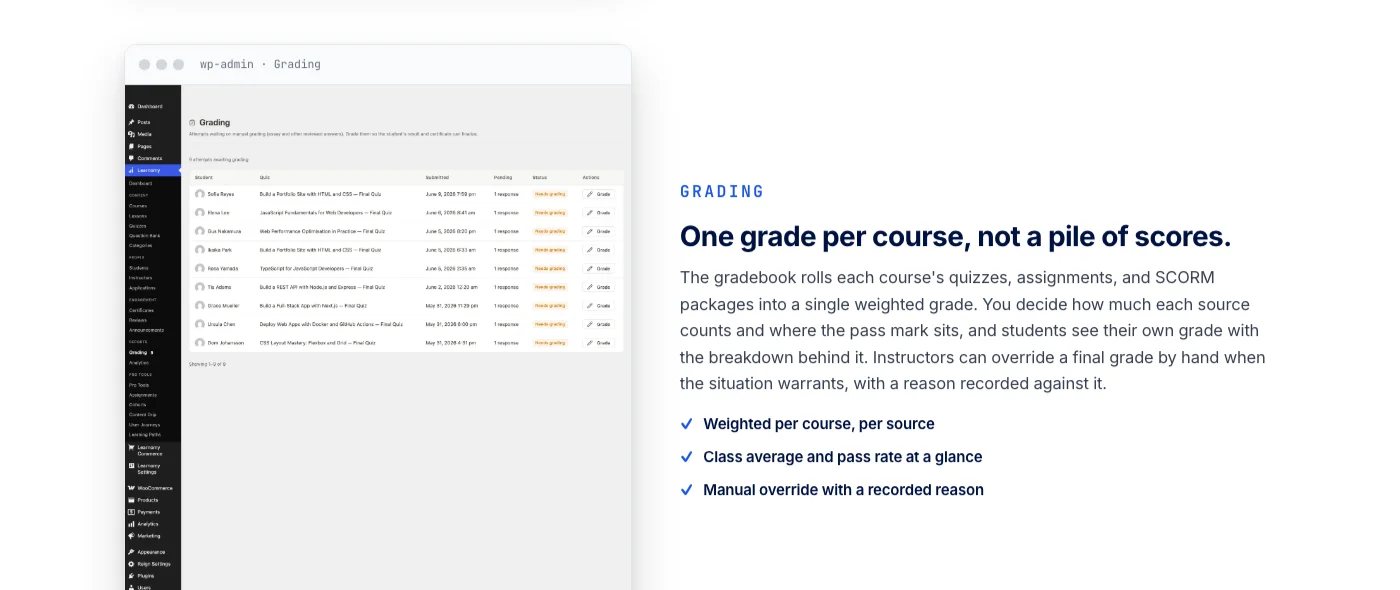
Built-in tab-switch tracking discourages the obvious workaround, where a vendor opens a second tab, searches for the answer, and passes the quiz without absorbing anything. That distinction is exactly why a training program needs a real exam instead of a quiz anyone can skim past, and for a comprehension check that’s supposed to confirm real understanding before someone starts taking orders on your platform, that matters more than it might for a casual hobby course. There’s a real cost when a vendor who never actually learned the dispute policy ends up in a dispute six weeks later, confused about rules they technically “passed” a quiz on without reading closely.
An essay grading inbox handles the harder cases: a module that ends with “describe how you’d handle this scenario” gets a written response you can actually review, rather than forcing every check into multiple choice. For onboarding content where judgment matters more than memorized facts, that’s often the more useful assessment format.
A completion certificate is proof, not decoration
Once a vendor finishes onboarding, Learnomy can issue a cryptographically signed certificate with a QR code linking to a public verification page. That’s not just a nice touch. It’s a record you can point to if a dispute ever comes up about whether a vendor was properly briefed on a policy. “They completed the onboarding course and passed the assessment on order handling” is a defensible position. “We sent them a PDF at signup” is not.
Vendors can also share the certificate to LinkedIn directly, which quietly does marketing work for your marketplace. A vendor posting about completing certified onboarding, with your marketplace’s name attached, is a small, credible signal to their own network that they’re operating on a platform serious enough to have a real certification step, not just an open signup form.
Onboarding as part of a bigger learning platform, not a standalone tool
The course and quiz system covered so far handles onboarding on its own, but it’s worth knowing what else sits on the same platform, because a marketplace’s needs tend to grow past a single onboarding course over time. The same platform grows into a learning community for vendors who want a place to compare notes with each other, with discussion boards and Q&A sitting alongside the training content instead of vendors emailing questions individually. Gamified onboarding, points and badges for completing modules on schedule, gives vendors a small nudge to finish training instead of letting it sit half-done for weeks.
A job board becomes relevant for marketplaces that also want to connect trained vendors with staff opportunities from partner businesses. None of that needs to be part of a first onboarding course. It’s part of what the same platform already covers once a marketplace operator decides it’s worth using.
Who should actually build the onboarding course
A common mistake is treating course creation as a task to hand off entirely to whoever manages support, on the theory that support agents know the most common vendor questions. Support agents do know the questions, but they don’t always know the underlying reasons behind a policy, which matters when a vendor asks a follow-up the course didn’t anticipate.
The strongest onboarding courses usually come from a short collaboration: the marketplace operator or product owner supplies the policy reasoning and the bigger picture of what the marketplace is trying to protect, while the support team supplies the specific, recurring pain points worth addressing directly.
That collaboration doesn’t need to be elaborate. A single working session where support lists the ten questions they answer most often, followed by the operator explaining the reasoning behind each answer, is usually enough raw material to draft a first course. The course doesn’t need to be perfect on the first attempt. It needs to cover the handful of things that are currently costing the most support time, which a quick internal conversation surfaces faster than weeks of planning ever would.
What changes for buyers when vendors are properly onboarded
Onboarding quality is usually framed as an internal operations concern, something that saves the marketplace time and reduces disputes. That’s true, but it undersells the buyer-facing effect. A marketplace where every vendor has gone through structured training and passed a real assessment produces a more consistent buying experience across the board, not just fewer isolated incidents. Buyers stop needing to gamble on which vendors happen to have figured things out on their own, because the baseline competence level is enforced before anyone starts taking orders, not left to chance.
This consistency compounds into something buyers notice even if they can’t name it directly: a marketplace that “just works” more reliably than competitors, where response times are predictable, delivery formats match what was promised, and disputes are rare enough that a buyer’s guard comes down after a few good experiences. That reputation, once established, becomes one of the hardest things for a competing marketplace to copy, because it’s built from thousands of small, individually invisible training moments rather than a single marketing claim anyone could imitate.
Structuring onboarding as a real curriculum, not a single course
Once onboarding outgrows a single course, the core course and quiz system still covers the basics, but a marketplace running larger vendor volume typically needs more structure than one-course-fits-all. This is where the platform’s deeper capability tier becomes relevant rather than optional polish.
Content drip for pacing
Releasing modules over a scheduled window instead of dumping the entire curriculum on day one keeps new vendors from getting overwhelmed in their first session and abandoning the course halfway through. A week-one module on platform mechanics, followed by a week-two module on quality standards once they’ve actually started fulfilling orders, tends to land better than everything at once.
Learning paths for sequential onboarding
A learning path chains multiple courses into an ordered curriculum with its own completion certificate at the end, useful for marketplaces that separate basic onboarding from category-specific training. A vendor selling design services and a vendor selling copywriting services might share the first course but diverge into different paths after that.
Cohorts for onboarding vendors in groups
Cohorts group vendors who start onboarding around the same time, which matters for marketplaces that run periodic vendor recruitment drives rather than accepting applicants one at a time year-round. Onboarding an entire cohort together also creates a natural moment for a live Q&A or kickoff, rather than each new vendor going through the material in total isolation.
Spaces for vendor teams, not just individuals
Not every vendor is a solo operator. Some are small agencies with a handful of team members who all need the same onboarding. Spaces let a company buy a seat pack and manage its own roster, so an agency vendor can put several team members through onboarding under one account instead of you manually managing multiple separate individual enrollments. The agency itself becomes responsible for keeping its own roster current, adding a new hire’s seat or removing one that’s left, rather than every staffing change turning into a request that lands on your desk.
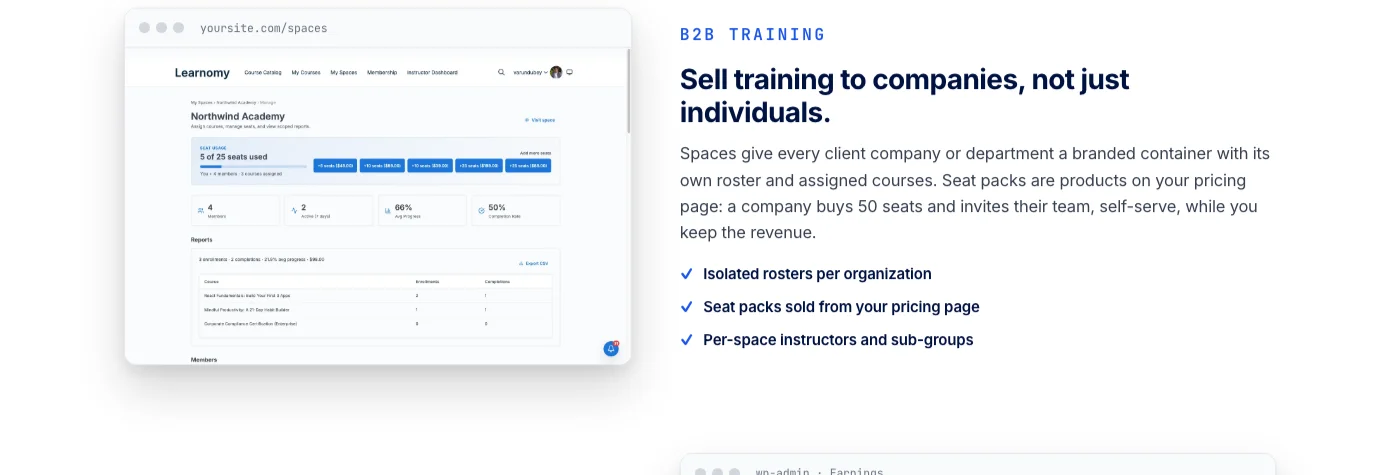
That distinction matters more than it looks on paper. A marketplace that only supports individual onboarding accounts ends up either turning away agency vendors or manually juggling a pile of near-duplicate accounts under one business name. Neither is a good outcome once a marketplace has enough agency-style vendors that the pattern stops being an edge case and starts being a meaningful share of the vendor base.
Onboarding as an ongoing course, not a one-time gate
The version most marketplaces build first is a single onboarding course a vendor completes once at signup and never returns to. That’s a fine starting point, but policies change, new categories get added, and a payout process that made sense a year ago sometimes doesn’t anymore. A vendor who onboarded a while back is often operating on assumptions that quietly went stale, because nobody ever asked them to revisit anything.
Treating the course as a living resource rather than a one-time gate solves this without much extra work. A short “what’s changed” module, released whenever policy actually shifts, keeps existing vendors current without forcing them through the entire onboarding sequence again. It also gives a marketplace operator a direct channel for reaching every active vendor with something they’re required to actually engage with, rather than hoping an email announcement gets read.
Where this sits next to a service marketplace
If you’re running a vendor marketplace on infrastructure similar to what powers wpsellservices.com, onboarding quality is directly tied to marketplace reputation. Buyers don’t distinguish between “the marketplace has bad vendors” and “the marketplace didn’t train its vendors well.” Both read as the same failure from the outside. A structured onboarding course is one of the cheapest reputation investments a marketplace operator can make, because it prevents the specific class of early-vendor mistakes that generate public disputes and refund requests before a vendor has even built a track record.
It also shortens the time between a vendor signing up and a vendor becoming genuinely useful to your marketplace. A vendor who’s uncertain about the rules moves cautiously, takes fewer orders, and responds to buyer questions with hedging language that erodes buyer confidence. A vendor who’s completed a real onboarding course and passed an assessment on the policies that matter starts operating with the same confidence as someone who’s been on the platform for months, within days instead of months.
None of this requires the onboarding course to live inside the same plugin that runs your vendor listings and checkout. Learnomy operates as its own standalone system on the same WordPress install, so a marketplace built around a plugin like WP Sell Services can add a Learnomy onboarding course alongside it without needing the two systems to share a database or talk to each other behind the scenes. The vendor completes the course on the same site, gets the same certificate, and the marketplace side of the operation keeps running exactly as it already does.
Measuring whether onboarding is actually working
The question every marketplace operator should be able to answer and usually can’t is: which part of onboarding is actually failing new vendors? Without tracked data, the honest answer is a guess based on whichever support ticket happened to land this week. A course changes that, because completion rates and quiz scores are visible per module, not just as one aggregate “finished onboarding, yes or no” flag. That’s the same underlying need as knowing exactly which learners are progressing and which ones are quietly stuck, just applied to vendors instead of paying students.
If most vendors ace the platform-mechanics module but only a minority pass the dispute-handling quiz on the first attempt, that’s a direct signal the dispute module needs rewriting, not the whole course. Maybe the lesson is too abstract and needs a worked example. Maybe the quiz question is ambiguously worded. Either way, that’s a specific, fixable problem instead of a vague sense that “onboarding could be better,” which is where most marketplace operators get stuck without any data to act on.
This also surfaces which vendors are worth extra attention before they start taking orders. A vendor who finishes the whole course in one sitting with high scores is probably ready. One who stalls halfway through for two weeks, or barely passes the response-time module, is a reasonable candidate for a quick manual check-in before their first listing goes live, rather than finding out the hard way after a buyer complaint.
Getting started without overbuilding it
The core platform covers everything a first onboarding course needs: unlimited course creation, all four lesson formats, the full quiz system with partial credit, and verifiable certificates. There’s no reason to wait to build the first version. Start with one course covering the handful of mistakes that generate the most support tickets in a new vendor’s first month, ship it, and watch which quiz questions vendors miss most often. It’s the same zero-fee checkout foundation that lets any creator turn expertise into a paid course without losing a cut to platform fees, just pointed at training instead of a monetized catalog.
That data tells you exactly where the next module needs to go, which is a far more useful planning input than trying to anticipate every edge case before a single vendor has gone through it.
Key takeaways
- A vendor onboarding training course beats a welcome PDF because it can be measured: a quiz shows what a vendor actually absorbed, not just what they skimmed.
- Tab-switch tracking and partial-credit quizzes make the assessment itself hard to fake, unlike a checkbox saying “I’ve read the policy.”
- A completion certificate is proof a vendor can point to, and something a marketplace can gate listing access behind.
- Spaces let a vendor team onboard together under one branded roster, while learning paths and cohorts handle sequential, scheduled rollouts.
- A single afternoon recording five key lessons and wiring up a short quiz is enough to get real onboarding data flowing.
Frequently asked questions
How long should a vendor onboarding course take to complete?
Shorter than most marketplace operators assume. A course that takes thirty to forty-five minutes to finish, split across three or four focused modules, tends to get completed at a much higher rate than a two-hour deep dive that vendors start and never finish. You can always add advanced modules later for vendors who want to go deeper.
Can I require onboarding completion before a vendor can list a service?
Yes. Certificates can be gated behind quiz completion and passing scores, and that completion status is trackable, so a marketplace operator can build a listing-approval process that checks for a completed onboarding certificate before a new vendor’s first listing goes live.
What happens if a vendor fails the assessment quiz?
With partial credit scoring across six question types, a vendor who’s mostly right but misses a nuance doesn’t get treated the same as one who clearly didn’t engage with the material. Quizzes can be retaken, and the question bank reshuffles the pool so a retake isn’t just memorizing the previous attempt’s answers.
Do I need the platform’s deeper capability tier to run vendor onboarding, or does the core version work?
The core platform handles a complete onboarding course from end to end, with unlimited courses, a full quiz system, and verified certificates included by default. The deeper capability tier’s content drip, learning paths, cohorts, and Spaces become useful once onboarding needs to scale across larger vendor volumes or team-based vendor accounts, but they’re not required to launch the first version.
Can vendors see their onboarding progress, or is it a black box to them?
Vendors see their own course progress and quiz results as they go, the same way any student would in a standard course platform. That transparency matters for onboarding specifically, because a vendor who can see they’re most of the way through a short course is more likely to finish it than one staring at an undifferentiated wall of policy text with no sense of how much is left.
Does this integrate directly with my marketplace’s vendor approval workflow?
Learnomy runs as its own standalone platform, so the onboarding course and its completion data live independently of whatever marketplace software manages your vendor listings. Most operators use the completion certificate as a manual or semi-automated gate in their existing approval process rather than expecting a built-in technical bridge between the two systems.
Is it worth building a separate course for different vendor categories?
Usually not from scratch. Most of onboarding is universal: platform mechanics, payout timing, response expectations, dispute handling. The category-specific parts, what a complete brief looks like for a design service versus a writing service, for example, are usually short enough to handle as an additional module rather than a fully separate course. Learning paths are the better tool once category differences genuinely justify branching into different curricula after a shared foundation, letting every vendor sit through the same core lessons once before splitting off into whatever track actually fits the work they do.
Should onboarding include anything about the marketplace’s own culture, or just mechanics and policy?
Marketplaces that skip culture and stick to pure mechanics tend to end up with technically compliant vendors who never quite feel invested in the platform’s reputation. A short closing module on what the marketplace actually stands for, and why buyers choose it over competitors, gives new vendors a reason to care about the standards beyond simply avoiding a policy violation.
Does a certification-style onboarding course work for a marketplace with only a handful of vendor categories?
Yes, and it’s often easier to build well at that scale than for a marketplace spanning dozens of categories. With only a few categories, a single core course plus one short category-specific module each covers most of what’s needed, without the added complexity of branching learning paths a larger, more varied vendor base would require.
The same certificate system covered here works just as well for recognizing your best performers once they’re past onboarding. See certifying your marketplace’s top vendors and why it builds buyer trust for how a verified credential extends beyond onboarding into an ongoing trust signal.
There’s a related question worth asking before scaling any of this: what should happen to a vendor who completes onboarding, passes every quiz, and still turns out to be a poor fit for the marketplace once they start taking real orders? Onboarding proves a vendor understood the rules. It doesn’t guarantee they’ll follow them under real pressure from a demanding buyer or a tight deadline. Keep a light early-review period after onboarding, even a first-few-orders check-in, so the training and the real-world track record work together rather than the certificate being treated as the final word on a vendor’s readiness.
The cheapest fix for a problem you’re already paying for
Every unonboarded vendor mistake costs someone’s time: a support agent explaining the same rule again, a buyer left waiting on a response nobody told the vendor to expect, an operator mediating a dispute that a five-minute module would have prevented. That cost doesn’t show up on an invoice, so it’s easy to keep absorbing it instead of fixing it. A real onboarding course, built once and improved as you see where vendors actually get stuck, is the rare fix that pays for itself the first month a new vendor cohort goes through it.
The version worth building isn’t the exhaustive one that tries to anticipate every possible vendor question on day one. It’s the short, honest one covering the five mistakes that actually happen most often, shipped this month instead of planned for next quarter. The rest of the curriculum fills itself in once real vendor behavior tells you what’s actually missing, and that’s data you only get by publishing something instead of waiting to make it perfect first.
A marketplace operator who treats onboarding as a living system rather than a document filed away after signup ends up with fewer disputes, faster-productive vendors, and a support queue that isn’t clogged with the same five preventable questions every week. That compounding benefit is easy to underestimate the first time a course goes live, and obvious in retrospect a year later once the pattern of avoided problems becomes visible in the numbers.
A well-run onboarding course also becomes a recruiting asset over time. Prospective vendors researching a marketplace before applying can see that training and certification are taken seriously, which signals a level of professionalism that attracts better-quality applicants in the first place. A marketplace known for training its vendors well tends to draw vendors who want to be trained well, and that self-selection compounds the same way the reputation benefit does on the buyer side.
None of this needs to be built by a large team or planned out for months before launch. A single afternoon spent recording the five most important lessons, wiring up a short quiz, and turning on certificate issuance is enough to get real onboarding data flowing. Everything after that is refinement based on what actual vendors actually get wrong, which is a far better planning input than any amount of upfront guessing about what a course should cover.
Replace the PDF with a course vendors actually finish
Learnomy turns vendor onboarding into a real course: structured lessons, quizzes that prove comprehension, and a verifiable certificate at the end. Spaces and learning paths scale it from a single vendor to a whole team, on the same platform running your marketplace.