Video Editing Service Delivery on WordPress: Cloud Storage, Revisions & Launch Checklist

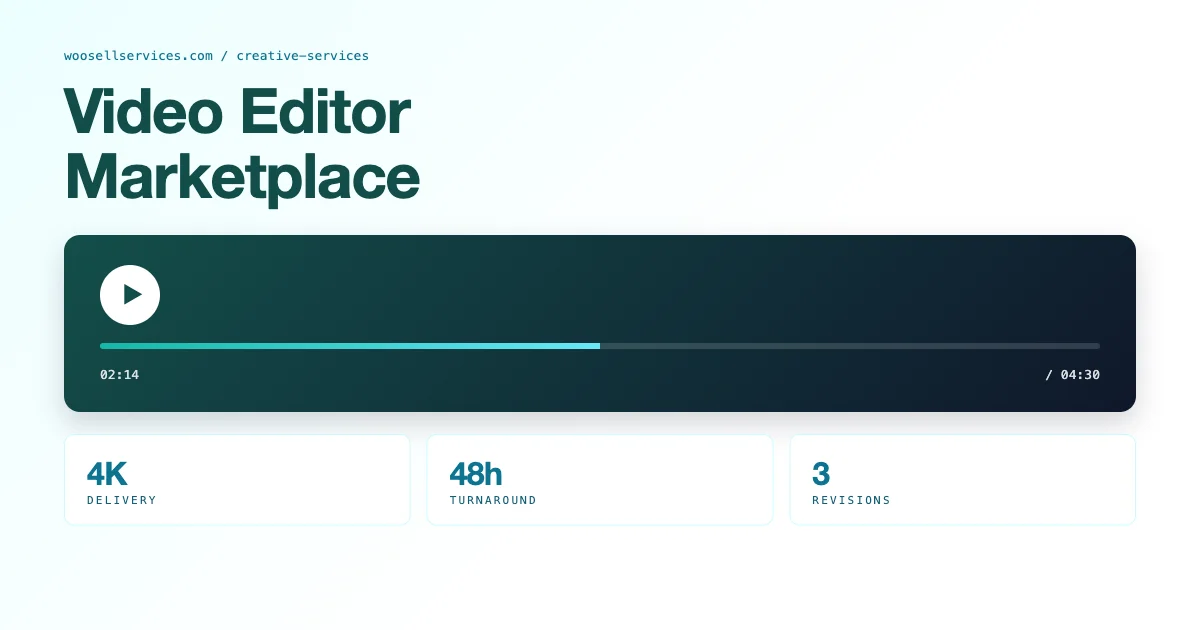
Video editing is one of the fastest-growing freelance categories, driven by the volume of video content required for social media, corporate communications, and e-learning. Building a video editor marketplace on WordPress requires solving specific challenges beyond a standard service marketplace: large file delivery, reel and portfolio display, royalty-free licensing clarity, and revision workflows suited to video content. This guide covers the complete configuration using WP Sell Services.
Why Video Editing Has Unique Marketplace Requirements
Video editing services differ from text-based or design services in three key ways that affect marketplace architecture: file sizes are large (even a 5-minute edited video might be 2-10GB for the source file), review requires video playback rather than document preview, and revisions are iterative in ways that are harder to define upfront than text revisions. A standard service marketplace configured out-of-the-box will struggle with all three.
The solution is to treat the WP Sell Services delivery system as a coordination layer rather than a file delivery system. Actual video files move through cloud storage (Google Drive, Dropbox, WeTransfer, Frame.io); the WP Sell Services delivery submission contains links to those files, not the files themselves. This keeps WordPress server storage manageable and allows clients to preview videos in their native players.
Cloud Storage Integration for Video Delivery
Configure the WP Sell Services delivery system for link-based delivery rather than file upload. The vendor delivery submission form should include fields for: the cloud storage link (Google Drive, Dropbox, or Frame.io URL with view-only access), the file format and resolution specs (MP4 1080p, MOV 4K, etc.), and the delivery notes. Use the wss_proposal_fields and wss_delivery_fields hooks to add these structured fields to the delivery form.
Frame.io is worth highlighting for professional video marketplace deployments. It provides client-facing review tools built in: clients can leave timestamped comments directly on the video rather than trying to describe timestamps in text. WP Sell Services handles the order and payment flow; Frame.io handles the video review workflow. The two systems connect via a link in the delivery submission.
Service Package Structure for Video Editors
Video editing service packages need to define scope precisely because scope creep is the primary source of disputes in video editing engagements. Guide editors to use package structures like:
| Package Tier | Typical Scope | Revision Rounds | Delivery Time |
|---|---|---|---|
| Basic Edit | Raw footage cut, basic color, music sync, up to 3 min | 1 | 3-5 days |
| Standard Edit | Storytelling cut, color grade, sound design, titles, up to 10 min | 2 | 5-7 days |
| Full Production | Multi-camera, motion graphics, professional color grade, any length | 3 | 7-14 days |
The revision count per package matters enormously for video editing because each revision cycle involves re-exporting and re-uploading large files. Set revision counts in the package configuration and make the revision policy visible to clients before purchase. The WP Sell Services package description field supports detailed text – use it to spell out exactly what a revision includes (new edit based on feedback vs minor trim adjustments).
Sample Reel Display on Editor Profiles
Clients evaluating video editors need to watch sample work, not read about it. The WP Sell Services vendor portfolio supports media embed URLs. Configure the portfolio to accept YouTube and Vimeo URLs so editors can embed their sample reels directly in the portfolio section. The embeds play inline without leaving the marketplace.
Guide editors to organize their portfolio by content type rather than client: “Corporate Testimonials”, “Social Media Shorts”, “Documentary Style”, “Motion Graphics”. A client who needs a corporate testimonial video needs to see examples of exactly that, not a general mix of the editor’s best work. Specific portfolio organization increases conversion from profile view to order.
Encouraging YouTube vs Vimeo
Vimeo embeds are preferable to YouTube for professional marketplace profiles: Vimeo allows password-protected portfolios, has no ads, and does not recommend competing content after playback. For editors showing client-confidential work, Vimeo Pro’s privacy settings (link-only access) allow portfolio display without public video exposure. YouTube is acceptable for editors whose sample work is already public.
Royalty-Free Music and Licensing Clarity
Royalty-free music licensing is a recurring source of confusion and disputes in video editing marketplaces. The standard marketplace clarification: the editor’s package price covers the editing service only; royalty-free music licensing is the client’s responsibility unless explicitly included in the package description. Editors who include royalty-free music (from Artlist, Epidemic Sound, or similar platforms) should state this explicitly in the package description and delivery notes.
Configure the order requirements form to ask about music licensing upfront. A custom requirements field asking “Will you provide the music track, or should the editor select royalty-free music?” prevents post-delivery disputes about whether music cost was included. This field can be added using the wss_proposal_fields filter in the requirements form configuration.
Marketplace vs Single-Editor Site
Before building, clarify whether you are building a marketplace (multiple editors) or a single-editor booking site (one editor taking client work). WP Sell Services Pro Personal ($69/year) covers a single vendor (the site owner as the service provider). WP Sell Services Pro Agency covers multiple vendors. The architecture differs significantly.
For a single-editor site, WP Sell Services Personal is a well-configured booking system: clients browse packages, pay, submit footage, and receive the edited video through the delivery system. For a marketplace with multiple editors, Pro Agency enables vendor registration, vendor-specific commission rates, and the multi-vendor payout infrastructure.
Handling Rush Orders and Priority Queues
Rush orders (faster delivery at a premium price) are common in video editing. WP Sell Services handles this through additional package tiers: add a “Rush Delivery” package at 1.5-2x the standard price with a 24-48 hour delivery commitment. Clients self-select for rush when they need it; editors set their own rush capacity through the packages they activate.
For editors who want to offer rush add-ons to existing packages (rather than separate packages), the WP Sell Services extras feature (in Pro tiers) allows add-on purchases. An editor can offer a “Rush Delivery” extra for +$50 on any package, or a “Subtitles” extra for +$30. Clients add extras at the time of order. This is more flexible than fixed package tiers for experienced editors with varied client needs.
Handling a Dissatisfied Client on a Delivered Video
Video is subjective in a way text deliverables are not. Two clients can watch the identical cut and disagree on whether the pacing works, which makes dispute handling on a video marketplace genuinely harder than on a marketplace selling written content. Build this into the platform’s expectations from the first order rather than discovering it during the first real dispute.
The package description should specify what a revision covers versus what counts as a new creative direction requiring a new order. A client asking to trim ten seconds and adjust the music volume is a revision. A client asking for a completely different edit style after approving the storyboard is scope creep, and the editor should be able to point to the original brief when declining to absorb that as a free revision. Configure the WP Sell Services dispute flow to require both parties to reference the original order requirements when a disagreement escalates to admin review, since a dispute resolved against the documented brief is far faster to settle than one argued from memory.
Video Editor Marketplace Launch Checklist
- Cloud storage policy documented: which platforms are acceptable for delivery (Google Drive, Dropbox, Frame.io)
- Portfolio embed configured to accept YouTube and Vimeo URLs
- Order requirements form includes music licensing question and footage format question
- Package descriptions specify revision scope explicitly (what counts as a revision)
- Delivery SLA communicated: how long after delivery does client have to request revision or accept
- Royalty-free music responsibility spelled out in terms of service
- At least 3-5 editor profiles live before launch with sample reels embedded
- Test the full delivery flow: upload to Google Drive, submit link via WP Sell Services, verify client can access
For video editing marketplaces that will scale to significant GMV, the payment infrastructure guide is essential reading. See how installment payment options can make high-value production packages more accessible to clients. For the broader service marketplace architecture decision, the guide on WordPress marketplace plugins for selling services covers when WP Sell Services is the right foundation versus alternatives.
Pricing Your Video Editing Marketplace Services
Pricing on a video editing marketplace is more complex than text-based service marketplaces because deliverable complexity varies enormously. A 30-second social media cut from pre-shot footage is a fundamentally different scope from a 10-minute corporate video with motion graphics, color grading, and custom sound design. The service package structure should reflect this complexity range with clear scope definitions that prevent misaligned expectations.
Market research for video editing rates on major platforms (Upwork, Fiverr, Freelancer) shows wide variation: basic social media cuts from $30-$100, standard corporate video editing at $150-$500, full production post-processing at $500-$2,000+. For your marketplace’s pricing guidance, aim for the mid-range of your target geographic market. Setting prices too low attracts low-quality editors and undervalues the skill; setting prices too high reduces order volume for new editor profiles that have not yet built reputation.
Consider tiered commission rates based on order value: 20% commission on orders under $200, 15% on orders $200-$1,000, 10% on orders over $1,000. This structure makes the platform accessible for entry-level editors while rewarding high-value production work with better net earnings. The sliding commission also creates an incentive for editors to upsell clients to larger packages – a $300 package nets the editor more in absolute dollars than a $150 package even after the lower commission tier kicks in.
Handling Client-Provided Footage: Intake and Storage
Clients submitting footage for editing face the same large-file problem as the editors delivering the final cut. A 4K raw footage dump from a day-long shoot can easily be 100-300GB. The intake process needs a clear protocol that keeps this file transfer outside the WP Sell Services platform (which is not designed for large file hosting) while maintaining a documented trail of what was delivered.
Best practice: configure the order requirements form to ask for a cloud storage link where the client will upload their raw footage (Google Drive, Dropbox, WeTransfer). The requirements form submission records the link within the WP Sell Services order. The editor accesses the footage from the link, downloads what they need, and edits locally. This workflow documents the footage delivery without requiring your WordPress server to handle file storage.
Add a clear timeline expectation to the intake process: footage should be uploaded and the link submitted within 24 hours of order placement. If the footage is not submitted within the delivery window start date, the editor cannot start on time, which should not count against the editor’s delivery time. Include this policy in the order requirements confirmation email using the wss_order_accepted email filter to insert the footage submission deadline alongside the acceptance notification.
For video editing marketplaces that want to offer premium service tiers with guaranteed response times and priority queue access, the package pricing guide covers how to structure service tiers that justify premium pricing with concrete deliverables. For marketplaces offering high-value production packages where clients need payment flexibility, the installment payment guide covers milestone-based payment structures that work with WP Sell Services’ order lifecycle.
Managing Multiple Revision Rounds Without Frame.io
Not every video editing marketplace will integrate Frame.io for timestamped feedback. For marketplaces that use email or the WP Sell Services messaging system for revision communication, the revision process needs clear structure to avoid miscommunication. Establish a revision request format that editors can enforce: revision feedback must be submitted as a numbered list, with each item describing the specific change (timecode range, what to change, what it should look like instead). Unstructured feedback (“the middle part feels slow”) cannot be efficiently actioned without back-and-forth clarification.
Post a revision submission template in the WP Sell Services order requirements section. When a buyer requests a revision, the platform’s messaging system surfaces this template as a reminder of the expected format. Editors who receive well-structured revision requests complete revisions faster and with fewer follow-up questions. Buyers who submit structured revisions get back results that match their intent more precisely. The template is a small operational investment that reduces revision cycle duration and increases buyer satisfaction scores.
Source Footage Standards: What Editors Need to Deliver Professional Results
Video editors cannot produce professional results from poor-quality source footage. Many first-time clients on video editing marketplaces do not know what “good source footage” means. Build a source footage requirements guide into the order requirements form. Minimum requirements for professional editing results: footage shot at 1080p or higher, sufficient exposure (editors cannot fix severely underexposed footage), stable footage (handheld footage without stabilization is difficult to cut smoothly), and audio recorded separately from camera audio for dialogue-heavy content.
A brief pre-order checklist in the requirements form reduces footage quality disputes. Include a checkbox: “My footage meets the minimum quality requirements described above.” Clients who check this box and submit unusable footage have implicitly accepted that the resulting edit may not meet professional standards. This checklist does not prevent all quality disputes but provides the editor with a clear reference point when a client is dissatisfied with the output of footage that was not suitable for professional editing. The editor can reference the requirement acknowledgment rather than absorbing a dispute for circumstances outside their control.
Scaling a Video Editor Marketplace: From 5 Editors to 50
The transition from a boutique video editing marketplace (5-10 editors, curated, high-touch) to a scaled platform (50+ editors, broad categories, automated workflows) requires infrastructure changes beyond what WP Sell Services provides natively. At 50+ editors, the operational challenges shift: quality control across a large vendor base, consistent client experience across different editing styles, and vendor discovery (how do clients find the right editor among 50 options?) all require systematic solutions.
Quality control at scale uses review data and completion metrics: track average client rating, on-time delivery rate, and revision request rate per editor. Surface these metrics on editor profiles as platform-calculated scores (not just raw reviews). Editors who fall below platform minimums on these metrics are flagged for review or suspended. Vendor discovery at scale requires investment in the search and filtering infrastructure: by editing style, content type, delivery speed, price range, and review score. WP Sell Services taxonomy and tag configuration provides the foundational structure; a dedicated search plugin (SearchWP or FacetWP) provides the filtering UI. Plan these requirements into the architecture before you hit 50 editors, not after.
Storage Costs as the Marketplace Scales
Because raw and delivered video files live in third-party cloud storage rather than on the WordPress server, storage cost scales with the marketplace but does not appear as a WordPress hosting bill. Budget separately for this: a marketplace processing 50 video orders a month, each with 20-50GB of raw footage plus delivered files, will accumulate meaningful Google Drive or Dropbox storage costs on either the platform’s own account or across individual editor accounts. Decide upfront whether the platform provides shared storage (simpler for buyers, a real cost line for the platform) or requires each editor to use their own account (no platform cost, but less consistent buyer experience), and state that decision clearly in vendor onboarding so editors are not surprised by it after their first order.