Fraud Detection Tools That Integrate With WooCommerce in 2026

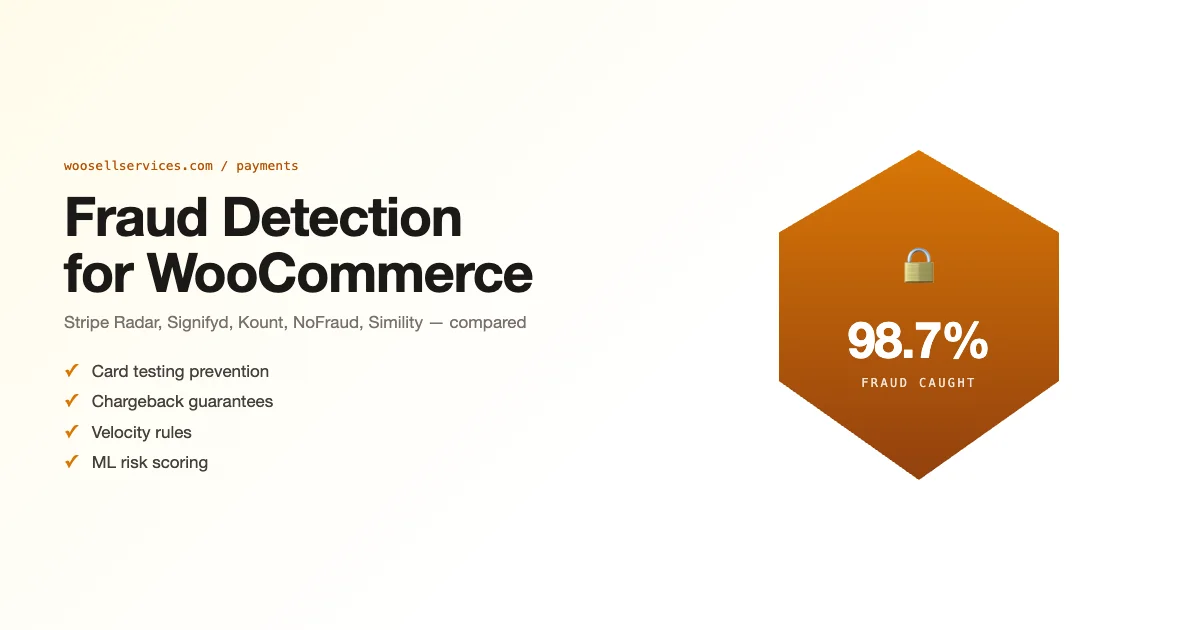
WooCommerce fraud costs stores in chargebacks, lost merchandise, and payment processor penalties. In 2026, the most effective fraud detection for WooCommerce combines Stripe Radar’s built-in scoring with a dedicated overlay tool like Signifyd or NoFraud for high-risk order review. This guide covers six options, Stripe Radar, Signifyd, Kount, NoFraud, Simility, and WooCommerce’s built-in protections, with honest assessments of what each actually catches and what it costs.
Why WooCommerce Fraud Detection Requires More Than a Plugin
WooCommerce has no native fraud scoring. It processes payments through gateways (Stripe, PayPal, Authorize.net) and records orders, full stop. The gateway handles payment fraud at the transaction level, but card-present-fraud (stolen card used by a person who has the physical card or its details), account takeover, and friendly fraud (legitimate cardholder disputes a valid charge) are not caught at the gateway level.
A complete WooCommerce fraud stack has three layers: gateway-level fraud scoring (Stripe Radar, PayPal fraud filters), order review tools that analyze behavioral signals and order data, and chargeback management tools that help you win disputes when they occur. Most stores need the first two layers; only high-volume stores need dedicated chargeback management.
Stripe Radar: The Built-In Option Most Stores Already Have
If your WooCommerce store uses Stripe for payments, Stripe Radar is already running on every transaction. Radar uses machine learning trained on data from all Stripe merchants to score each payment and block transactions that match fraud signatures. The standard tier (included free with Stripe) blocks obvious fraud automatically. Radar for Fraud Teams ($0.02 per transaction) adds custom rules, risk insights, and manual review queues.
Stripe Radar’s strength is breadth of data, it sees signal across millions of merchants and can identify a stolen card being tested across multiple stores before it hits yours at scale. Its weakness is that it is payment-focused, not order-focused. A fraudulent order placed with a legitimate card (for example, an account takeover) passes Radar because the card itself is not flagged.
- Included free with Stripe (standard rules)
- $0.02/transaction for Radar for Fraud Teams (custom rules, insights, review queue)
- Integrates via the Stripe gateway plugin natively
- Blocks card testing attacks automatically (rate limiting by card number patterns)
- Radar for Fraud Teams adds 3D Secure trigger rules, IP velocity checks, and rule-based blocklists
Signifyd: Chargeback Guarantee With ML Scoring
Signifyd is the market leader for order-level fraud protection with a chargeback guarantee. You pay a percentage of your gross merchandise value (typically 0.5-1.5% depending on your risk profile and volume), and Signifyd guarantees that any order it approves will not result in a chargeback you have to pay. If a Signifyd-approved order results in a chargeback, Signifyd covers it.
Signifyd’s WooCommerce integration is a plugin that sends order data to Signifyd’s API in real time. Signifyd scores the order within seconds and returns an approve/decline decision. Approved orders proceed to fulfillment automatically. Declined orders are held for manual review or cancelled based on your configuration. The ML model analyzes 500+ signals including email age, device fingerprint, IP reputation, shipping address match, and order velocity from the same device.
Signifyd is best suited for stores with average order values above $50 and chargeback rates above 0.5%. Below that threshold, the cost of Signifyd (minimum monthly fees apply) may exceed the chargebacks it prevents. Request a quote directly, pricing is not published and varies by volume and category.
Kount: Enterprise-Grade Identity Trust
Kount (owned by Equifax) operates a global device intelligence network. Every device that has ever interacted with a Kount client is known to the network, its risk score improves with every interaction across the entire client base. For enterprise merchants, Kount offers the broadest device identity graph available.
Kount360 covers the full customer journey: account creation fraud, account takeover, and payment fraud in a single platform. This is meaningful for stores with registered accounts (rather than guest checkout only), account takeover prevention is a use case Stripe Radar does not cover at all.
Kount pricing is enterprise and quote-based. For stores below $1M in annual revenue, the minimum contract cost typically makes Kount uneconomical. At $1M+ with material chargeback exposure, Kount becomes worth evaluating. The WooCommerce integration requires a developer to build against Kount’s API, there is no ready-made plugin.
NoFraud: The Mid-Market Option With Chargeback Protection
NoFraud is the closest alternative to Signifyd for mid-market WooCommerce stores. Like Signifyd, it offers a chargeback guarantee on approved transactions and scores orders in real time. The key differences: NoFraud’s pricing is typically lower than Signifyd’s for similar GMV, and it has a WooCommerce plugin that installs without developer involvement.
NoFraud’s decision accuracy is strong for domestic US orders. For international orders, Signifyd’s larger global dataset gives it an edge in accuracy. Stores with 80%+ domestic orders and AOV of $50-$500 should evaluate NoFraud alongside Signifyd and compare the chargeback guarantee terms carefully, the fine print on what qualifies for the guarantee differs between them.
Simility: PayPal-Owned, Custom Rules Engine
Simility, acquired by PayPal, takes a different approach from Signifyd and NoFraud. Rather than a black-box ML score, Simility gives fraud teams a visual rules-builder and case-management console, letting an in-house analyst construct and tune custom decision logic (a specific combination of shipping mismatch plus high order value plus new account, for example) rather than relying entirely on a vendor-trained model. This makes Simility a better fit for merchants with an actual fraud team who want direct control over the decision logic, and a worse fit for a solo store owner who just wants an automated approve/decline answer.
Because Simility sits under the PayPal umbrella, it integrates cleanly with PayPal-processed transactions and offers reduced friction for merchants already using PayPal Commerce Platform as their primary gateway. For a WooCommerce store built primarily around Stripe, the integration work is heavier and the case for choosing Simility over Signifyd or NoFraud is weaker unless PayPal is the dominant payment method.
Recommended Stack by Store Size
| Store Size | Recommended Stack | Est. Monthly Cost |
|---|---|---|
| Under $10K GMV | Stripe Radar (free) + Anti-Fraud free plugin | $0-$5 |
| $10K-$100K GMV | Stripe Radar for Fraud Teams + NoFraud | $50-$300 |
| $100K-$1M GMV | Signifyd or NoFraud with chargeback guarantee | $200-$1,500 |
| $1M+ GMV | Kount360 or Signifyd Enterprise | Custom pricing |
For stores just getting started with fraud prevention, Stripe Radar with the free Anti-Fraud plugin covers the most common attack vectors at no cost. Invest in a paid tool only when chargeback rates exceed 0.5% or when a single fraudulent order would cause meaningful financial damage.
Card Testing: The Most Common Fraud Attack
Card testing is when fraudsters use your checkout to verify whether stolen card details are valid, typically by attempting small purchases. Each test attempt generates a payment processing fee even when declined. A card testing attack of 1,000 attempts costs your store $30-$50 in processing fees alone, plus the risk of the payment processor flagging your account for high decline rates.
Stripe Radar handles card testing natively with rate limiting. If Radar is not your gateway, or if you use a gateway without built-in rate limiting, add CAPTCHA to the checkout (Google reCAPTCHA v3 or Cloudflare Turnstile). The reCAPTCHA plugin or a form plugin like Gravity Forms with CAPTCHA add-on both work. For stores on Cloudflare, a WAF rule blocking more than 5 failed checkout attempts per IP per hour eliminates most card testing without affecting legitimate shoppers.
Dynamic pricing adjustments can also signal fraud risk, unusually large orders or orders with suspicious product combinations warrant additional verification. The guide on dynamic pricing plugins covers how pricing rules can be structured to trigger review flags on abnormal purchase shapes.
Chargeback Management: What to Do When Fraud Slips Through
Even with good fraud detection, some chargebacks are inevitable. For stores without a chargeback guarantee (Signifyd or NoFraud), winning chargeback disputes requires evidence submission within the payment processor’s dispute window (typically 7-20 days from notification).
WooCommerce does not automate chargeback response. You need to manually collect: the order confirmation email, IP address and device data logged at purchase, delivery confirmation (tracking number), any shopper communications about the order, and proof of account login if the shopper was authenticated. Keep this data in a format that can be submitted to Stripe or PayPal’s dispute portal quickly.
For stores with recurring orders or subscription services, fraud protection sits alongside a solid loyalty stack, genuine returning shoppers should never be declined. See how loyalty programs can help distinguish high-value returning shoppers from first-time high-risk orders when calibrating fraud thresholds.
Account Takeover Prevention
Account takeover (ATO) is distinct from payment fraud: instead of using stolen card details, the attacker uses stolen login credentials to access an existing shopper account and place orders using the saved payment method or accumulated store credit. ATO is particularly damaging because the purchase passes standard payment fraud checks (the card is legitimately on file, the billing address matches) and triggers no gateway-level alerts.
WooCommerce’s default account system has no ATO protection. The mitigations: two-factor authentication for shopper accounts (via a plugin like Two Factor Authentication by WP White Security), login velocity monitoring (flag accounts with unusual login signals from new locations or devices), and notification emails to account owners when a login occurs from an unrecognized device. Kount360 provides automated ATO detection as part of its platform-level device intelligence, but it is enterprise-priced. For most stores, 2FA on shopper accounts combined with login notifications covers the majority of ATO risk at zero additional cost.
Enable Two Factor Authentication on your store for all shoppers who save payment methods. Shoppers who do not save payment methods are at lower ATO risk because the attacker cannot complete a purchase without re-entering a card. Stores with high account credit or gift card balances should treat all accounts as high-priority for 2FA enforcement.
Friendly Fraud: The Hardest Type to Prevent
Friendly fraud occurs when a legitimate shopper disputes a legitimate charge, claiming they did not receive the order, did not authorize the purchase, or that the product was not as described. Payment processors treat this as a chargeback, and without strong evidence, the merchant loses. Friendly fraud accounts for 30-40% of all chargebacks in typical e-commerce businesses and is growing.
Preventing friendly fraud is primarily a documentation and process problem, not a fraud scoring problem. Key practices: send order confirmation emails with detailed product descriptions (hard to claim you did not know what you ordered), require signature on delivery for high-value shipments (hard to claim non-receipt), maintain detailed shopper communication records (hard to claim no contact was made), and use delivery tracking that includes GPS-confirmed delivery (hard to claim the package never arrived).
Signifyd and NoFraud both cover friendly fraud under their chargeback guarantees when their decision model approved the order. This is a significant benefit, friendly fraud is nearly impossible to prevent at the transaction level, so having a guarantee that covers disputes after the fact is meaningful for stores with high-value orders. For stores running a fraud and chargeback prevention stack alongside their loyalty program, see the guide on loyalty rewards plugins for how loyalty data can help distinguish high-value genuine shoppers from one-time buyers with higher chargeback rates.
Configuring for Maximum Fraud Visibility
Beyond third-party fraud tools, several configuration choices maximize visibility into suspicious orders without additional cost. Enable order notes for all status changes, this creates an audit trail that is useful when fighting chargebacks. Log payment gateway response codes for declined transactions, patterns of declined attempts before a successful transaction are a fraud signal. Use order status custom email triggers to send yourself an immediate notification when orders over a threshold amount are placed, giving you a manual review window before fulfilling high-value orders.
The order admin screen shows shopper IP address, order history for that email, and the number of orders from that device in the order detail panel when you use a fraud detection plugin. These signals together give you a manual fraud review capability that costs nothing beyond time. For small stores processing under 50 orders per day, manual review of flagged orders (high value, first-time shopper, overnight order from distant location) is a practical fraud prevention approach without the cost of a dedicated fraud tool. As volume grows and manual review becomes unsustainable, that is the trigger to invest in Stripe Radar for Fraud Teams or NoFraud.
PayPal and Other Gateway-Level Protections
Stripe Radar gets most of the attention because it is bundled with the most common WooCommerce payment gateway, but stores accepting PayPal have their own layer worth configuring correctly. PayPal Seller Protection covers eligible transactions against unauthorized payment claims and items-not-received disputes, provided the order meets PayPal’s requirements, shipped to the confirmed address on the transaction, with tracking uploaded to PayPal within the required window. A store that ships to an address different from the one on the PayPal transaction, even at the buyer’s request, forfeits that protection, so it is worth training support staff to flag and verify any address-change request rather than quietly accommodating it.
Authorize.net, still common on stores with a merchant-account-first payment setup, includes its own Advanced Fraud Detection Suite (AFDS) as part of the gateway rather than as a separate product. AFDS lets you configure velocity filters (block a card attempting more than N transactions in a time window), IP address filters, and AVS/CVV mismatch handling directly in the gateway dashboard, at no additional per-transaction cost beyond the standard processing fee. For stores already on Authorize.net, configuring AFDS properly is a free first step before evaluating a paid overlay tool like Signifyd or NoFraud.
Building a Fraud Review Workflow Your Team Can Actually Follow
A fraud detection tool is only as good as the process around it. Flagging a suspicious order is useless if nobody looks at the flag before the warehouse ships it. A workable review workflow needs three things: a clear hold state (an order status like “Fraud Review” that visibly blocks fulfillment until cleared), a defined reviewer (a specific person or rotating role responsible for checking flagged orders daily, not “whoever has time”), and a documented decision checklist (does the billing name match the account name, does the shipping address match a known pattern of fraud, is the order value unusually high relative to the customer’s history).
Stores that skip the workflow and rely purely on automated scoring tend to see two failure modes: either every borderline order gets auto-approved because nobody is actually watching the review queue, or every borderline order gets auto-declined because the thresholds were set conservatively and nobody adjusts them, quietly losing legitimate sales to false positives. Review your decline rate monthly against your actual chargeback rate. If declines are high and chargebacks are near zero, your fraud rules are probably too aggressive and costing you real revenue from real customers.
Frequently Asked Questions
Can I use Signifyd or NoFraud without also running Stripe Radar?
Technically yes, since Signifyd and NoFraud score orders independently of the payment gateway. In practice, most stores keep Stripe Radar’s free standard tier active as a baseline even when running a paid overlay tool, since Radar catches obvious card-level fraud before it reaches the more expensive order-scoring layer, reducing the volume Signifyd or NoFraud need to process.
Does enabling stronger fraud rules hurt conversion rates?
Yes, if configured too aggressively. Every fraud rule that declines or holds an order for review also risks declining a legitimate customer whose behavior happens to look unusual (a new IP address from travel, a gift purchase shipped to a different address than usual). The tools with a chargeback guarantee (Signifyd, NoFraud) are generally tuned to minimize false declines because they are financially on the hook for approved orders that turn fraudulent, which gives them an incentive to approve more borderline orders than a purely rules-based system would.
Is a free fraud plugin from the WordPress repository worth installing?
Free anti-fraud plugins typically offer basic IP blocking, disposable email detection, and simple velocity rules. They are worth installing as a zero-cost first layer, especially paired with Stripe Radar’s free tier, but they lack the machine-learning scoring and chargeback guarantees of paid tools. Treat them as a baseline, not a complete solution, once your order volume or average order value grows enough that a successful fraud attempt would meaningfully hurt the business.