Video Editor Marketplace in WordPress: Creative Services Hub With WP Sell Services

Video editing is one of the highest-demand creative services online. The market is fragmented across freelance platforms, agency websites, and direct client relationships. Building a dedicated WordPress marketplace for video editors – with proper file delivery, tiered service packages, revision policies, and portfolio showcases – gives you a focused platform that stands out from generalist freelance directories. WP Sell Services handles the commerce and service infrastructure. This guide covers the setup from scratch.
Why Video Editing Services Need a Dedicated Setup
Video editing services have different operational requirements than most other creative services. The primary difference is file size. A client brief, design mockup, or written report can be delivered through email or a simple download link. A video project cannot. Raw footage for even a short commercial project runs into gigabytes. Finished deliverables – master files, compressed exports, different aspect ratio cuts – add more. Your marketplace infrastructure needs to handle this reality from the start.
The second distinction is revision management. Video editing revisions are expensive in editor time. A client who misunderstands what “two revision rounds” means can quickly erode the margin on a project. Your service packages need explicit revision terms, and your platform needs a way to enforce those terms in the service delivery flow.
The third is portfolio presentation. Video editors win work on the strength of their showreels and sample edits. A marketplace that does not support compelling portfolio display – video embeds, project categories, client industry filters – puts your editors at a disadvantage compared to the platforms they are competing against for client attention.
WP Sell Services handles the commerce layer cleanly. The file delivery and portfolio display elements require deliberate configuration choices, which this guide covers in detail.
File Delivery: Cloud Storage Is Not Optional
The single most important infrastructure decision for a video editing marketplace is how finished files reach clients. Inline WordPress media library storage is not viable for video project files – the file sizes exceed reasonable hosting storage limits and the delivery speeds through standard WordPress hosting are too slow for large file transfers.
The correct approach is cloud storage integration. Three options work well in the WP Sell Services stack:
- Amazon S3 or compatible storage: The most scalable option. Video files are stored in S3 and delivery links are generated per order. S3 integration with WooCommerce is handled by plugins like WooCommerce Amazon S3 Storage, which generates secure time-limited download links automatically after order completion.
- Google Drive or Dropbox shared folder links: The simplest option for low-volume platforms. The editor uploads the finished file to a shared folder and the client receives the link via the order completion email. Less automated than S3 but requires zero additional infrastructure setup.
- Frame.io or WeTransfer Pro: Video-specific delivery platforms with large file transfer built in. The editor sends the delivery link directly to the client via the WooCommerce order note system after upload. Adds a manual step but uses platforms designed specifically for video file delivery.
For a marketplace launching with a small number of editors and moderate order volume, the Google Drive or Dropbox approach gets you live fastest. For a platform that expects to scale to dozens of editors and hundreds of monthly projects, invest in S3 integration from the start – retrofitting storage infrastructure onto a running marketplace is painful.
Building Your Service Package Structure
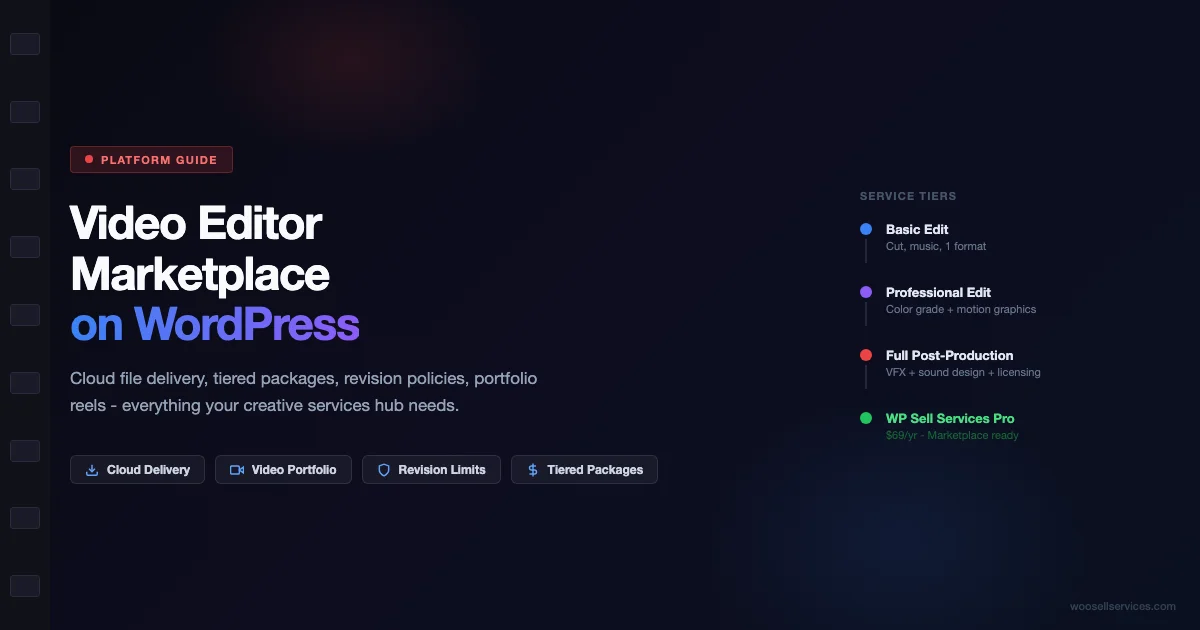
Video editing services break naturally into tiers based on production complexity. Structure your packages to match how clients think about their video projects, not how editors think about their workflow. Here is a three-tier structure that maps well to the market.
| Package Tier | What It Includes | Best Client Fit | Typical Revision Policy |
|---|---|---|---|
| Basic Edit | Cut and assemble raw footage, add music, basic color correction, one output format | Social media content, simple explainers, event recaps | 1-2 revision rounds |
| Professional Edit | Full cut, color grading, sound design, motion graphics, up to three output formats | Marketing videos, product demos, training content | 2-3 revision rounds |
| Full Post-Production | Everything in Professional plus visual effects, advanced color science, custom music composition or licensing | Brand films, commercial spots, documentary segments | 3 revision rounds, defined scope |
Each tier is a separate product listing in WP Sell Services. The service description for each listing should explicitly state what is included, the estimated turnaround time, and the revision policy. Clients who misunderstand what they are purchasing are your most common source of disputes – over-specify rather than under-specify at the listing level.
Add-On Services
Beyond your core package tiers, consider offering add-on services as separate purchasable products. Subtitle and caption creation, platform-specific reformat packages (16:9 to 9:16 for vertical), rush delivery (48-hour turnaround), and additional revision rounds all work well as add-ons. WooCommerce product add-on plugins let clients select these at checkout without requiring a separate purchase flow.
Revision Management: Set Clear Terms Before the First Project
Revision policy is where video editing marketplaces either run smoothly or create constant friction. The broader challenge of handling project revisions and scope creep on service sites applies directly to video editing projects, where scope boundaries are especially important. The standard marketplace approach is to define revision rounds in the service listing and enforce them through the order communication flow.
A revision round is the editor reviewing and incorporating one set of client feedback. The definition of “one set of feedback” needs to be explicit: all feedback for a given version should be consolidated into a single response rather than delivered piecemeal. A client who sends revision notes in three separate messages is not submitting a single revision round – they are submitting three, each of which may require reopening already-completed work.
State this clearly in your service descriptions. Include a note in the order confirmation email that explains how revision rounds work and asks clients to consolidate their feedback before submitting. Most friction around revisions comes from miscommunication about process, not from editors over-promising.
For editors who need a formal revision tracking mechanism, WooCommerce order notes serve as a timestamped communication log. The client submits feedback via order notes; the editor acknowledges and responds via order notes. The order note history provides a documented record of revision rounds if a dispute arises.
Portfolio Showcase for Video Editors
A video editor’s portfolio is their most powerful sales tool. Your marketplace needs to support compelling portfolio display because editors who cannot showcase their work effectively will not attract clients, regardless of their skill level. For the general approach to adding a portfolio to a freelance services site, that guide covers the structural decisions that apply here too.
Video Portfolio Embeds
WordPress handles embedded video from YouTube and Vimeo natively via oEmbed. Editors should host their showreels and sample edits on Vimeo (preferred for professional work) or YouTube and embed them in their WP Sell Services profile page. Vimeo’s privacy controls let editors set portfolio videos to “unlisted” so they appear on your marketplace but are not publicly searchable on Vimeo itself – useful for client work that requires discretion.
Structure the portfolio section of each editor’s profile to include at least: a primary showreel (2-3 minutes covering their full range), two to three project spotlights (single-project videos with brief case study descriptions), and category filters so clients can see examples relevant to their specific content type.
Before and After Showcases
Before and after showcases are particularly effective for video editors because they demonstrate the transformation the editor delivers, not just the finished product. A split-screen showing raw footage alongside the edited version communicates skill more clearly than a polished final cut alone. Encourage editors to create these for their portfolio listings and include a block for before/after comparisons in your profile template.
Royalty-Free Licensing Notes
Portfolio videos that use commercially-licensed music require attention. An editor who builds a showreel using music they do not own the commercial rights to puts your platform in a legally ambiguous position. Include a note in your editor onboarding that requires all portfolio content to either use royalty-free music or music the editor has appropriate licenses for. Recommend libraries like Artlist, Musicbed, or Epidemic Sound for editors who need royalty-free music for their portfolio and client work.
Onboarding Video Editors to Your Marketplace
The quality of your marketplace is determined by the quality of the editors on it. A rigorous editor application process filters for skill and professionalism before clients ever encounter an editor’s profile.
Your editor application should collect: a link to their current showreel, examples of at least two specific project types they handle, their software stack (Premiere Pro, DaVinci Resolve, Final Cut Pro, After Effects), their turnaround time commitments for each service tier, and their pricing expectations.
Review the showreel and project examples before approving the application. Set specific quality thresholds – color work that meets a professional broadcast standard, audio that is properly leveled and cleaned, cuts that are technically clean – and apply them consistently. A marketplace that approves everyone who applies will lose client trust when a low-quality editor delivers a poor product.
Once approved, editors need onboarding documentation that covers: how to set up their WP Sell Services profile, how to create service listings at each tier, your revision policy template, your file delivery process, and your communication standards for client interactions. This documentation reduces support requests and produces more consistently professional editor behavior.
Client Communication Flow
Video editing projects require ongoing client communication between purchase and delivery. The client needs to share source footage, provide a creative brief, give feedback on drafts, and approve the final version. Your marketplace needs a clear process for each step.
After a client purchases a service package, the order confirmation email should prompt them to submit their project brief. For a detailed look at how to automate service delivery emails after payment, that guide covers the WooCommerce email template configuration in full. Include a standardized brief template in the email: project type, target audience, key messages, style references, music preference, and deadline. A well-completed brief is the single best predictor of a smooth editing project.
For source footage delivery, clients need a clear way to share large files. Include instructions in the post-purchase email for how to share footage – typically a shared Google Drive folder or WeTransfer link sent via order notes. Specify file format requirements (raw files preferred, compressed deliveries acceptable for social content) and any naming conventions that help editors work efficiently.
Draft delivery and revision communication happens through WooCommerce order notes by default. For high-volume platforms where editors and clients need richer communication tools, a dedicated client portal plugin that integrates with WooCommerce can provide a more structured communication experience without replacing the WP Sell Services order management layer.
Pricing Your Video Editing Services Competitively
Video editing pricing on marketplaces varies widely based on editor experience, project complexity, and turnaround time. Research current market rates on established platforms before setting your price ranges. Your marketplace pricing needs to be competitive enough to attract clients while being high enough to attract and retain quality editors.
For a new marketplace, consider a launch pricing strategy where editors offer their first few projects at a reduced rate to build reviews and portfolio examples specific to your platform. WooCommerce coupon functionality supports this without requiring changes to the base service listing prices.
Rush delivery pricing – a premium for 48-hour or same-day turnaround – is a legitimate upsell that many clients need and are willing to pay for. Price rush delivery at a 50-75% premium over standard turnaround. Editors who offer rush delivery should commit to it as a genuine service, not a way to double their rate without changing their timeline.
Marketing Your Video Editing Marketplace
Launching the platform is the first step. Getting the right clients and editors in front of each other is the sustained work that determines whether the marketplace grows. Video editing marketplaces have specific marketing channels that work better than others for client acquisition.
Content Marketing Around Video Production
Clients who are searching for video editing help often search for information before they search for a provider. Articles that answer the questions video clients actually have – “how long does video editing take?”, “what files do I need to send a video editor?”, “what does color grading actually do?” – attract clients at the research phase of the buying decision. Your marketplace blog is a natural home for this content. The clients who find you through informational content are already educated about what they need and convert more efficiently than cold traffic.
Video SEO for Editor Profile Pages
Editor profile pages on your marketplace are landing pages for search queries about specific editing specializations. An editor who specializes in wedding videography editing should have a profile page optimized for queries like “wedding video editor WordPress” or “wedding film post-production freelancer.” Help your editors write profile descriptions that include the specific keywords relevant to their specialization. Profile pages that rank for relevant terms drive qualified client traffic without paid advertising.
Community and Referral Programs
Video production professionals refer work to each other constantly. A cinematographer who does not edit refers post-production work to editors. A director refers to an editor they trust. A client who was happy with their project refers colleagues. A structured referral program – where referring parties receive a small commission on the first project from a new client they introduce – formalizes these referral relationships. WooCommerce affiliate plugins handle the tracking and commission management without writing any code.
For the editor side of your marketplace, building a community component – a forum, Slack channel, or Discord server where your editors can share resources, refer overflow work to each other, and get platform support – increases editor retention and creates organic advocacy for your marketplace. Editors who are active in your community are less likely to leave when a client approaches them directly.
Sample Reels as Conversion Tools
Your marketplace homepage needs video content. A curated selection of editor showreels embedded on the homepage – with permission from your editors – demonstrates quality immediately for prospective clients. Video on a landing page consistently outperforms static imagery for service marketplaces. Choose showreel clips that represent the range of your marketplace’s specializations and quality levels, and update them as your editor roster and quality standards evolve.
Build Your Video Editing Marketplace
A focused video editing marketplace built on WP Sell Services gives editors a professional platform that positions them clearly for the clients looking for specialized video production help. The infrastructure – WooCommerce for commerce, WP Sell Services for the service marketplace layer, cloud storage for file delivery, video embeds for portfolio presentation – handles the operational requirements that make video editing commerce work.
WP Sell Services Pro Personal at $69 per year covers the full setup for a single-site video editing marketplace. It handles service listings, tiered packages, revision tracking through the order management system, automated delivery confirmation emails, and the client communication flow that keeps projects moving. Add a cloud storage integration appropriate for your file delivery needs and you have a production-ready platform.
Handling Niche Video Editing Specializations
Video editing is not monolithic. Different editors specialize in different content types, and clients looking for a specific specialization are better served by a marketplace that organizes around those distinctions rather than presenting all editing services as equivalent. Consider structuring your marketplace around the key specialization categories that match your editor pool and your target client market.
Social Media and Short-Form Content
Short-form video – Instagram Reels, TikTok clips, YouTube Shorts – has created a distinct editing specialization. Editors who excel here understand platform-specific pacing, vertical format optimization, hook-driven opening sequences, and caption and subtitle integration. Service listings for this category should specify platform (or multi-platform) output, aspect ratio options, and whether the editor handles caption creation as part of the package or as an add-on.
Corporate and B2B Video
Corporate video clients have different requirements than consumer brands. They often need multiple stakeholder approvals built into the revision process, accessibility compliance (closed captions, audio description), and delivery in formats that work with their internal video management systems. Editors who specialize here are familiar with these requirements; service listings should reflect them explicitly to attract the right client segment.
Event and Wedding Videography
Event and wedding video editing has distinct requirements: longer source footage, emotional storytelling priorities, music licensing for personal use, and deliverables that often include highlight reels, full ceremony cuts, and digital album formats. If your marketplace serves this category, service listings should specify turnaround times (wedding clients often wait 8-12 weeks for full edits), revision policies for emotionally sensitive content, and music licensing terms for personal use versus social sharing.
Documentary and Long-Form Editing
Documentary and long-form projects – podcasts with video, educational content, documentary films – require editors with strong narrative construction skills, comfort with extended timelines, and experience managing large multi-camera projects. Service listings for this category should address project scope assessment (how do you price a 60-minute documentary?), milestone-based delivery for long projects, and communication protocols for projects that run over weeks or months rather than days.
Quality Control on a Video Editing Marketplace
Maintaining quality standards across a marketplace with multiple editors requires deliberate systems. Unlike a single freelancer relationship where quality is assessed before hire, a marketplace continuously onboards new editors and needs a way to ensure consistent quality over time.
The most effective quality control mechanism is the client review system. WooCommerce’s product review functionality, applied to service listings, gives clients a structured way to rate their experience. Require that reviews include a rating and a brief written comment – rating-only feedback is less useful for prospective clients and provides less signal for identifying quality issues.
Monitor review patterns for each editor. An editor who consistently receives comments about revisions exceeding the stated policy, or deliverables that do not match the package description, needs intervention before those issues accumulate into client disputes. A periodic quality audit – reviewing a sample of completed projects against their stated package descriptions – catches systemic issues before they become review problems.
For editors who receive consistent high ratings and build a track record on your platform, consider a tiered editor status system – Featured Editor, Top Rated, Rising Talent – that appears on their profile and in search results. This creates a quality ladder that incentivizes good performance and helps clients identify which editors have the strongest track records for their specific project type.
If building and launching a marketplace like this falls outside your team’s bandwidth, Wbcom Designs offers WooCommerce development services for custom service marketplace builds.