How to Build a Website Like Urban Company on WordPress


Before an Urban Company beautician takes her first paid booking, she’s often already out several hundred dollars: an onboarding and training fee, a mandatory product and tools kit purchased through the platform, sometimes a monthly fee just to be guaranteed a minimum quota of jobs. Then the platform takes 25 to 30 percent of every booking on top of that. In 2019, beauty professionals in Delhi protested the terms publicly. The company has since adjusted rates more than once under similar pressure, and the underlying model, professionals paying to work before they’ve earned a rupee, is still the template most “managed marketplace” home-services platforms follow.
Angi (the HomeAdvisor and Angie’s List merger) runs a more familiar pay-per-lead model layered under a history of homeowner membership fees, closer to the Thumbtack pattern already covered in this series. What both platforms share, and what actually makes this niche distinct from the rest of this series, is fixed, upfront, catalog-style pricing for standardized home services: AC repair, appliance service, deep cleaning, pest control, salon-at-home. Not a quote. Not an hourly rate. A number you see before you book, because the service itself has been standardized enough to price in advance.
That standardization is genuinely valuable to customers, and it’s the piece worth keeping. The pay-to-work tax on professionals is the piece worth cutting. This post builds the first without the second.
What makes this vertical different from everything else in this series
Every other build here (Thumbtack, TaskRabbit, Rover, Care.com, Booksy) either uses custom quotes, hourly rates, or per-session pricing set by the individual provider. This one doesn’t, and that’s the whole point.
Fixed pricing requires standardized service definitions. “AC gas top-up and service” has to mean the same thing whether professional A or professional B performs it, at the same price, with the same included scope. This is more setup work than an open marketplace where every provider prices freely, and it’s exactly the work that makes the customer experience feel trustworthy: no site-visit surprise, no negotiation, no wondering if you’re being quoted differently than your neighbor.
Quality control matters more because the price promise is the product. If two different pros deliver wildly different quality at the identical listed price, the fixed-price model breaks immediately. This is why Urban Company invests so heavily, if extractively, in training. You need the training investment without needing to fund it by taxing the professional for the privilege of being trained.
The customer relationship is with the platform, not the individual pro, more than in any other build here. A customer booking “AC Repair” isn’t choosing a specific technician’s profile the way they’d choose a specific nanny or wedding photographer; they’re trusting the platform’s standard. That’s a genuinely different trust architecture, and it changes what you build.
The professional-cost problem, and the fix
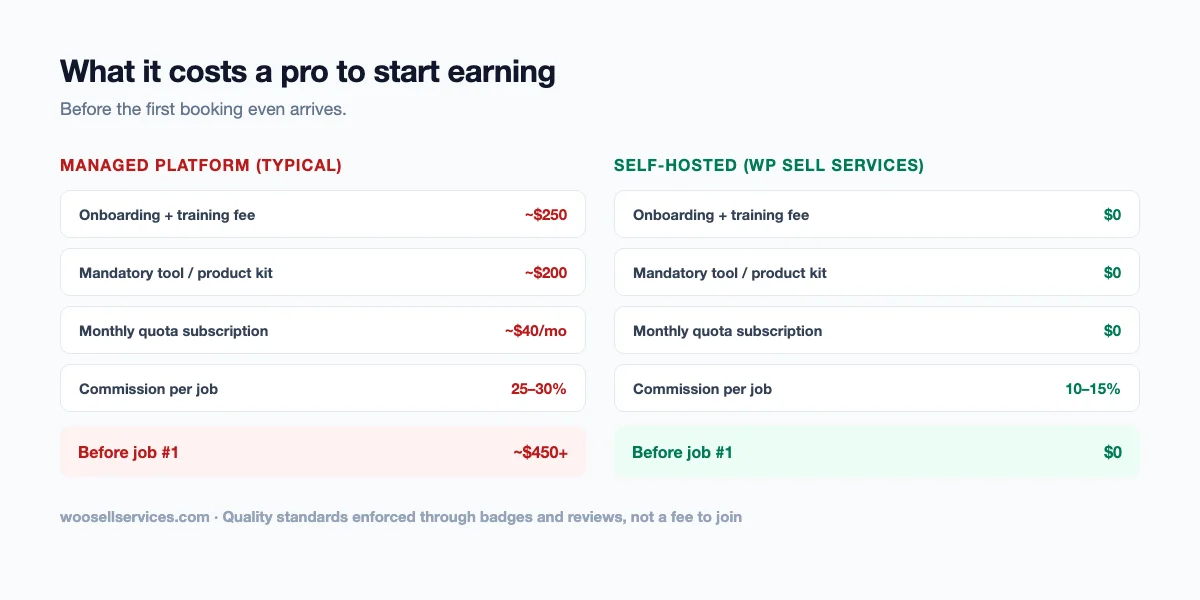
Here’s what a professional actually pays before earning a dollar on a typical managed platform, and what the same list looks like on a commission-only build:
| Cost before job #1 | Managed platform (typical) | Self-hosted (this build) |
|---|---|---|
| Onboarding + training fee | ~$250 | $0 |
| Mandatory tool / product kit | ~$200, platform-set price | $0, source anywhere |
| Monthly quota subscription | ~$40/month | $0 |
| Commission per completed job | 25 to 30% | 10 to 15% |
| Total before the first booking | $450+ | $0 |
Every one of those line items is a business decision, not a law of physics. Training can be genuinely valuable without being a paid gate professionals must clear before they’re allowed to earn. Standardized tools can be recommended, even required as a specification, without being sold through the platform at a markup. A commission funds the platform; a joining fee funds the platform’s cash flow at the professional’s expense before the professional has made a cent.
Your version: real training, delivered free or at cost, because well-trained pros protect your fixed-price promise and your reviews. A recommended tools and supplies list with links to buy anywhere, not a bundled kit sold through you. Commission alone, in the 10 to 15 percent range that’s held up across this whole series, as the entire monetization. Professionals do this arithmetic the moment they hear about your platform, and it is not a close call.
The stack
- WordPress, self-hosted, $10 to $30 a month in hosting
- WP Sell Services as the marketplace engine
- A clean, catalog-style theme built for browsing fixed-price listings (theme comparison)
- Stripe or PayPal for payments
The free plugin’s tiered package structure is, unexpectedly, the exact tool for fixed-price catalog services, more directly than for any other build in this series:
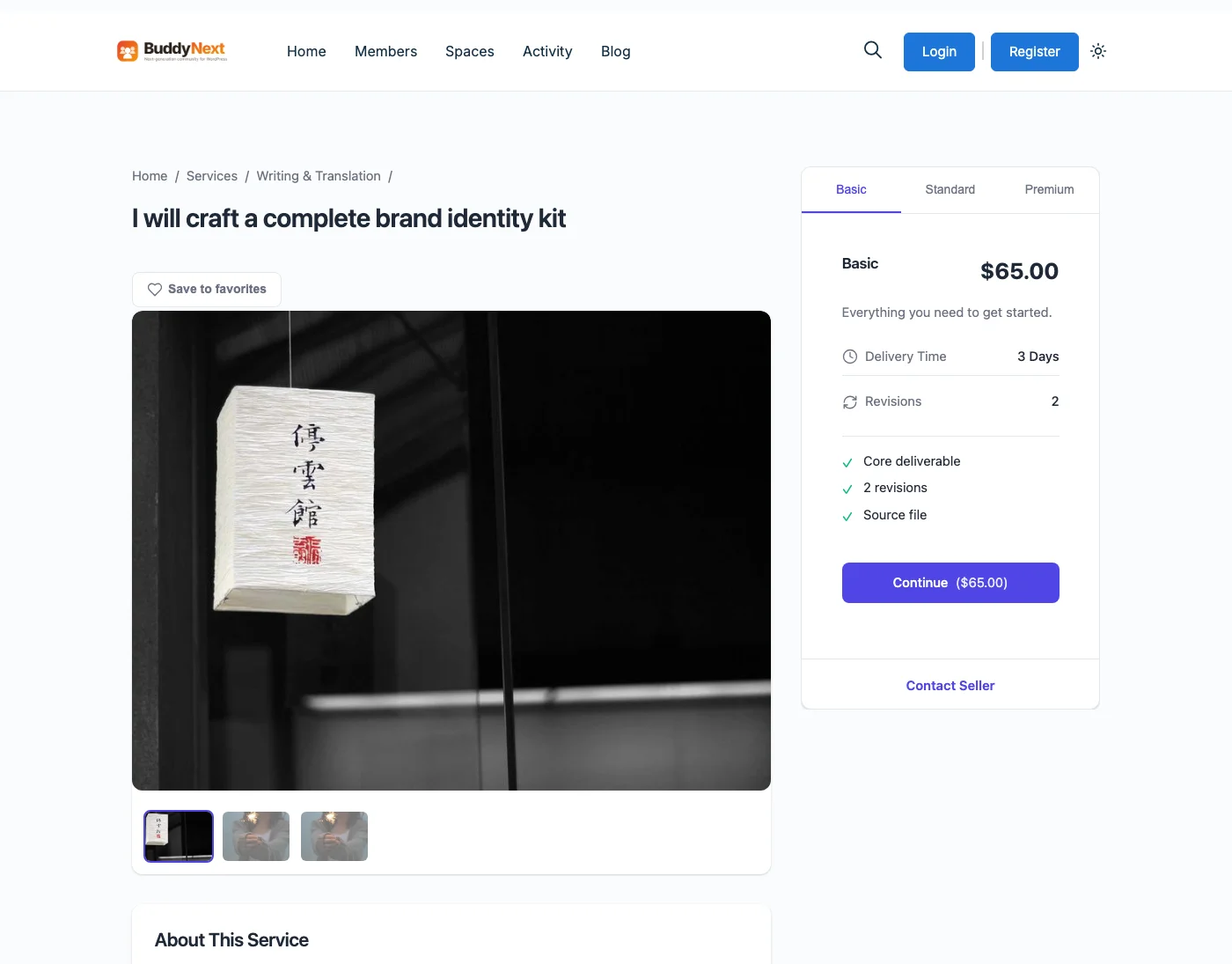
Where a freelance gig uses Basic/Standard/Premium for scope tiers, a home-services catalog uses the same three slots for the same standardized job at different specification levels: “AC Service (up to 1.5 ton) / AC Service (1.5 to 2 ton) / AC Service (above 2 ton) with gas top-up,” each a fixed number, no quote required. The delivery-time field becomes your service-window commitment. The structure translates without modification; only the labels change.
Beyond the pricing structure, the free plugin covers professional registration and dashboards, on-platform messaging, verified reviews, and dispute handling. Pro adds Stripe Connect for automated payment splits and per-category or per-professional commission rules, useful once you want to offer better terms to your most-trained, most-reviewed technicians.
Building the fixed-price catalog
Five decisions shape whether the fixed-price promise actually holds up once real bookings start flowing:
- Define services at the SKU level, not the category level. “Appliance Repair” is a category. “Refrigerator Repair, single-door, diagnosis included” is a listing with a real price. The narrower and more specific your listings, the more genuinely fixed your pricing can be, and the fewer awkward “final price may vary” conversations your professionals have to have on-site.
- Publish what’s included and what triggers an add-on, on every listing. A fixed AC service price should say plainly: gas top-up up to X grams included, parts beyond routine wear billed separately at listed rates, additional units at a stated per-unit rate. The add-on system handles this cleanly, base service fixed, extras itemized and priced in advance rather than negotiated at the door. This is what actually earns the “no surprise” trust the fixed-price model promises. A fixed price that turns into a surprise upsell on-site is worse than an honest quote system, because it breaks a promise instead of just being imprecise.
- Build a real training track, and make it free. This doesn’t need to be elaborate at launch: a written service standard per category, a short video walkthrough, and a supervised first job or two before a professional’s profile goes fully live. The investment is what lets you stand behind the fixed price; making the professional pay for that investment is what turns a legitimate business cost into an extraction. If you eventually want paid, advanced certifications (a specialty repair track, an expert tier with different pricing), that’s a reasonable optional upsell, clearly separated from the mandatory baseline that gets a professional earning at all.
- Recommend tools and supplies; don’t sell them at a markup. A published spec list (“bring X, Y, Z; here’s a reputable supplier”) accomplishes the standardization goal without the platform inserting itself as a mandatory vendor. If you later want to offer bulk-purchasing convenience as a genuine service, price it near cost and make it optional, not a condition of onboarding.
- Skip the quota subscription entirely. A monthly fee just to be eligible for a minimum volume of jobs is the clearest version of pay-to-work, and it inverts the entire pitch of a commission-only platform. If job distribution needs any structure at all, handle it through review-based ranking and category expertise, not a fee gate.
Quality control without the extraction
Standardized pricing lives or dies on consistent quality, so this isn’t optional polish, it’s the mechanism that makes the whole model work.
A visible completion checklist per service category, shown to the customer after the job (gas pressure checked, filter cleaned, unit tested) so quality is demonstrable, not just claimed. This also gives professionals a clear standard to work against rather than a vague expectation.
Verified reviews weighted by category expertise. A technician’s rating on refrigerator repair should be visible separately from their rating on washing machine repair if they do both, since fixed-price trust is earned per service type, not as one blended score.
A re-training path for quality issues, not an instant deactivation policy. Managed platforms have drawn real criticism for opaque, hard-to-appeal account suspensions. A documented process (a quality flag triggers a conversation and a retraining option before deactivation, with an actual appeal path) costs you almost nothing to build and is a genuine differentiator professionals will have heard about from friends on other platforms.
Spot-check a sample of completed jobs, especially early on, through customer follow-up calls or photo verification. This is the “we personally maintain the standard” story, the same trust lever the Care.com build leans on for a different reason, applied here to service quality instead of safety.
Economics of a fixed-price home services platform
Run real numbers for a mid-sized category like AC service.
A technician completing 40 jobs a month at an average $75 fixed price is $3,000 in monthly volume. At 12 percent commission, that’s $360 a month in platform revenue from one technician, with the technician keeping $2,640 instead of the roughly $2,100 to $2,250 they’d net after a 25 to 30 percent managed-platform commission on the same volume, before even accounting for the upfront fees they’d have already paid to start.
Twenty active technicians across a handful of categories at similar volume is $7,000-plus in monthly commission, against hosting and plugin costs that round to noise in that comparison. The gap between your take rate and the managed-platform take rate isn’t marginal; it’s the entire recruiting pitch, delivered in one sentence: keep 88 percent of every job instead of 70 to 75 percent, and pay nothing to start.
What you genuinely cannot replicate on day one
Bulk-negotiated parts and supply pricing. Large managed platforms use their purchasing volume to negotiate better rates on parts, sometimes passing a version of that savings through, sometimes not. At launch you don’t have that leverage, and you shouldn’t pretend to; let professionals source their own supplies at whatever rates they already have, which is very often close to or better than a platform markup once you net out the platform’s own margin on the kit.
Instant, algorithmic professional-to-job matching at city scale. Managed platforms route jobs automatically across large fleets of standardized workers. At launch scale, category-based browsing plus a buyer-request option (the reverse-marketplace pattern from the Thumbtack build: “need AC service today, who’s available”) covers this adequately until your volume genuinely requires automated dispatch, which is a problem worth having and solving later.
A large enough fleet to guarantee same-day service in every category, everywhere. Be honest about coverage on launch, city by city and category by category, rather than implying a scale you don’t have yet. A platform that under-promises and reliably delivers on a smaller footprint builds more trust in this vertical than one that overstates availability and produces cancellations.
Handling account disputes without the arbitrary-deactivation problem
This deserves its own section because it’s a specific, well-documented complaint against managed platforms in this vertical, and it’s cheap to do better.
Professionals on large managed platforms have reported IDs (their access to the app and job queue) blocked with little warning and less explanation, sometimes over a single customer complaint, sometimes over an algorithmic quality-score dip that’s never explained in plain terms. Labor groups have filed formal complaints over exactly this pattern. Whether or not any individual case was justified, the process itself, opaque and unappealable, is what generates the resentment, and it’s entirely a design choice, not a requirement of running a quality marketplace.
Build the opposite, deliberately. A quality or conduct concern generates a documented flag, visible to the professional, with the specific issue stated in plain language. A first flag triggers a conversation and, where relevant, a retraining path, not an automatic suspension. Repeated or serious issues (safety violations, verified customer harm) can and should lead to removal, but through a stated process with a real human decision at the end of it, not a silent algorithmic cutoff. Give professionals a genuine appeal channel, and honor it: reverse a decision when the appeal reveals you got it wrong, publicly enough within your own community that professionals trust the process is real.
None of this makes your quality bar lower. It makes your quality bar legible, which is the thing professionals on the incumbent platforms say they’re missing most.
Launch: recruit on the fee gap, prove it on the first invoice
- Find professionals currently on a managed platform and show them the math directly. Pull their approximate monthly volume, run it through both commission structures, and hand them the comparison. This is the single most persuasive recruiting document you can produce in this vertical, more effective than any pitch deck, because it’s their own numbers.
- Start with two or three tight categories, not a full home-services catalog. AC service and appliance repair, or cleaning and pest control: pick categories where you can genuinely build and verify a training standard at launch, and expand once the first ones are running well. A thin catalog across fifteen categories reads as unfinished; a deep, trustworthy catalog across two reads as a real business.
- Publish your training standard publicly, not just to onboarding professionals. A visible page explaining exactly what a technician goes through before their profile goes live is a customer-trust asset as much as a recruiting one, and it’s the plain-language version of the “professionally managed” promise the big platforms make with far less transparency.
- Seed real completed jobs before public launch. Book actual services through your own platform, pay full price, verify the completion checklist works, leave detailed reviews. This is the same seeding discipline as every build in this series, and it matters especially here because your first reviews are effectively validating your entire quality-control system, not just individual professionals.
Common questions
Is Angi’s model different enough from Urban Company’s to matter for this build? Mechanically yes: Angi leans closer to pay-per-lead and homeowner-facing membership than to mandatory professional training fees, which makes it closer in spirit to the Thumbtack pattern than to the fixed-price catalog model this post focuses on. What both incumbents share, and what this build responds to either way, is charging a party in the transaction for access rather than for value delivered: Angi historically charged homeowners to see reviews and charges pros per lead regardless of outcome, Urban Company charges pros to be allowed to work at all. A commission-only, fixed-price catalog answers both patterns with the same structural fix.
Isn’t Urban Company’s model successful specifically because of the training and standardization it funds through those fees? The standardization is genuinely valuable; the funding mechanism is the part worth changing. Training and quality control cost real money, and a commission-only model funds them fine at reasonable volume, the same way this entire series has funded messaging, dispute resolution, and review systems through commission rather than membership walls. The fee-funded version simply shifts the platform’s working-capital risk onto the professional before they’ve earned anything, which is a choice, not a requirement of running a quality standard.
How is this different from the Thumbtack build? Thumbtack-style platforms are quote-driven: the price is negotiated per job. This build is catalog-driven: the price is fixed and published before booking. That difference changes almost everything about the setup, from how you structure listings (SKU-level fixed prices instead of open requests) to what you’re actually selling customers on (price certainty and standardized quality instead of competitive quotes). The Thumbtack guide covers the quote-driven variant if your services genuinely can’t be standardized into fixed prices.
Can I mix fixed-price catalog services with quote-based ones on the same platform? Yes, and many real businesses do exactly this: standardized, high-volume services (routine AC service, standard cleaning) as fixed-price catalog items, and larger, more variable jobs (a full renovation, an unusual repair) routed through the buyer-request quote flow. The plugin supports both patterns simultaneously; you’re not forced to choose one model platform-wide.
Do I need to require professionals to buy tools and products through me at all? No, and I’d actively recommend against it. A published specification list with supplier recommendations achieves the standardization goal without inserting your platform as a mandatory, marked-up vendor, which is one of the more resented aspects of the managed-platform model among the professionals who’d otherwise be your best recruits.
What happens if a fixed-price job turns out to need more work than expected? Publish the escalation path on every listing before it’s needed: what’s included in the base price, what triggers a documented add-on with its own fixed rate, and how the professional gets customer sign-off on any additional charge before proceeding. Handled this way, scope changes stay honest instead of becoming the on-site upsell pressure that damages trust in the fixed-price promise.
Does the professional or the platform own the customer relationship for repeat bookings? Let the platform be the front door for discovery and the first booking, but don’t fight a returning customer who asks for the same technician by name; a “rebook with [name]” option on the completed order actually strengthens your platform, because it’s the reason that customer opens your site instead of a competitor’s next time. Owning the relationship isn’t about blocking direct requests, it’s about being the place both sides default to because leaving is more friction than staying.
How do I price categories I don’t personally understand well enough to standardize? Bring in a working professional from that trade as a paid consultant to help define the fixed-price tiers and the completion checklist before you list the category publicly. An hour or two of a real technician’s time, paid fairly, produces a far more credible catalog than guessing at scope and pricing from the outside, and that technician often becomes your first, most invested professional in the category.
Want to see the tiered pricing structure and professional dashboard in action before building your catalog? Try WP Sell Services. The free version covers everything above except automated payment splits.