How to Build a Website Like Codeable on WordPress

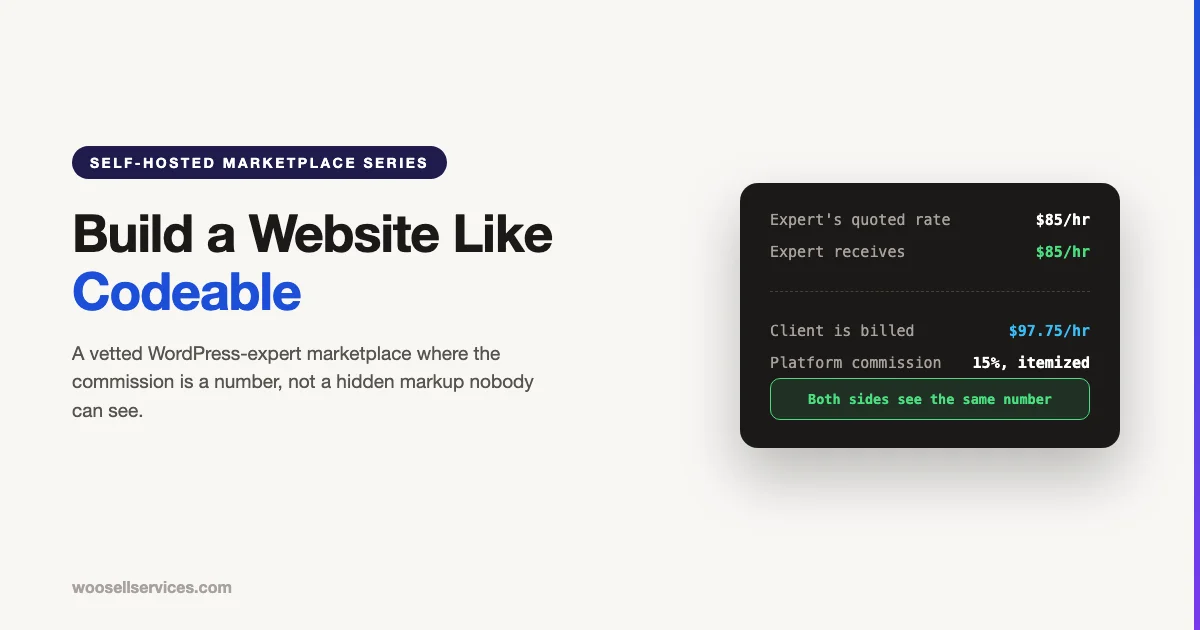
Toptal doesn’t charge its freelancers a fee. Read that sentence again, because it’s true and it’s also not the whole story. Toptal bills clients at a rate that includes a margin the freelancer never sees, reportedly averaging somewhere around 28 percent, baked into the client’s invoice rather than itemized as a platform fee. The freelancer quotes $85 an hour, receives $85 an hour, and has no visibility into what the client actually paid for that hour. Codeable, built specifically for WordPress work, runs a cleaner model: no freelancer fee, and it backs every project with a real money-back guarantee if an expert doesn’t deliver.
Both platforms share the thing that actually matters here, and it isn’t the fee structure: brutal, credible vetting. Toptal accepts roughly the top 3 percent of applicants who apply. Codeable puts every WordPress developer through screening built specifically to filter for people who can be trusted with a client’s production site. That vetting is the entire product. Nobody pays a premium for “a developer.” They pay for “a developer who’s already been checked so I don’t have to.”
This build is different from the rest of this series in one important way: the audience reading this post is disproportionately likely to be the exact kind of expert this marketplace would vet and list. If you’ve read this far into a WordPress plugin’s blog, you may be building this platform, or you may be the person who’d apply to join one. Keep both hats on.
What actually differentiates a vetted expert marketplace
Every other build in this series (Thumbtack, TaskRabbit, Rover, Care.com, Booksy, Urban Company) is built around volume: get enough vendors listed, get enough bookings flowing, let reviews do the trust work over time. A Codeable-style platform inverts that. Volume is not the goal. Exclusivity, credibly earned, is the goal.
The vetting bar is the brand. “Top 3 percent” only means something if the other 97 percent were genuinely evaluated and genuinely rejected, not waved through with a rubber stamp to hit a growth number. A marketplace that vets loosely and calls itself premium gets found out within a few bad projects, and word travels fast in a technical community that size.
Clients pay a premium price for a lower-risk hire, not for the cheapest hour. This changes your entire positioning. You’re not competing with Upwork on price. You’re competing with the client’s alternative of doing their own vetting, which costs them time, false starts, and the occasional disaster project. Price your commission and your positioning around risk reduction, not around being the budget option.
Pricing transparency, or the lack of it, is a real point of differentiation. Toptal’s model works, evidently, at scale. It also draws consistent complaints about opaque client pricing and unexpected trial-period invoices. A platform that shows both sides the same number, expert rate plus a clearly stated commission, competes directly against that specific frustration.
Revenue model: transparent commission, stated plainly to both sides
Two honest options, and I’d pick the first:
- Commission added on top, itemized. The expert sets $85/hour. The client sees “$85/hour + 15% platform fee = $97.75/hour” as a line item, not folded silently into a bigger number. Both sides know exactly what they’re paying and what the platform is earning for the vetting and dispute protection.
- Commission taken from the expert’s rate, stated as a percentage. The expert lists at their full desired take-home rate; the platform adds its cut on top for the client-facing price, same math, different framing. Codeable itself runs closer to this model with no visible fee to the freelancer.
What I wouldn’t build: Toptal’s structure, where the margin exists but is invisible to the person earning the underlying rate. It’s not fraudulent, it’s disclosed in Toptal’s terms, but it’s also precisely the pattern that generates the “wait, how much did the client actually pay?” freelancer forum threads. A transparent number, shown to both parties, is a stronger trust story for a new platform trying to win freelancer signups away from an established one, and it’s the position every build in this series has taken, applied here too.
The stack
- WordPress, self-hosted, $10 to $30 a month in hosting
- WP Sell Services as the marketplace engine
- A clean, credibility-forward theme, since this niche sells on trust signals more than visuals (theme comparison)
- Stripe or PayPal for payments
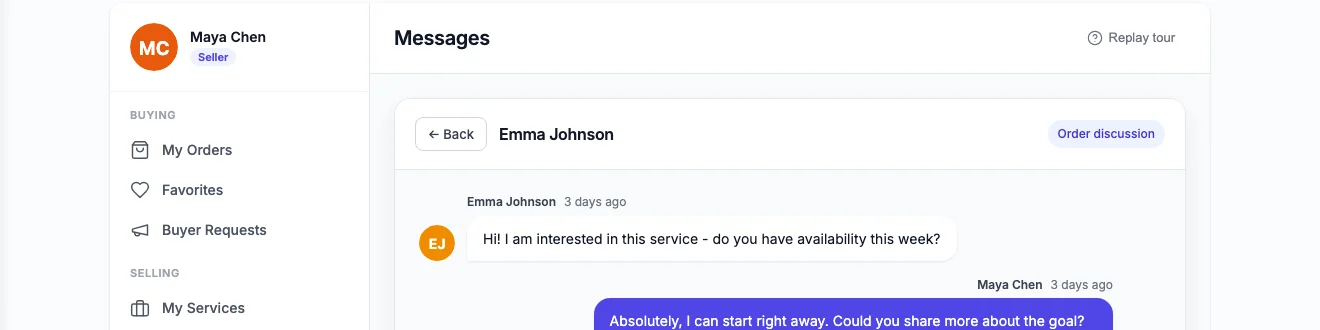
The free plugin’s structure fits a vetted-expert marketplace closely. Tiered packages become project-scope tiers (a small fix, a full build, an ongoing retainer), buyer requests become the “post your project, get proposals from vetted experts” flow, and built-in messaging keeps every scope discussion on record, which matters enormously the first time a project dispute needs a paper trail. Reviews and dispute resolution ship in the free version too; Pro adds Stripe Connect for automatic payment splits and per-expert commission rules, useful once you want to offer your most senior, longest-tenured experts better terms.
The vetting funnel: rigorous without being arbitrary
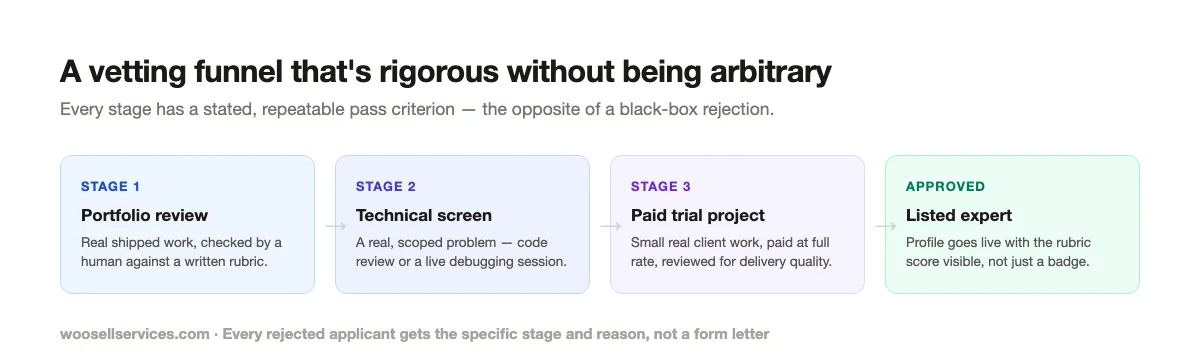
This is the actual product you’re building. Get it right and everything else, pricing, positioning, client trust, follows from it.
- Portfolio review against a written rubric. Not “looks good to me.” A stated checklist: production sites the applicant actually built (verifiable, not just claimed), code quality where inspectable, complexity of the work shown. Score it the same way for every applicant, and keep the rubric consistent over time so your bar doesn’t quietly drift.
- A real technical screen. A scoped debugging problem, a code review of a deliberately flawed snippet, or a live pairing session, evaluated by someone who can actually judge the answer. This is the stage that’s most tempting to skip at small scale and the one that most determines whether your “vetted” claim is real.
- A paid trial project. Small, real client work, paid at full rate, reviewed for delivery quality, communication, and whether the expert handled scope questions like a professional. This is expensive in your time to run, and it’s also the single best predictor of how someone performs on a real engagement, better than any interview.
- Approval, with the rubric score attached to the profile, not just a generic “vetted” badge. Showing the actual evaluation criteria, even in summary form, is a stronger trust signal than a badge alone, because it tells clients what “vetted” concretely means on your platform.
Reject clearly and specifically. “You didn’t pass at stage 2; here’s the general area to strengthen” is dramatically better for your reputation among the developer community than a form-letter rejection, and developer communities talk to each other constantly. A platform known for fair, transparent rejections attracts better applicants over time than one known for opaque ones, precisely the complaint pattern that dogs the biggest incumbent here.
Building the marketplace around real project work
Structure listings around project types, with packages inside each. “WordPress Plugin Development,” “Site Migration,” “Performance Audit,” “Security Hardening,” each as a service category, with Basic/Standard/Premium representing genuine scope differences: a plugin fix versus a plugin built from spec versus an ongoing plugin maintenance retainer. The package pricing guide applies directly, and add-ons handle the real-world variability: rush delivery, extended support windows, additional revision rounds.
Lean on buyer requests for anything too custom for a fixed package. A client with a specific, unusual project posts what they need; vetted experts respond with scoped proposals. This is the same reverse-marketplace pattern from the Thumbtack build, and it fits custom development work naturally, since so much of it genuinely can’t be priced as a catalog SKU.
Back every engagement with a real guarantee, and mean it. Codeable’s 28-day bug-fix warranty plus money-back guarantee is a genuine differentiator, not just marketing copy, because it shifts real risk from the client to the platform. At small scale, this is affordable precisely because your vetting is doing its job upstream; a well-vetted expert produces far fewer warranty claims than an unvetted one, which is the whole economic argument for investing in vetting in the first place rather than skipping straight to guarantees you can’t actually back.
Handle trial-period billing with total clarity, learning from where Toptal draws complaints. If you offer any kind of “no-risk” trial period or introductory engagement, write down exactly what triggers billing, what qualifies as unsatisfactory, and what the refund process actually is, before a client ever encounters it. Publish the policy where a client sees it before starting a trial, not buried in terms they never read. This single piece of upfront clarity heads off the most-cited class of complaint against the model you’re differentiating against.
Economics of a vetted expert marketplace
The math here looks different from every volume-based build in this series, because the average transaction size is much larger and the volume is much lower.
Twenty vetted experts, each averaging one $3,000 project a month (a realistic mid-size WordPress build or a month of retainer work), is $60,000 in monthly platform volume. At a 15 percent commission, that’s $9,000 a month, against a plugin license and hosting cost that’s a rounding error against that number.
The real cost center isn’t infrastructure, it’s the vetting labor. Running four vetting stages for every applicant, especially the paid trial project, costs real time and, for the trial stage, real money paid to applicants regardless of outcome. Budget for this explicitly as your primary early-stage cost, and treat a healthy rejection rate as evidence the system is working, not as wasted effort. A platform that approves nearly everyone who applies isn’t running a vetting funnel; it’s running a directory with extra steps.
Handling the client side: why someone pays a premium at all
Every build in this series so far has spent most of its energy on the supply side, the vendor or provider being recruited. This one needs equal attention on the demand side, because the entire pitch to a client is “pay more, worry less,” and that pitch only works if it’s substantiated at every step of the client’s experience, not just claimed on a landing page.
Show the vetting criteria before the client ever browses a profile. A short page explaining exactly what an expert went through to get listed, portfolio rubric, technical screen, paid trial, does more to justify your commission than any amount of marketing copy, because it answers the client’s actual question: why should I trust this platform’s judgment over my own googling?
Make the intake process itself feel vetted. A client posting a project through buyer requests should be prompted for the specifics an experienced developer would actually need (current hosting environment, existing codebase state, timeline constraints, budget range), not just a blank text box. This does double duty: it produces better-scoped proposals from experts, and it signals to the client that your platform understands the work well enough to ask the right questions upfront.
Publish real outcome data once you have it. Average project completion time, dispute rate, guarantee claim rate. These numbers, once they exist and look healthy, are more persuasive to a skeptical enterprise client than any amount of “top 3 percent” framing, because they’re falsifiable and specific rather than a marketing multiplier borrowed from a bigger platform.
Price transparency extends to the proposal stage, not just the final invoice. When an expert responds to a buyer request, the proposal should show the expert’s rate and the platform commission as separate line items, the same transparency principle from the revenue-model section, applied at the exact moment a client is deciding whether to hire. A client who sees the math upfront trusts the number more than one who discovers it buried in an invoice later.
What this costs, compared honestly
| Self-hosted (this build) | Toptal (as a client) | Codeable (as a client) | |
|---|---|---|---|
| Platform cost | Plugin license + $10 to $30/month hosting | None (margin baked into hourly rate) | None (commission structure not public) |
| Fee visibility to the freelancer | Fully itemized, both sides see it | Not disclosed to the freelancer | No fee charged to the freelancer |
| Vetting transparency | Published rubric, stated pass criteria | “Top 3%,” process not published | Described in general terms, not itemized |
| Guarantee backing every project | Yours to design and back | Trial-period only, has drawn billing complaints | 28-day bug-fix warranty + money-back guarantee |
| Code and data ownership | Yours | N/A, not a platform you run | N/A, not a platform you run |
The comparison against Toptal and Codeable looks different from every other incumbent comparison in this series, because you’re not primarily competing on price the way you would against Thumbtack’s lead fees or Rover’s booking commission. You’re competing on the same axis they compete on: trust, transparency, and how convincingly you can prove your vetting is real. A self-hosted build lets you make every one of those claims verifiably, because you control and can publish the actual process, rather than asking a client to take “top 3 percent” on faith.
What you genuinely cannot replicate on day one
Scale-driven trust. “Top 3 percent of 100,000 applicants” is a statistically bigger claim than “top 3 percent of 40 applicants,” even if the vetting rigor per-applicant is identical. Be honest about your numbers rather than borrowing the incumbent’s framing; “every expert on this platform passed a paid trial project, reviewed by a senior developer” is a true, specific, and credible claim at any scale, and it doesn’t need a large denominator to be persuasive.
Instant global coverage across every technical specialty. At launch, you’ll cover the specialties your founding vetted experts actually have. Say so plainly rather than implying broader coverage than you’ve verified; a client who’s misled into a project outside your platform’s real depth becomes your first bad review for a reason that was entirely avoidable.
A large enough trial-project budget to vet at high volume simultaneously. Vet in batches, priced into your runway, rather than trying to open floodgates immediately. A slower, deeper vetting cadence is a feature to advertise (“we’re deliberately growing our vetted expert pool slowly”) rather than a constraint to hide.
Launch: recruit experts who already resent the alternative
- Find developers who’ve been rejected by Toptal or similar platforms for reasons that felt arbitrary, and developers who passed but grew frustrated with fee opacity. Both groups exist in visible numbers in developer forums and communities, and both are receptive to a platform that vets transparently and prices transparently.
- Recruit your first ten experts personally, from people whose work you already know. This is the fastest way to seed a rubric-based vetting process with people who’d genuinely pass it, which matters because your first ten profiles are effectively your platform’s credibility statement to every client and every future applicant who looks at it.
- Publish your vetting rubric publicly, not just apply it privately. This is both a recruiting tool (serious applicants self-select in) and a client-trust tool (clients can see exactly what “vetted” means here, unlike the black-box version at bigger platforms).
- Run your own first few projects through the platform. Post a real project as a buyer, hire a real vetted expert, pay full price, leave a detailed, specific review. This seeds the review base and, just as importantly, proves your own buyer-request flow and guarantee process actually work before a paying client encounters a gap in either.
Common questions
How is this different from a general freelance marketplace like Upwork? Upwork is open to nearly anyone who signs up, with client-side filtering doing the vetting work after the fact through reviews and ratings. This build inverts that: vetting happens before a profile ever goes public, so a client browsing your platform is choosing among pre-screened experts rather than screening candidates themselves. That inversion is the entire value proposition and the entire reason a client would pay a premium over a completely open marketplace.
Do I need to charge a fee to freelancers at all, or can I run Toptal’s no-fee-to-freelancer model? You can run either transparent structure described above without hiding the margin the way Toptal’s model does. The freelancer-fee-free version (Codeable’s approach) is entirely workable and arguably an easier sell to your first cohort of experts, since “you keep exactly what you quote” is a clean, simple pitch that needs no further explanation.
What happens if a vetted expert’s quality slips after approval? Re-review periodically, not just at onboarding, the same principle as the account-fairness section in the Urban Company build: a documented quality flag, a real conversation, a path back to standard before removal, and a genuine appeal option. A platform that vets hard at entry and then never checks again drifts in quality exactly as fast as one that never vetted at all.
Should the guarantee cover disputes over creative or subjective work, not just bugs? Scope the guarantee to objective failures (the code doesn’t work as specified, a deadline was missed without communication) rather than subjective ones (the client simply didn’t like the design direction). Subjective disagreements belong in the standard dispute and revision process; an unlimited guarantee against “I didn’t like it” is a guarantee you can’t actually price or sustain.
Can this work for non-WordPress technical specialties, or is it WordPress-specific? The mechanics transfer directly to any specialty where clients value verified expertise over price: mobile development, DevOps, data engineering, design systems work. WordPress is a strong starting niche for this particular audience because the vetting criteria are well understood and the client base (site owners, agencies) already knows what “vetted WordPress developer” is worth paying for.
How many vetted experts do I need before this feels like a real marketplace rather than a handful of freelancers with a website? Fewer than you’d think, if the vetting is genuinely rigorous. Ten to fifteen experts who can each credibly cover a distinct specialty (performance, security, a specific page builder ecosystem, a specific hosting environment) reads as a real, focused marketplace to a client evaluating options. What breaks the illusion isn’t a small number, it’s overlap without depth: fifteen generalists who all claim to do everything reads thin, while ten specialists who each own a lane reads considered and deliberate.
Want to see how buyer requests, project packages, and the review system actually work before building your vetting funnel on top of them? Try WP Sell Services. The free version covers everything above except automated payment splits.