How to Build a Website Like Wyzant on WordPress


On one major tutoring platform, a tutor’s very first lesson with a brand-new student pays nothing to the tutor. All of it, the entire fee, goes to the platform. Only from the second lesson onward does the tutor start earning a share, and even then on a sliding scale that starts around 67 percent and only climbs toward the low 80s after accumulating dozens of hours with that platform. Wyzant runs a simpler, flatter structure, a consistent 25 percent taken off every lesson regardless of tenure, which is more predictable but never improves no matter how long a tutor stays or how many students they teach.
Both models share something worth noticing: a new tutor’s first real experience on the platform is either free labor or an unchanging tax, neither of which rewards the thing that actually matters in tutoring, a student who keeps coming back.
Tutoring is one of the purest repeat-business services in this entire series. A student learning algebra doesn’t need one session, they need one session a week for a semester. The platform that treats lesson one and lesson forty the same way, transparently, is the platform tutors will move their students to the moment they hear about it. This post builds that platform.
Why tutoring behaves differently from every other build in this series
The relationship, once formed, is the entire business. The Rover build established that repeat bookings compound; tutoring compounds harder and faster than pet care, because a weekly tutoring relationship over a school semester is 15 to 20 sessions with the same two people, often extending across school years if the tutor is good.
Trial lessons are a real, necessary step, not overhead to eliminate. A parent or student reasonably wants to meet a tutor before committing to a semester. The mistake incumbent platforms make isn’t offering a trial lesson, it’s making that trial lesson unpaid labor for the tutor rather than a discounted or platform-subsidized introduction.
Subject-matter credibility matters differently than trade-skill trust. A customer evaluating a plumber cares about reliability and fair pricing. A parent evaluating a calculus tutor cares about subject mastery, teaching ability, and whether their kid will actually engage, three things a star rating alone captures poorly. Your listing and review structure needs to work harder here than in most of this series.
The commission structure, side by side
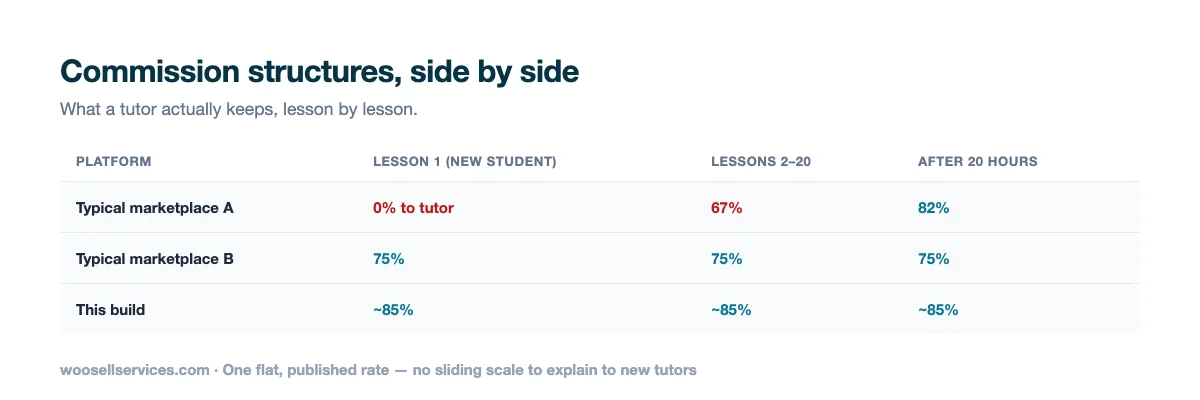
The unpaid-first-lesson model and the sliding-scale model both share a structural problem: they’re genuinely hard for a new tutor to evaluate honestly before joining, and hard to explain to a suspicious student weighing “why does the price per hour seem to shift.” A single, flat, published percentage, applied to every lesson from the first one onward, is both more tutor-friendly and dramatically simpler to market. “You keep 85 percent, every lesson, no exceptions” fits in one sentence and needs no footnote.
Applied to the trial-lesson question specifically: rather than making the first lesson free labor for the tutor, offer it at a modest platform-subsidized discount (say, the student pays 50 percent of the normal rate, the tutor is still paid their full percentage of that discounted amount) or let the tutor set their own trial-lesson policy entirely. Either respects the tutor’s time without pretending trial lessons don’t need to exist.
The stack
- WordPress, self-hosted, $10 to $30 a month in hosting
- WP Sell Services as the marketplace engine
- A clean, approachable theme that reads as trustworthy to parents evaluating a tutor for their kid (theme comparison)
- Stripe or PayPal for payments
The free plugin’s structure maps onto tutoring cleanly. Tiered packages become lesson bundles (a single trial session, a five-lesson pack, a full-semester block), buyer requests handle the “I need an AP Chemistry tutor available Tuesday evenings” case, and built-in messaging keeps scheduling and homework questions attached to the student relationship rather than scattered across text messages. Reviews and dispute handling ship free; Pro adds Stripe Connect for automated payment splits, useful the moment you have more than a handful of tutors and don’t want to run payroll by hand every week.
For the course and lesson layer, Learnomy is a free, standalone WordPress LMS worth a look: it connects Stripe or PayPal directly and takes 0% in platform fees on course or lesson sales, ships certificates, and includes importers from LearnDash, Tutor LMS, and LifterLMS if you’re migrating existing content.
Structuring lessons and packages
Sell blocks, not single hours, as the default. The same logic as Rover’s walk blocks: a five-lesson or ten-lesson package at a small per-lesson discount over singles gives both sides a reason to commit past the trial, and gives the tutor predictable near-term income instead of week-to-week uncertainty.
Structure the three-tier packages around commitment level, not just lesson count:
- Basic: single trial lesson, discounted rate
- Standard: a five-lesson package, standard rate, ideal for exam prep or a short-term skill gap
- Premium: a semester-length block (12 to 16 lessons), best per-lesson rate, positioned for an ongoing subject relationship

Let subject and level filtering do real work in the browse experience. “Algebra 2, high school level” and “Conversational Spanish, adult beginner” are different enough searches that your category and filter structure needs real depth here, more than a flat category list. Subject, level, and format (online, in-person, either) as three separate filters covers most of what a parent or student is actually trying to narrow down.
Homework help and exam-prep intensives deserve their own listing type, distinct from ongoing weekly tutoring, since the buyer intent and urgency are different: a student cramming for Friday’s exam needs a same-week booking, not a semester commitment. The buyer request flow fits this case directly: “need help with AP Bio before Thursday’s test, who’s available.”
Trust signals that actually matter for tutoring
Subject-specific ratings, not one blended score. A tutor who teaches both algebra and SAT prep should show ratings for each separately where volume allows, because a parent choosing a tutor for algebra doesn’t care how good that same tutor’s SAT-verbal reviews are.
Credentials, displayed plainly. Teaching certification, subject degree, standardized test scores if relevant to test-prep tutoring, years of experience. Require upload at registration and show a simple verified badge, the same pattern as the certification layer in the Care.com build, adapted from safety credentials to academic ones.
Background checks for any in-person or minor-facing tutoring, non-negotiable, the same reasoning that governs every build in this series touching children. Online-only adult tutoring carries a lower bar, but in-home or in-person tutoring involving minors should never launch without identity and background verification in place first.
A visible outcome, where honestly possible. Grade improvement, test score gains, a completed course, whatever’s measurable and truthful for that subject. This is harder to systematize than a simple star rating, and it’s also the single most persuasive piece of social proof in this entire vertical when a review can genuinely say “my son’s grade went from a C to a B this semester.”
Handling cancellations and no-shows in a scheduling-heavy niche
Tutoring runs on recurring weekly appointments more tightly than almost any other build in this series, which means schedule friction, a sick kid, a forgotten lesson, a last-minute conflict, shows up constantly. Handle it badly and both tutors and families churn quietly.
Publish a cancellation window before the first booking, not after the first dispute: free rescheduling with, say, 24 hours notice, a partial charge inside that window, full charge for a no-show where the tutor showed up and waited. Apply the same standard symmetrically if a tutor cancels or no-shows, which is the detail incumbent platforms often get one-sided in ways that erode student trust.
Build a simple reschedule flow directly into the messaging and order system rather than making a family cancel and rebook from scratch. A parent juggling a school schedule, a sports practice, and a tutoring slot needs to move Tuesday’s lesson to Wednesday in two taps, not a support ticket.
For semester-length packages specifically, build in a small number of built-in flex sessions, say two “skip weeks” per twelve-lesson block, for school holidays and predictable disruptions, so families aren’t renegotiating the schedule every time the calendar has a break in it. This single feature, cheap to build, is disproportionately appreciated by parents managing a school-year calendar around a standing weekly commitment.
What this costs, compared honestly
| Self-hosted (this build) | Wyzant (as a tutor) | Sliding-scale platform (typical) | |
|---|---|---|---|
| Platform cost | Plugin license + $10 to $30/month hosting | None, funded by commission | None, funded by commission |
| First lesson with a new student | Tutor paid their full rate share | Tutor paid, minus flat 25% | Often $0 to the tutor |
| Ongoing commission | ~15%, flat and published | Flat 25%, never improves | 18% to 33%, improves with volume |
| Commission transparency | One number, no tiers to track | One number, simple | Multi-tier, harder to predict monthly income |
| Cancellation policy symmetry | Yours to design, applied both ways | Platform-set | Platform-set |
The Wyzant comparison is the cleaner one to lead with in recruiting conversations, since its flat structure is easy to explain and easy to beat with a lower flat number. The sliding-scale comparison takes one extra sentence, “your first ten students effectively cost you money before this platform starts paying you fairly,” but it’s the more emotionally resonant one for a tutor who’s actually lived through that ramp.
Three mistakes specific to tutoring marketplaces
Treating a tutoring session like a generic hourly task. The TaskRabbit build works because tasks are interchangeable; tutoring relationships are the opposite. A platform that routes a family to “whichever algebra tutor is available” instead of letting them build a relationship with one specific tutor over a semester is optimizing for the wrong thing entirely.
Under-investing in the subject and level taxonomy. A flat list of “Math,” “Science,” “English” undersells how specific tutoring search intent actually is. A parent isn’t looking for “a math tutor,” they’re looking for “an AP Calculus BC tutor available Tuesday evenings who’s worked with kids prepping for the exam.” Cheap to fix at the taxonomy level, expensive to retrofit once a thin category structure is already live.
Letting the trial-lesson economics quietly become the incumbent’s model by default. It’s tempting, when margins are tight early on, to shave the trial lesson toward free or heavily discounted for the tutor “just at launch, temporarily.” This is exactly the drift that produces the fee structure this whole post is positioned against. Decide the trial-lesson economics deliberately, publish them, and hold the line once real tutors are relying on the number you quoted them.
Economics of a tutoring marketplace
Take a tutor averaging 15 lessons a week at $50 an hour, roughly $3,000 a month in lesson volume. At a flat 15 percent commission, that’s $450 a month in platform revenue from one active tutor, with the tutor keeping $2,550, meaningfully more than the roughly $2,250 they’d net on Wyzant’s flat 25 percent structure at the same volume, and dramatically more than the unpaid-first-lesson model costs a tutor building a fresh student roster from scratch.
Twenty active tutors at similar volume is $9,000-plus in monthly commission, against infrastructure costs that don’t meaningfully move that number. The retention math matters even more here than the acquisition math: a tutoring relationship that survives past the trial lesson tends to run a full semester or longer, which means your acquisition cost, recruiting the tutor and the first student, gets amortized across many more billable hours than almost any other vertical in this series.
What you genuinely cannot replicate on day one
A large enough tutor pool to guarantee same-day availability across every subject and level. Be specific about coverage rather than implying breadth you don’t have; a parent who searches “AP Physics C tutor” and finds nobody available is a worse experience than a platform that’s honest about which subjects it covers well at launch.
Institutional partnerships and school-district relationships that larger platforms sometimes build over years. These are genuinely valuable and genuinely slow to earn; don’t fake them, and don’t need them to serve individual families well from day one.
A large, statistically robust base of measurable outcome data. Your first cohort of grade-improvement and test-score stories will be small and anecdotal. Publish them as exactly that, honestly, rather than dressing up a handful of results as a broad statistical claim you can’t yet support.
Launch: recruit tutors around the fee-transparency story
- Find tutors currently on Wyzant or Preply and calculate their actual take-home under your flat rate. For most active tutors, this is a straightforward, favorable number, especially against the unpaid-first-lesson model, and it’s the single most persuasive recruiting document you can hand someone in this niche.
- Start with two or three subject areas you can genuinely vet and staff well, rather than claiming every subject from kindergarten math to graduate statistics on day one. Depth in a few subjects builds more trust than breadth across dozens with only one tutor each.
- Recruit through the channels tutors already use to find students independently: local parent Facebook groups, school PTA newsletters, college tutoring-center bulletin boards. Many independent tutors already have a client base; your pitch is payment protection, scheduling tools, and a public profile, not cold-start student acquisition.
- Seed real completed lessons before public launch. Book a few real tutoring sessions through your own platform for family or friends who genuinely need them, pay full price, leave detailed reviews. This validates your booking, messaging, and payment flow end to end before a paying family encounters a rough edge.
Launch checklist
- Flat commission rate decided and published, including your trial-lesson policy
- Subject, level, and format filters built out with real depth, not a flat category list
- Lesson packages configured: trial, five-lesson, semester block
- Cancellation and no-show policy published, applied symmetrically to tutors and families
- Background checks required for any in-person or minor-facing tutoring
- Subject-specific review display working for tutors who teach multiple subjects
- Buyer requests tested for the “need help before Friday’s exam” urgent case
- Two or three founding tutors recruited with a direct fee-comparison pitch
- First real lessons booked and reviewed before public launch
Common questions
How is this different from the Care.com build? Care.com-style platforms center on safety and trust for in-home caregiving; tutoring shares some of that (especially for in-person, minor-facing lessons) but adds subject-matter credibility and measurable academic outcomes as the primary trust signal, alongside safety rather than instead of it. The Care.com build covers the safety-first trust architecture that still applies here for in-person work with minors.
Is this also a good fit for test-prep companies or tutoring centers that already have staff, not just independent tutors? Yes, and it’s often an easier launch than the independent-tutor cold start. An existing tutoring center already has vetted staff, a client base, and a working curriculum; the platform becomes a scheduling, payment, and review layer for a business that already exists, the same pattern the Booksy build describes for salons migrating their own book online first before opening to independent stylists. A center with a dozen staff tutors and an established parent mailing list can be moved onto the platform in a week, generating meaningful booking volume from day one rather than waiting months for independent tutor recruitment to build critical mass.
Should trial lessons be free, discounted, or full price? Full price if your tutors and students are comfortable with that; discounted (with the tutor still earning their normal percentage of the discounted rate) if you want to lower the barrier to a first booking without asking tutors to work for free. What to avoid is the incumbent pattern of a fully unpaid first lesson, which puts the entire cost of customer acquisition onto the tutor rather than sharing it between tutor and platform.
Can tutors teach both online and in-person on the same platform? Yes, and most successful builds in this niche support both from day one, with format as a filter rather than a separate platform. Just make sure your background-check and safety requirements apply consistently to in-person listings regardless of subject.
How do I handle recurring weekly bookings without building complex subscription billing? Lesson-count packages, the same pattern used across this series: a family buys a 12-lesson semester block upfront or in installments, and the tutor and family settle the weekly time slot directly. This absorbs the natural flexibility of school schedules (holidays, exam weeks, occasional cancellations) far better than rigid recurring billing would.
What about group tutoring or small classes? Model it as a distinct package tier, priced per student or as a flat group rate with a stated maximum class size, since the economics and format differ enough from one-on-one tutoring to deserve its own listing rather than being squeezed into the standard individual-lesson structure.
Do I need video conferencing built into the platform for online lessons? No, and I’d avoid building that yourself at launch. Let tutors and families use whatever video tool they’re already comfortable with (Zoom, Google Meet), linked through the messaging system for each scheduled lesson. Building and maintaining reliable video infrastructure is a specialized, ongoing engineering cost that doesn’t differentiate your marketplace; the booking, payment, and trust layer is where your effort belongs.
How do I keep tutors from taking students off-platform after the trial lesson? The same answer as every build in this series: compete on value, not policing. Payment protection, the review history a tutor builds by staying, package pricing that makes booking through the platform genuinely convenient, and a fair, published commission a tutor doesn’t feel the need to route around. A tutor who trusts the fee structure has little reason to move a paying, engaged family off-platform for the sake of a percentage they already consider fair.
Should parents or students leave the review, when both are involved in the decision? Let the account holder who booked leave the primary review, typically the parent for a minor student, but prompt for a field specifically about the student’s experience and engagement, not just the adult’s logistics-and-communication satisfaction. A tutor can score perfectly on responsiveness and billing clarity while genuinely missing the mark on whether the actual student is learning, and a review system that only captures the parent’s administrative experience misses the signal that matters most to the next family evaluating that profile.
Want to see how lesson packages, buyer requests, and the review system work before building your tutoring catalog on top of them? Try WP Sell Services. The free version covers everything above except automated payment splits.