How to Build a Website Like Rover on WordPress

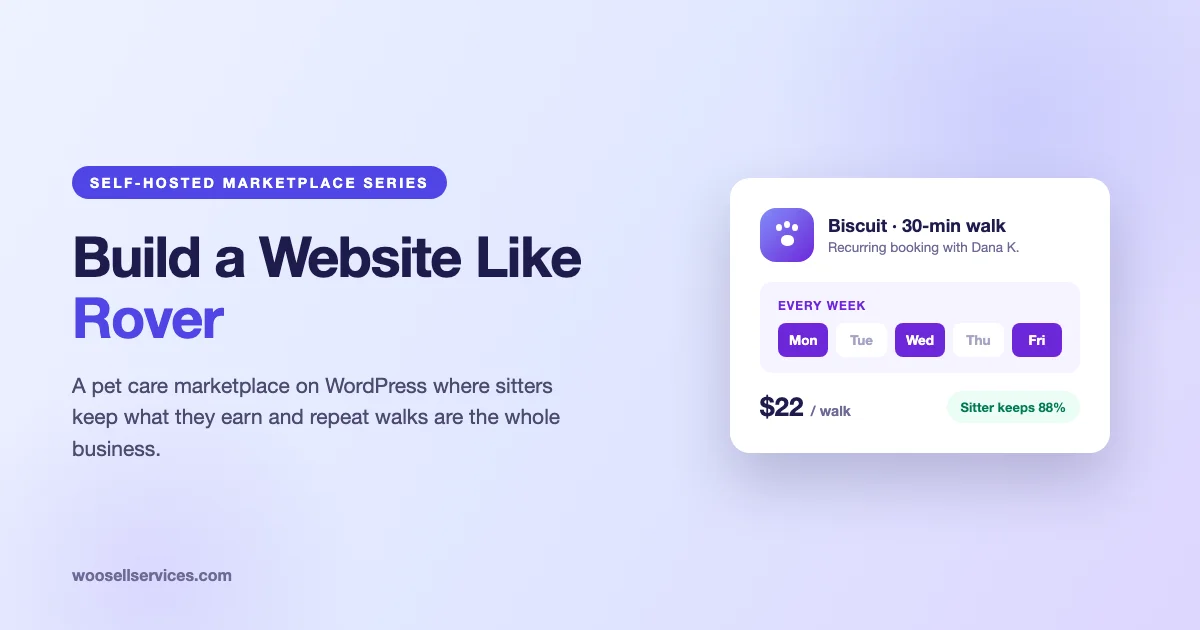
A dog walker on Rover hands over roughly 20 percent of every booking. The owner pays a service fee on top of that. So a $22 walk becomes $24-something for the owner while the walker pockets about $17.60, and the platform collects from both directions on a transaction it did nothing for beyond the introduction, which happened two years ago.
That last detail is the strange part. Rover’s fee applies forever: the same regular client, the same Monday-Wednesday-Friday walk, the same walker, year after year, with the platform skimming every repeat. Pet care is the most repeat-heavy service niche there is, and the incumbent’s pricing treats booking number two hundred exactly like booking number one.
Sitters notice. Owners notice. Most of them just don’t have anywhere else to go, because “book the neighbor kid by text” loses the payment protection, the reviews, and the backup plan when someone gets sick.
Building that somewhere-else is very doable on WordPress, and pet care might honestly be the best-fit vertical in this whole series. This post covers why, and then the full build: service structure, the trust machinery this niche demands, recurring-booking economics, and a launch plan that starts at your local dog park rather than an ad platform.
Why pet care is a near-perfect marketplace niche
Three structural reasons, before any plugin talk.
Demand repeats on a schedule. A Thumbtack customer needs a plumber once a year. A dog owner with a commute needs a walker three times a week, every week, and boarding every time they travel. Marketplace economics transform when the average customer generates dozens of bookings annually; your acquisition cost amortizes across all of them.
Passion runs the supply side. People genuinely want this work in a way nobody wants to assemble furniture. Your sitter recruitment pool includes students, retirees, remote workers, and that person at the dog park who knows every animal’s name. Supply is easier to find here than in any trade vertical.
Trust is the product, and small platforms can out-trust big ones. Every booking means a stranger with your pet, often inside your home. Rover handles this with scale: background checks and a support line. A local platform handles it with something scale can’t buy: the operator personally knows the sitters. That’s not a weakness to apologize for; it’s the whole pitch.
The catch, and it’s real: the trust bar cuts both ways. One badly handled incident with someone’s animal can end a small platform. The build below takes that seriously.
Revenue model: commission, and respect the repeats
Commission on completed bookings is the right model here, same conclusion as the Thumbtack build and the TaskRabbit build, with one niche-specific adjustment worth considering: a rate that respects repeat bookings.
Rover charges its full percentage on every booking forever. You can position directly against that with a structure like 15 percent on a customer’s first booking with a sitter and 10 percent on repeats, or a flat 12 percent that undercuts the incumbent’s combined take from both sides. Sitters do this arithmetic constantly; being visibly better on repeats is how you pull the established walkers who bring their client lists with them.
And a sitter who brings clients is the best acquisition channel you have. More on that in the launch section.
The stack
- WordPress, self-hosted ($10 to $30 a month for hosting)
- WP Sell Services as the marketplace engine
- A warm, photo-forward theme, because this niche sells on pet pictures (theme comparison)
- Stripe or PayPal for payments
The free plugin gives you the loop: sitter registration and dashboards, service listings with tiered packages and add-ons, image galleries on every listing (load them with happy client dogs), orders, buyer requests for the “who can board my reactive husky over Christmas” cases, on-platform messaging, verified reviews, and dispute handling. Checkout is standalone; WooCommerce is optional.
Pro earns its keep here through payment volume, same as any high-frequency vertical: Stripe Connect splits every booking automatically, PayPal Payouts batches sitter withdrawals, and per-vendor commission rules let you give founding sitters or high-volume walkers better terms permanently. The Stripe Connect guide covers setup.
Structuring pet care services so they sell
Six services, six listing types
Pet care has a settled service taxonomy, and you should adopt it rather than invent one, because owners already think in these terms:
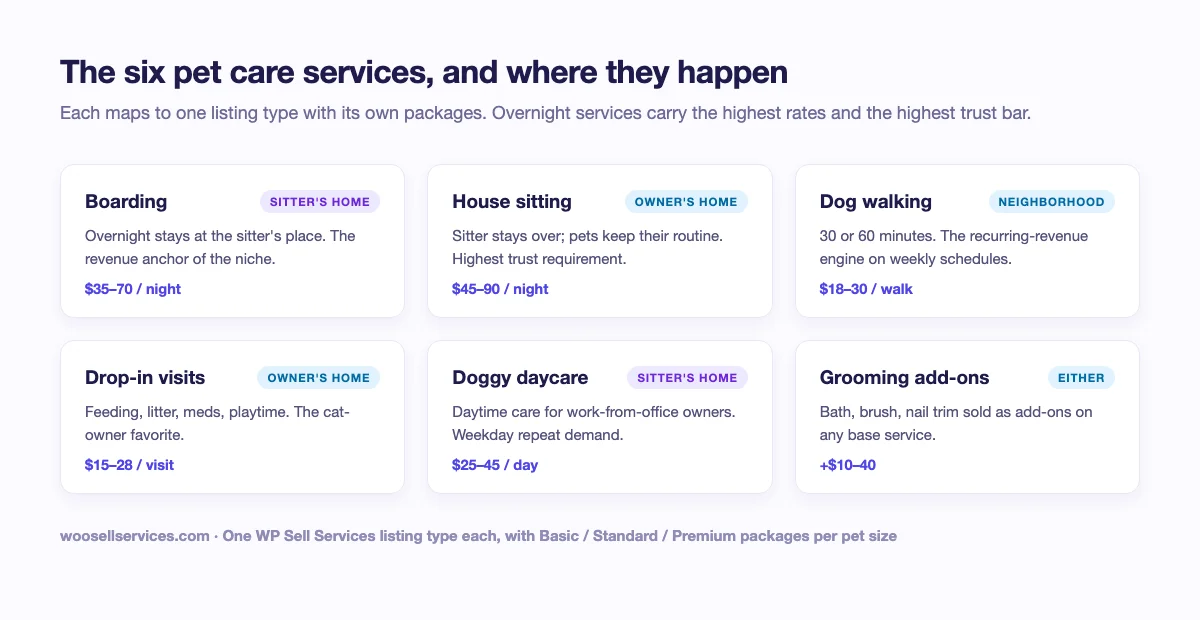
Boarding and house sitting are your revenue anchors: overnight rates, multi-night bookings, holiday surges. Walking and drop-ins are your frequency engine: smaller tickets, weekly schedules, the recurring relationships that make the spreadsheet work. Daycare sits in between. Grooming works better as an add-on menu than a standalone category at launch.
Each becomes a listing type a sitter can offer, with their own pricing.
Packages by pet, not just by time
The three-tier package structure maps to how pet pricing actually works:
- Walking: 30-minute walk / 60-minute walk / 60 minutes with two dogs from the same home
- Boarding: one small dog per night / large dog per night / two pets from the same family
- Drop-ins: one visit per day / two visits per day / twice daily with medication
Then the add-on menu does the heavy lifting: additional pet, puppy surcharge, medication administration, holiday dates, photo updates after every visit. That last one costs a sitter ninety seconds and is the single most loved feature in this niche; make it a default suggestion. The package pricing walkthrough covers the setup mechanics.
The meet and greet is a booking type, not a phone call
Every experienced sitter insists on meeting the pet before a first boarding or house-sit, and they’re right to. Formalize it: a free or five-dollar “Meet & Greet” listing, thirty minutes, booked and tracked like any order.
Putting it on-platform does three jobs at once. It keeps the pre-booking conversation in your messaging system where the dispute process can see it. It gives both sides a graceful exit before money changes hands on the real booking. And it starts the relationship on your rails instead of over text messages you’ll never see again.
Recurring schedules without recurring-billing infrastructure
The Monday-Wednesday-Friday walk client is the business, so model it from day one, and you don’t need subscription billing to do it. Sell blocks as packages: “12 walks, used within a month” at a small per-walk discount over singles. Owner books once, the sitter and owner settle the weekly rhythm in chat, and the block renews with one tap when it runs out.
Blocks beat true auto-billing at launch for a quiet reason: pet schedules flex. Owners travel, dogs see vets, holidays scramble weeks. A 12-walk block absorbs all of that without a single proration email, which is exactly the kind of support ticket you don’t want to invent for yourself.
The trust machinery, because this niche runs on it
Treat this section as load-bearing. It’s the part owners actually evaluate.
Screening, visibly. Identity verification on every sitter through a screening API (a few dollars per head), criminal check for anyone offering in-home services, and a personal conversation with the operator before approval. Then say so on every profile: “Verified by us. We’ve met every sitter on this platform.” Rover cannot truthfully say that sentence, and it’s worth more than any feature.
Verified reviews with photos. Purchase-verified reviews only, sitter responses enabled, pet photos encouraged. Ten detailed reviews with pictures of relaxed dogs beats a hundred bare star ratings. The review system guide has the configuration details.
An incident protocol written before you need it. What happens when a dog gets injured on a walk, escapes a yard, or bites the sitter. Who calls whom, who pays the vet, what the platform covers versus what falls to the sitter’s insurance. Write it while calm, publish the customer-facing half, and require sitters offering boarding or house-sitting to carry their own liability coverage; several pet-sitter associations bundle affordable policies, and the proof-of-insurance badge does double duty as marketing. Our legal-protection guide covers the contractual layer.
Emergency information as a workflow. Vet name and number, medication list, feeding quirks, gate codes. Collect it at booking through the order form so it’s attached to every job, not buried in a chat thread from three weeks ago. A sitter standing in a kitchen with a wheezing cat should be one tap from the vet’s number.
Plan for the holiday surge before your first December
Pet boarding demand is violently seasonal, and the platforms that handle it well turn the surge into their best quarter instead of their worst support week.
Thanksgiving, the winter holidays, and summer vacation weeks routinely triple boarding demand while supply shrinks, because sitters travel too. Three preparations matter, and all of them happen months ahead.
Let sitters price holiday dates up. A holiday-dates add-on, or simply higher-priced holiday packages, keeps your best sitters working through the season instead of blocking it off. Owners grumble and pay; a $10 nightly holiday premium beats a “no availability” wall by every measure, including the owner’s own stress. Publish the norm so nobody feels gouged: holiday premiums are standard across this industry, and saying so plainly reads as honesty.
Recruit a seasonal bench in October. Students home for winter break and remote workers who don’t travel are natural holiday-only sitters. A small autumn recruiting push, framed exactly that way (“earn over the holidays, no year-round commitment”), fills the gap the regulars leave.
Turn scarcity into structure, not chaos. When December boarding fills, the failure mode is owners messaging every sitter individually and getting angrier with each decline. The buyer request flow absorbs this: one posted request, visible to every available sitter, with the owner booking the first workable reply. Point demand there during peak weeks with a homepage banner and you’ve converted your worst UX moment into your platform working as designed.
Handled this way, one good December funds your spring. Unhandled, it burns sitter goodwill and owner trust simultaneously, at the exact moment volume is highest.
The economics of repeat bookings
Run the numbers, because they behave differently from every other vertical in this series.
Take a modest walking client: three walks a week at $22, roughly $285 a month, $3,400 a year. At 12 percent commission that’s about $410 a year from one recurring relationship. Twenty-five such clients is $10,000 a year of commission on walking alone, before any boarding, and boarding is where tickets triple during every school holiday.
Now the acquisition math. Suppose a local ad or a month of dog-park conversations lands you one walking client: that $410 recurs next year, and the year after, for a one-time acquisition effort. Compare the TaskRabbit-style economics where each customer must be re-earned per task, and you see why pet platforms obsess over retention instead of reach.
Which reframes what your commission buys. It isn’t matchmaking, which happens once. It’s the ongoing layer: payment protection, the review history, the incident process, and, if you build one thing beyond the basics, the backup-sitter network for when a regular walker gets the flu. Sitters who feel that value stay on-platform; sitters who don’t will drift to cash, and in a repeat-heavy niche, leakage is the number that decides everything. Make staying the obviously better deal.
What you won’t replicate on day one
Honesty section, same as every guide in this series, because the gaps are real even when they’re survivable.
Rover’s protection plan. The incumbent advertises up to a million dollars in vet-care coverage per booking, backed by an insurer relationship a new platform can’t get. Your equivalent at launch is layered instead of monolithic: sitter-carried liability policies, your written incident protocol, and an operator who answers the phone. For a local platform, that stack genuinely covers the realistic scenarios; what it doesn’t cover is the marketing value of the big number, and you should compete on “we’ve met every sitter” rather than on coverage figures you can’t back.
The 24/7 support line. At launch, support is you, and the honest version of that is a stated window (“we answer within two hours, 7 a.m. to 10 p.m.”) plus a true emergency contact for active bookings. Small platforms routinely beat giant ones on support quality here, because “the founder called me back in ten minutes” is a story owners retell for years. You just can’t promise it around the clock, so don’t.
Search-result gravity. Rover owns the generic national keywords and will keep them. You’re not contesting “dog boarding” nationally; you’re winning “dog boarding [your neighborhood]” and the referral channels that never touch a search engine. That’s not a consolation prize; in a hyperlocal service, it’s most of the market.
What this costs
| Self-hosted (this build) | Rover (as a sitter) | SaaS marketplace builder | |
|---|---|---|---|
| Platform cost | Plugin license + $10 to $30/month hosting | 20% of every booking, forever | $39 to $299/month, forever |
| Who owns the client list | You | Rover | The vendor, in practice |
| Payment splits | Stripe Connect (Pro) | Handled | Higher tiers |
| Custom trust features | Yours to build | None | Limited |
The comparison to Rover itself belongs in this table because your first sitters will make it: an established walker doing $2,000 a month hands Rover roughly $400 of it. Your whole platform’s monthly cost is less than that one sitter’s monthly fee burden, which is the arithmetic that recruits them.
Launch: start at the dog park, not the ad platform
Recruit ten to fifteen sitters you’d trust with your own pet. Dog parks, veterinary clinic notice boards, groomers, local pet-owner Facebook groups, and existing independent walkers who already juggle clients by text. That last group is gold: they arrive with client lists, and your pitch is payment protection plus reviews plus lower fees than Rover for a business they already run.
Convert one existing walker’s client list as your seed market. A walker with eight text-message clients who moves them onto your platform gives you eight reviewing, repeating customers in week one. Give that walker founder terms without being asked.
Own the local search results the incumbent can’t. “Dog boarding [neighborhood]” and “cat sitter [suburb]” pages, written by someone who can name the actual parks and the actual vet clinics. National platforms generate these pages programmatically; local specificity beats them more often than the SEO industry admits.
Partner where pet owners already stand. Groomers, trainers, pet shops, and vets all get asked “know a good sitter?” weekly. A referral card at four local counters outperforms a month of paid social in this niche.
Seed the review base honestly. Book your founding sitters for real jobs with real pets belonging to you and your friends, pay full price, review with photos. Ten reviewed profiles is a marketplace; a grid of empty ones is a warning sign.
Then let the community flywheel spin. Pet owners talk to each other constantly: at parks, in breed-specific Facebook groups, in vet waiting rooms. Once your platform has a few dozen genuine local stories in circulation, referral becomes the main channel and stays there. Help it along with the cheap moves: a “refer a neighbor, both get $10 off” credit, sitters handing a card to every new client’s neighbor who asks, and a monthly photo roundup post in the local groups featuring the platform’s cutest boarding guests, with owner permission. None of this scales nationally, which is precisely why the national incumbent can’t do it.
Three mistakes specific to pet platforms
Skipping meet-and-greet enforcement to reduce friction. It feels like conversion optimization; it’s actually how you get your first bad boarding incident with a dog and sitter who’d never met. Keep the friction for first-time overnight bookings. Owners respect it, sitters demand it, and the incident it prevents would cost more trust than a hundred smoother checkouts earn.
Under-weighting cats and small pets. Dog walking is the visible market, so new platforms build dog-first and treat everything else as a checkbox. The drop-in visit segment (cats, rabbits, birds, fish, the occasional bearded dragon) is lower-drama, higher-loyalty, and largely ignored by incumbent marketing. A genuinely welcoming small-pet experience is cheap differentiation.
Confusing sitters with gig labor. The TaskRabbit playbook of interchangeable supply fails here, because owners book a person, not a service. Everything in your product should reinforce the specific sitter relationship: rebook-with-Dana buttons, sitter profiles with personality, backup arrangements that ask the owner first. Platforms that route around the sitter relationship to “optimize liquidity” discover that both sides leave together, and they leave as a pair holding each other’s phone numbers.
Common questions
How is this different from the other builds in this series? Structurally: recurring bookings dominate (weekly walks versus one-off tasks), the trust bar is higher (living animals, home access), and supply recruitment is easier (people love this work). The plugin engine is the same; the configuration and the launch strategy shift. The Thumbtack and TaskRabbit guides cover quote-driven and task-driven variants.
Do sitters set their own rates? Yes, per listing and per package. You set the commission. That division also supports independent-contractor classification, which you want.
Can owners book recurring walks automatically? Through walk blocks (multi-walk packages) from day one, which handle the real-world flexibility of pet schedules better than rigid auto-billing anyway. True subscription billing is a year-two feature if your walkers ask for it.
What about pet profiles: vaccination records, temperament notes? Collect the essentials (vet contact, meds, behavior flags) through booking forms so they attach to each order. A full pet-profile system is a lovely later feature; a required “tell the sitter about your pet” field at checkout gets you 90 percent of the value on launch day.
Cats too, or dogs only? Both, and don’t skip cats. Drop-in visits for cats are quietly excellent business: no walking logistics, high trust, extremely loyal owners, and the incumbent platforms treat them as an afterthought. A “cat people welcome” positioning is a real wedge in most cities.
Can I run this alongside a grooming salon or pet store I already own? It’s one of the strongest launch positions available. You already hold the trust, the foot traffic, and a client list of verified pet owners; the marketplace becomes an extension of a brand that exists rather than a cold start. Several of the healthiest local pet platforms began exactly this way, with the shop’s own staff as the founding sitters.
What insurance does the platform itself need? General liability for the business entity at minimum, and a conversation with a local insurance broker about whether your state expects more from a platform operator. Sitter-side coverage plus your incident protocol handles the per-booking risk; the entity-level policy is about the platform. Cheap relative to what it protects.
Want to click through the sitter dashboard, packages, and booking flow before building? Try WP Sell Services. Everything above except automated payment splits ships in the free version.