A WordPress Fiverr Alternative: What 20% Really Costs


Open a calculator. Not a spreadsheet template somebody built to sell you a course, just the calculator app already on your phone. Type in what you billed on Fiverr last year. Multiply by 0.20. Look at the number. That number is why a WordPress Fiverr alternative is worth ten minutes of your attention.
Most freelancers never do this. They see the commission line on each individual order, shrug, and move on, because $12 off a $60 gig doesn’t feel like much in the moment. It’s the annual total that changes the conversation, and almost nobody runs it until they’ve been on the platform long enough for the number to actually hurt. It’s also usually the moment someone starts quietly looking for a Fiverr alternative on WordPress instead of another marketplace with the same math.
The Fee Isn’t Just 20%, and It Isn’t Just One Fee
Fiverr’s headline number is a flat 20% service fee taken from every order, no matter how long you’ve sold on the platform or how much volume you do. There’s no tier where it drops to 15% or 10% once you’ve proven yourself. A seller who’s delivered 2,000 orders pays the exact same rate as someone who joined last week.
That alone puts a full-time freelancer in a strange position. Take someone billing $80,000 a year through the platform, a realistic number for a mid-level designer or developer with steady repeat clients. Twenty percent of that is $16,000 gone before it ever reaches a bank account. Not $16,000 in expenses that bought something. Gone, permanently, to a payment processor for the platform that connected the first client. Sixteen thousand dollars is a decent used car. It’s four months of rent in a lot of American cities. It’s the entire marketing budget most solo freelancers never think they can afford, because the money that would fund it left before they saw it.
And that 20% is the floor, not the whole story. Buyers pay their own service fee on top of the price they see, which pushes total order cost up and makes freelancers price defensively to stay competitive against sellers who haven’t done the math yet. Withdrawal methods carry their own fees depending on how you pull money out. Currency conversion, if you’re not in the platform’s default currency, takes another bite. None of these show up in the big “20%” number people quote, but they all subtract from the same paycheck.
Running the Actual Numbers
Here’s what the arithmetic looks like at a few different income levels, using just the base 20% commission and nothing else:
- $20,000/year billed on Fiverr → $4,000 lost to commission
- $50,000/year billed → $10,000 lost
- $80,000/year billed → $16,000 lost
- $120,000/year billed → $24,000 lost
These aren’t edge cases. They’re round numbers picked to be easy to verify, and every freelancer reading this can plug in their own annual total and get an uncomfortable answer in about four seconds.
Compare that to what a payment processor charges for actually moving money. Stripe’s standard rate sits around 2.9% plus a small fixed fee per transaction. PayPal is similar. On that same $80,000, processing fees alone run somewhere in the $2,300 to $2,800 range depending on transaction size and volume discounts. The difference between a 20% marketplace commission and a roughly 3% payment processing fee, on $80,000 of annual billing, is over $13,000. That gap is the entire argument for owning the transaction instead of renting it from a platform.
Why the Fee Also Shapes Your Prices, Not Just Your Payout
There’s a second cost that never shows up on a payout statement: the commission changes how freelancers price their own work, and usually not in their favor. A designer who wants to actually take home $80 per logo has to charge $100 to clear Fiverr’s cut. But buyers browsing a crowded category don’t compare take-home pay, they compare the sticker price against every other seller’s sticker price. So sellers quietly shave their listed price to stay competitive, which means the commission doesn’t just take a slice of what you’d have charged anyway. It pushes the whole category’s pricing down, because everyone’s doing the same math and landing on the same defensive number. Run that forward for a year and the effect compounds. A freelancer might genuinely believe their rate is “$60 a gig” when the honest number, the one that reflects what buyers would pay a known, trusted seller off-platform, is closer to $75. The gap between those two numbers is a second, quieter cost sitting on top of the visible 20%.
Off a marketplace, that pressure mostly disappears. A returning client who already trusts you isn’t shopping five other sellers in a side-by-side grid. They’re paying what you ask, because the decision to hire you again was already made before they opened your pricing page.
What the 20% Is Actually Paying For
To be fair to Fiverr, that commission isn’t pure profit skimmed off the top for nothing. It buys discovery, meaning buyers who’ve never heard of you find your gig through search and category browsing. It buys dispute mediation when a client goes sideways. It buys payment infrastructure so you don’t have to think about PCI compliance or chargebacks yourself. It buys a review system that, love it or hate it, gives cold buyers a reason to trust a stranger with their project. Those are real services. Building them from scratch is real work, and a lot of freelancers correctly conclude that paying for discovery is worth it, especially early on when nobody knows their name yet.
The problem is that the fee doesn’t shrink as those services matter less to you. A freelancer with three years of repeat clients, a full inbox from referrals, and zero need for Fiverr’s discovery algorithm still pays exactly the same 20% as someone who joined last month and needs every bit of that exposure. The platform doesn’t distinguish between a seller who needs it to find work and a seller who’s just using it as a payment processor with a nicer waiting room.
That’s the moment worth paying attention to. Once your client relationships exist independently of the marketplace, the marketplace is charging you full price for services you’re barely using.
The Fiverr Alternative on WordPress: Take Payment Directly
The freelancers who leave successfully don’t usually leave cold. They build a second channel first, one where a client who already trusts them can pay directly, without a platform sitting between the invoice and the bank account. WP Sell Services exists for exactly that transition: a self-hosted WordPress plugin that lets you list services with tiered pricing, take payment through built-in Stripe and PayPal checkout, and run the whole client relationship, requirements, delivery, revisions, messaging, on infrastructure you own.
The free version needs no WooCommerce, no BuddyPress, no separate ecommerce plugin sitting underneath it, see when WooCommerce is worth adding on top and when it isn’t if you want the deeper technical comparison. Install it, set up a service listing with pricing packages, connect Stripe or PayPal, and buyers can pay you directly. There’s no 20% service fee layered on top, because there’s no marketplace operator taking a cut of your commission, the only costs are the payment processor’s standard rate, the same 2.9%-ish rate any online business pays to accept a card.

What you’re trading isn’t the fee for nothing. You’re trading Fiverr’s built-in discovery for owning the client relationship completely. Your reviews live on your site, not a profile you don’t control. Your pricing isn’t squeezed by a race-to-the-bottom category page full of competitors undercutting each other by five dollars. And if you ever want to grow past a solo operation, the same plugin has a full vendor system underneath it, so a one-person service page today can become a small team marketplace later without switching tools.
Where the Math Gets Interesting: Your Own Earnings Dashboard
Once payments run through your own site, you also get to see the actual shape of your income instead of a commission-adjusted number buried in a payout history page. Every order records what came in, and there’s no invisible 20% subtracted before it hits the ledger.
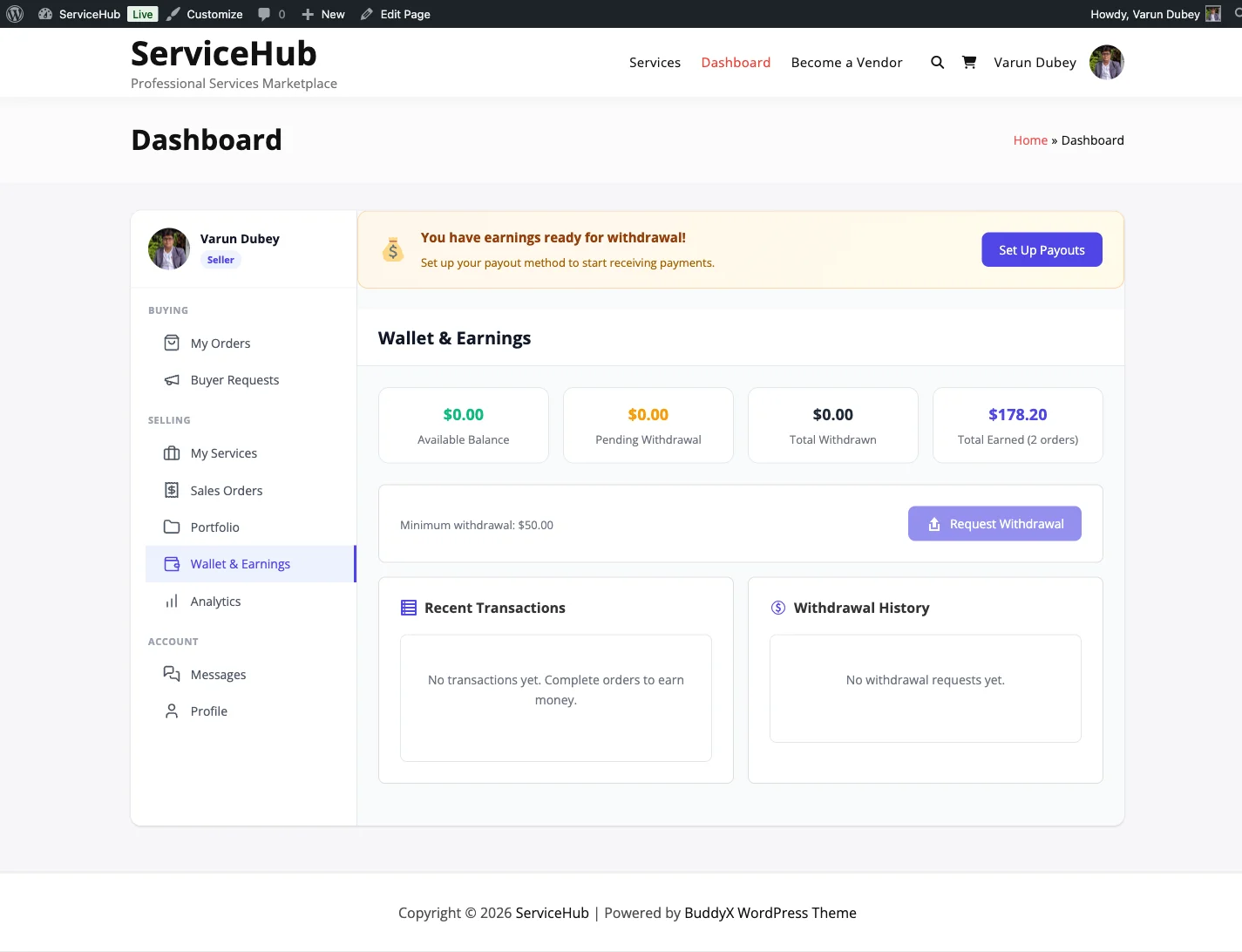
For a vendor system with multiple sellers, WP Sell Services does support commission, site owners running a marketplace of their own can set a platform fee if that’s the business model they want. But that’s a choice you make as the person who owns the site, not a fixed rate imposed on you by someone else’s platform. A solo freelancer running their own service page can set that commission to zero, because there’s nobody else’s infrastructure to fund.
What This Looks Like for a Small Team, Not Just a Solo Freelancer
The math so far assumes one person billing one commission rate. It gets more interesting for a small studio, three or four freelancers who already refer work to each other informally. Running each of them through separate Fiverr accounts means the group pays commission on every internal referral too, one member sends a client to another, and Fiverr takes 20% of a transaction it did nothing to generate beyond hosting the original profile. A shared service page changes that math directly. WP Sell Services includes a full vendor system underneath the single-seller use case, so a studio can list multiple team members as vendors on one site, each with their own services, own pricing, own order queue, while the site owner decides whether to apply any internal commission at all. For a tightly-knit team, that’s usually zero, the studio isn’t trying to run a marketplace business, it’s trying to stop paying an external one for connections it already has. The vendor system also auto-calculates seller levels based on completed orders, ratings, and on-time delivery, so even inside a small team, buyers can see who’s proven and who’s newer, the same kind of trust signal Fiverr’s badge system provides, just running on infrastructure the team actually owns.
The Honest Case for Staying on Fiverr, Too
None of this means every freelancer should quit Fiverr tomorrow. If you’re brand new, without an audience, without a portfolio anyone’s seen, the platform’s discovery is worth the commission because the alternative is zero clients, and 80% of something beats 100% of nothing. Freelancers in categories where buyers specifically search marketplaces first, rather than Google or referrals, get real value from being where the buyers already are. The honest framing isn’t “leave Fiverr.” It’s “stop paying 20% forever on relationships that don’t need Fiverr anymore.” Plenty of freelancers run both: Fiverr for cold discovery and new client acquisition, a self-hosted service page for repeat clients, referrals, and anyone who found them through a portfolio, a blog post, or word of mouth. Split the funnel that way and you only pay the marketplace tax on the leads it actually generated.
Over a year, that split can mean paying full commission on maybe a third of your revenue instead of all of it. Run the same $80,000 example with only $25,000 flowing through Fiverr and the rest through a direct channel: commission drops from $16,000 to $5,000. That’s $11,000 back, without losing the discovery that got you started.
What It Actually Takes to Set Up the Direct Channel
The technical bar is lower than most freelancers expect. WP Sell Services ships with a multi-step service creation flow, you describe the service, set up to three pricing tiers (Basic, Standard, Premium), attach requirements questions so clients give you what you need before work starts, and publish. Stripe and PayPal checkout are built in, so there’s no separate payment plugin to configure. Order messaging with file attachments handles the back-and-forth once a client buys, and the order itself moves through a defined lifecycle so nothing gets lost between “paid” and “delivered.”
None of that requires a developer. It requires an afternoon, a WordPress install (which most freelancers already have if they run a portfolio site), and a Stripe account, which takes about ten minutes to set up if you don’t already have one.
A Realistic First Month, Not a Fantasy One
Nobody replaces $80,000 of marketplace income overnight, and any post that implies otherwise is selling something. What actually happens is slower and less dramatic. A freelancer sets up their service page, tells their next three repeat clients “you can also book me directly now, here’s the link,” and maybe two of them use it. That’s not a failure. That’s two clients out of the commission pool, permanently, for the cost of sending one message. Month two, a referral comes in from one of those clients, someone who was never going to search Fiverr in the first place because they heard about you by name. That referral books through the direct page because there was never a Fiverr listing to find. Now three clients are off the commission clock. By month six or eight, a freelancer with a decent repeat-client base typically finds that somewhere between a quarter and half of their revenue has quietly migrated to the direct channel, not because they made a dramatic platform exit, but because every returning client got offered the option and most of them took it. Nobody enjoys paying a platform fee when there’s a direct link sitting right in an email signature.
This is also why the setup work matters more than it seems like it should. A service page that takes an afternoon to build pays for that afternoon the first time a $500 project closes without a $100 fee attached to it.
The Tax and Bookkeeping Side Nobody Mentions
There’s a bookkeeping benefit to direct payment that has nothing to do with the commission itself. Marketplace payouts arrive as a single net number, already reduced by fees, currency conversion, and whatever withdrawal method was used. Reconstructing gross revenue and expenses from that net figure at tax time is genuinely annoying, and a lot of freelancers just don’t bother, which means they’re not claiming the commission as a deductible business expense even when they could be. Payments processed directly through Stripe or PayPal on your own site show up as gross revenue with the processing fee as a clearly separated line item. That’s a cleaner set of books, a more accurate picture of what the business actually made, and a much easier conversation with an accountant in April.
What Ownership Actually Buys You Beyond the Fee
Strip the commission argument away for a moment and there’s a second reason freelancers eventually build their own service page: control over what happens to the business if the platform changes the rules. Marketplace terms of service aren’t static. Fee structures shift, algorithm changes bury established sellers under newer ones chasing visibility, and a policy update can suspend an account over a dispute that was mostly the buyer’s fault, with limited recourse and a review history that vanishes along with it. None of that is hypothetical. Every large marketplace has, at some point, changed how it ranks sellers, adjusted its fee schedule, or tightened its dispute policy in a way that caught established sellers off guard. A freelancer whose entire client pipeline runs through one platform is exposed to every one of those decisions with zero input into how they’re made. A self-hosted service page doesn’t have that problem, because there’s no external company that can change the rules on it. The plugin runs on a WordPress install the freelancer controls, the payment processor is a standard Stripe or PayPal account rather than a marketplace-specific wallet, and the client relationships, order history, and reviews live in a database nobody else can lock. That’s not a knock against Fiverr specifically. It’s just what “own the infrastructure” means in practice, and it’s worth more than the commission savings alone once a freelancer’s income depends on it.
Frequently Asked Questions
Does Fiverr’s 20% fee ever decrease with volume or tenure?
No. The 20% service fee is flat across all sellers regardless of how long they’ve been on the platform or how much they bill. There is no loyalty tier that reduces it.
Is 20% the only cost of selling on Fiverr?
It’s the largest and most consistent one, but buyers also pay a separate service fee that affects pricing competitiveness, and withdrawal methods and currency conversion can add further costs depending on how and where you’re paid.
If I leave Fiverr, do I lose my reviews and reputation?
Yes, reviews and seller history are tied to your Fiverr profile and don’t transfer. This is exactly why most freelancers who leave don’t leave cold. They build a direct channel alongside their Fiverr presence first, so a new site has time to accumulate its own reviews and reputation before it needs to stand alone.
Can I run a direct service page without any coding experience?
Yes. WP Sell Services is built for WordPress site owners without development backgrounds, the service creation wizard, checkout, and order management are all point-and-click through the WordPress admin and a frontend vendor dashboard.
What does it cost to run a self-hosted service page instead of using Fiverr?
The free version of WP Sell Services has no cost beyond standard payment processor fees, roughly 2.9% plus a small fixed amount per transaction through Stripe or PayPal. There’s no marketplace commission because there’s no marketplace operator between you and the client.
Should I cancel my Fiverr account entirely?
Not necessarily, and probably not right away. Many freelancers keep Fiverr running for new client discovery while moving repeat clients and referrals to a direct channel, which limits the 20% commission to only the leads the platform actually generated instead of everything you bill.
How long does it take to set up a direct service page?
Most freelancers can get a basic service listing live in an afternoon: install the plugin, run through the multi-step service creation wizard, set up Basic/Standard/Premium pricing, and connect a Stripe or PayPal account. Adding requirements questions, portfolio media, and testing checkout usually rounds out to a few hours total, not days.
Does this work for a small team, not just solo freelancers?
Yes. The vendor system in WP Sell Services supports multiple sellers on one site, each with their own listings and order queue, so a small studio can consolidate onto a shared, owned platform instead of running separate marketplace accounts and paying commission on referrals between teammates.
The Number That Actually Matters
If you want to see what actual users say once they’ve made the switch, this breakdown of WP Sell Services reviews from real buyers and vendors is worth reading before you commit. Twenty percent doesn’t sound like a lot when you’re looking at a single $60 order. It sounds like a great deal less when it’s $16,000 pulled out of an $80,000 year, money that funded nothing, built nothing, and would have covered a mortgage payment or a slow month if it had stayed in your account. The freelancers who eventually run that math don’t usually storm off the platform in protest. They just start building a second door, one that doesn’t take a cut of every client who already knows their name.