Running a Consulting Marketplace on WordPress: Credentialing, Commissions & Retainers

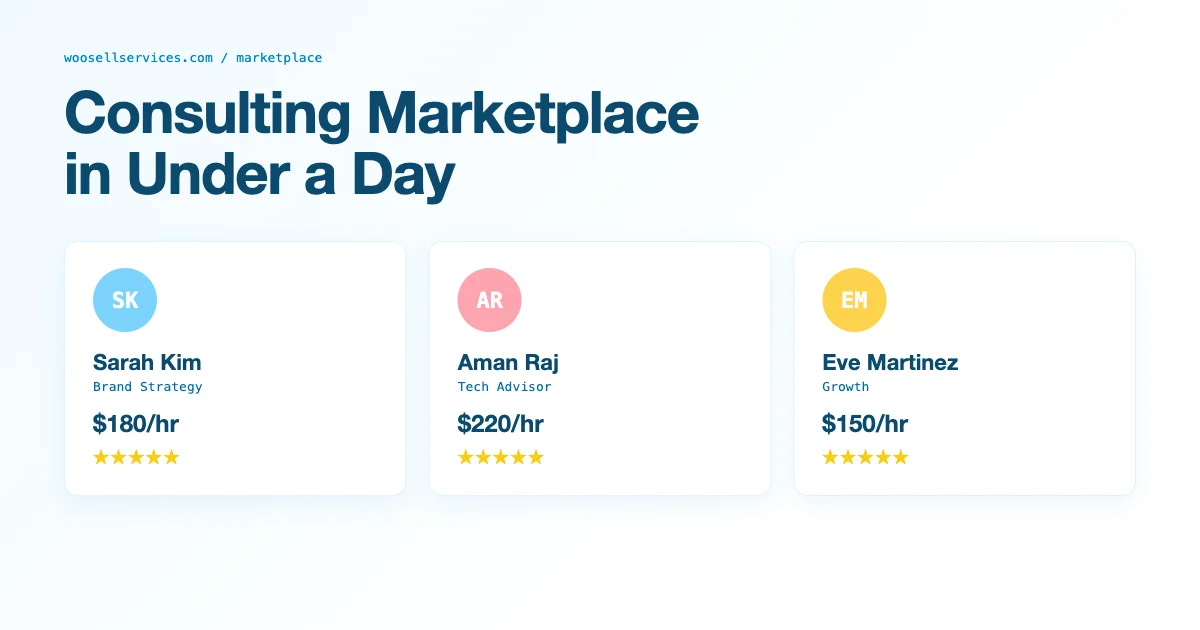
A WordPress consulting marketplace lets consultants list their services with tiered packages, handle bookings and payments, and deliver work through a structured order system – all without custom development. This guide covers the complete build process using WP Sell Services, from initial setup through consultant onboarding, availability calendar integration, recurring service configuration in Pro Agency, and go-live checklist.
What You Are Building
A consulting marketplace has specific requirements that distinguish it from a general service marketplace: consultants need to present credentials and portfolio, clients need to evaluate consultants before committing, engagements often involve discovery calls before work begins, and recurring retainers are a common business model. WP Sell Services handles all of these natively or with minor configuration.
The end result: a marketplace where consultants create profiles with their expertise, list service packages (hourly consultation, project-based, monthly retainer), clients browse and purchase, and the entire engagement lifecycle – from initial order through delivery and payment – happens within the platform.
Phase 1: WordPress and WP Sell Services Installation
Start with a clean WordPress installation on a reliable managed host (Cloudways, Kinsta, or WP Engine are appropriate for a marketplace that will handle payments). Install WP Sell Services from WordPress.org (free) or purchase the Pro tier directly for Pro Agency features (recurring services, white-label, Stripe Connect).
Essential plugins alongside WP Sell Services: a payment gateway (Stripe via WooCommerce Stripe Payment Gateway, or WP Sell Services Pro’s built-in Stripe integration), an SMTP email plugin (WP Mail SMTP or Postmark for reliable transactional email delivery), a caching plugin (WP Rocket or W3 Total Cache – configure to exclude order and vendor dashboard pages from caching), and an SSL certificate (your host likely provides this automatically).
Phase 2: Service Categories and Taxonomy
Set up service categories before creating any services or onboarding consultants. Categories in WP Sell Services define how the service catalog is organized. For a consulting marketplace, typical categories: Management Consulting, Technology Consulting, Financial Advisory, HR and Talent, Marketing Strategy, Legal and Compliance, and Operations. Subcategories can refine these – Technology Consulting might have subgroups for Cloud Infrastructure, Software Development, Data Analytics, and Cybersecurity.
Tags further refine discovery. Tags like “GDPR compliance”, “startup scaling”, “SaaS”, “B2B” let clients search by specific need rather than broad category. Configure tags in the WP Sell Services settings before consultant onboarding so consultants can tag their services from the start.
Phase 3: Consultant Onboarding
Consultant onboarding has two components: account creation (WordPress user registration with the vendor role) and profile completion (bio, expertise, portfolio, credentials). The account creation can be self-service or admin-managed depending on whether your marketplace is open (any consultant can apply) or curated (you review and approve each consultant).
For a curated marketplace, enable vendor application mode in WP Sell Services settings. Consultants apply by submitting their profile; you review and approve each application before their services become publicly visible. This prevents poor-quality listings from appearing on the marketplace before you have the scale to monitor them continuously.
Service Package Structure for Consultants
Guide consultants to create packages in three tiers that match how consulting is typically sold:
- Discovery call (30-60 min): Entry point for new clients, often low-cost or free. Delivery: video call link or Calendly booking link delivered via the platform’s delivery system.
- Project-based engagement: Fixed scope, fixed price. Delivery: deliverable documents, presentations, or recommendations submitted via the platform delivery uploader.
- Monthly retainer: Recurring engagement, requires WP Sell Services Pro Agency’s recurring service feature. Client pays monthly; consultant commits to defined availability or output.
Availability Calendar Integration
WP Sell Services does not include a built-in availability calendar. For consulting marketplaces where scheduling a call is the first deliverable, integrate Calendly or Cal.com. The workflow: consultant sets up their Calendly or Cal.com account with their availability, embeds the booking link as the delivery for a “discovery call” package, and when a client purchases the discovery call package, they receive the booking link as the delivery within minutes of payment.
For more integrated scheduling, use a WordPress booking plugin (Amelia or Bookly) alongside WP Sell Services. The WP Sell Services order flow handles payment; the booking plugin handles the actual appointment scheduling. Trigger the appointment booking link in the WP Sell Services order acceptance email using the wss_order_accepted action hook.
Recurring Services: Monthly Retainers
Recurring services in WP Sell Services Pro Agency let consultants offer monthly retainers where the client is billed automatically each month and the order auto-renews. This is the model for ongoing advisory relationships: a CFO consultant on retainer for 10 hours per month, a marketing strategist providing monthly reports and quarterly reviews.
Configure recurring services with clear deliverable definitions per cycle: what the consultant commits to deliver each month (a strategy document, a monthly review call, a defined number of advisory hours), what happens if the deliverable is not submitted by the end of the cycle, and what the revision and revision-limit policy is for recurring deliverables.
Portfolio Showcase Configuration
Consulting clients make purchase decisions based on demonstrated expertise. The vendor portfolio section supports file uploads (case studies, presentations, white papers) and portfolio item descriptions. Guide consultants to upload 3-5 portfolio pieces that represent different engagement types – a client who needs IT strategy advice wants to see a technology transformation case study, not a marketing audit.
The vendor profile also includes fields for education, certifications, languages, and years of experience. For a professional consulting marketplace, enforce profile completeness as a requirement for service listing activation – incomplete profiles reduce client confidence and suppress conversion rates.
Commission and Pricing Structure
Consulting marketplace commission rates typically range from 10-20% of transaction value, lower than general service marketplaces (which often charge 20-30%) because consulting engagements are high-value and consultants have alternatives. Setting commission too high relative to competitors drives experienced consultants to other platforms or to direct client relationships.
Consider a sliding scale: 20% on first-time orders from a new client (you generated the relationship), 10% on repeat orders from the same client (the consultant earned the relationship). This is configurable in WP Sell Services Pro using the commission filter hooks. It creates an incentive for consultants to deliver excellent first-engagement work to secure ongoing revenue at lower commission.
Go-Live Checklist
- SSL certificate active and HTTPS enforced sitewide
- Stripe Connect (or payment gateway) tested with a real transaction
- Order confirmation emails tested from buyer and vendor accounts
- Dispute system tested with a staging order
- Mobile layout verified on iOS Safari and Android Chrome
- 5+ consultant profiles live before launch (avoids empty marketplace problem)
- Terms of Service and Privacy Policy pages linked in footer
- Commission rate communicated clearly in consultant onboarding documentation
- Withdrawal policy documented (minimum amount, processing time, method)
For WooCommerce stores that also sell physical or digital products alongside consulting services, the integration guide covers how to maintain a unified customer account across both systems. See adding package pricing to WooCommerce service products for the pricing structure reference. For the financial infrastructure behind marketplace payouts, the installment payment guide covers deferred payment models relevant to high-value consulting engagements.
Managing Client Expectations for Long-Term Retainers
Consulting retainers fail most often not because the work is poor but because client expectations drift from what was agreed. Monthly retainers that start with a clear deliverable definition (4 strategy sessions per month, one written recommendation memo) gradually accumulate informal scope additions that erode consultant profitability and create resentment. WP Sell Services recurring orders provide a natural checkpoint for scope review: each monthly renewal is an opportunity to confirm deliverables, address scope additions formally, and reset expectations before they calcify into disputes.
Build scope review into your platform’s recurring order confirmation email. Use the wss_recurring_order_renewal action hook to insert a reminder that the renewal represents the agreed scope – and include a link to the original package description. Clients who see this reminder are less likely to expect scope additions to be absorbed silently. For consulting platforms where retainer scope creep is a common vendor complaint, this automated scope reminder is a low-effort intervention that protects vendor profitability and extends the average retainer lifetime by reducing burnout-driven cancellations.
Structuring Discovery Calls as Paid Entry Points
Free discovery calls are standard in consulting marketplaces but impose significant time costs on consultants who take calls from clients who are not ready to buy. Charging for discovery calls ($50-150 depending on consultant seniority) filters for clients with genuine intent while providing compensated time for consultants who do take unqualified clients. Platforms that have switched from free to paid discovery calls report a consistent pattern: call volume drops but conversion from call to project engagement increases by a similar proportion.
Configure paid discovery calls in WP Sell Services as a standard service package tier. The delivery for a paid discovery call package is the Calendly or Cal.com booking link delivered immediately on payment. The client pays, receives the link, books the slot, takes the call, and the order auto-completes after the scheduled call time passes using the wss_auto_complete setting on the discovery call package. Set the revision count to zero for discovery call packages – discovery calls are not a deliverable product with revision cycles.
Verification and Credentialing for Consulting Marketplaces
Credential verification is the trust differentiator between a consulting marketplace and a freelance directory. Verifying that a consultant who claims a CPA, PMP, or legal qualification actually holds that credential separates your platform from unverified alternatives. The verification workflow: during vendor application, require upload of certification documents, conduct a verification check (manual review, or via a verification service like Certn or Checkr for background and credential checks), and issue a platform-verified badge on the vendor profile that is visible to buyers.
Platform-verified credentials significantly increase conversion rates on high-value consulting packages. Buyers paying $200+ per hour for financial or legal consulting want verification that the consultant holds the claimed qualification. The verification badge signals that your platform has done this check – converting the buyer’s trust in the platform into trust for the individual consultant. Implement the verified badge as a custom field on the vendor profile in WP Sell Services, updated by admin review after document verification. For consulting marketplaces that want to offer installment-based billing for high-value projects, the installment payment guide covers how to configure deferred payment structures. For marketplace operators who also want to offer physical or digital products alongside consulting, the package pricing guide covers how to structure tiered product and service offerings in a unified catalog.
Commission Benchmarks for Consulting Marketplaces
Commission rates for consulting marketplaces require calibration across marketplace stage, consultant tier, and engagement type. These benchmarks represent typical configurations for consulting platforms at different stages.
| Stage | New Client Rate | Repeat Client Rate | Notes |
|---|---|---|---|
| Early (1-20 consultants) | 25% | 20% | Fund early growth |
| Growth (20-100) | 20% | 15% | Reduce as volume grows |
| Scale (100+) | 15% | 10% | Volume compensates for lower rate |
| Premium (verified experts) | 12% | 8% | Attracts senior consulting talent |
Configure the sliding scale model in WP Sell Services Pro using the wss_commission_rate filter. Check the buyer’s order history with the specific vendor to determine which tier applies. This creates aligned incentives: the platform earns more for generating new client relationships, and consultants earn more per engagement as they retain clients through quality work.
Client Onboarding Best Practices for Consulting Marketplaces
Client onboarding determines whether a buyer’s first experience generates a second order. Consulting marketplace clients need guidance on how to submit effective briefs, what to expect from the discovery process, and how the platform handles disputes if the engagement does not meet expectations.
Build a brief template into the WP Sell Services order requirements form. A well-structured brief reduces back-and-forth between consultant and client, shortens time-to-start, and results in deliverables that match client expectations. The brief template for a consulting engagement should capture: the business challenge being addressed, the desired outcome and how success is measured, the client’s timeline and budget constraints, any previous approaches that were tried and did not work, and the key stakeholders who will review the deliverable.
Send a welcome email to new clients immediately after their first order is placed. The welcome email covers: what happens next (the consultant will accept within 24 hours), how to communicate via the platform’s messaging system, what revision policy applies to the ordered package, and how to escalate if there is a problem. This email, sent via the wss_order_placed hook, sets expectations that prevent confusion-driven negative reviews.
Handling a Consultant’s First Cancellation Request
A consultant on retainer will eventually ask to leave, sometimes with plenty of notice, sometimes because a full-time role came up unexpectedly. How the platform handles this moment shapes whether the affected client trusts the marketplace again or quietly stops using it. Require a minimum notice period on all retainer packages, typically 30 days, so clients are never left mid-project without a transition plan.
When a consultant does give notice, the platform admin should proactively reach out to the affected client with two or three suggested replacement consultants from the same category, rather than leaving the client to search cold. This single gesture, offered before the client has to ask, is what separates a marketplace that retains clients through vendor turnover from one that loses them at the first disruption.
Building a Featured Consultant Program
Featured consultant programs create incentive alignment between your marketplace and your top performers. By elevating featured consultants in search results and with visual markers on the service listing page, you direct buyers toward your best vendors while giving top consultants a reason to prioritize your platform over competitors. Feature placement is earned through objective metrics: review score above 4.5, on-time delivery rate above 95%, and minimum order volume in the past 90 days.
Implement featured consultant status as a custom field on the vendor profile, updated by admin review monthly. Use the wss_service_loop_args filter to boost featured vendors in search results by adjusting the query’s orderby parameter when the featured meta field is set. Display a visual badge on featured vendor profiles using a custom CSS class added via the wss_vendor_profile_classes filter. Communicate the featured consultant criteria publicly so all consultants understand the path to featured status and have motivation to maintain quality metrics.
Handling Client Satisfaction Guarantees
Client satisfaction guarantees are a trust signal that can differentiate a consulting marketplace from freelance directories. A platform-backed guarantee (not just a vendor promise) signals that the platform stands behind the quality of work delivered through it. Common guarantee structures for consulting marketplaces: revision guarantee (at least one revision included in every package), outcome protection (if the deliverable does not meet the specified brief, the platform mediates and the consultant revises or the client receives a partial refund), and quality guarantee (if a consultant delivers work below a defined quality standard, the platform covers the gap).
Implement the guarantee framework using WP Sell Services’s dispute resolution system. Define the dispute grounds that trigger guarantee coverage, document the evidence required for a dispute to qualify (original brief, specific deliverable failure points, evidence of revision attempt), and train your dispute resolution team on consistent application of the guarantee policy. A well-implemented guarantee reduces buyer hesitation on first-time orders and justifies a slight premium in your commission rate relative to platforms without a buyer protection program.