Components of a Customer Journey Map

When I first started creating customer journey maps, I made the classic mistake, I treated it like a checklist.
Awareness?
Purchase?
Loyalty?
It looked neat, but it didn’t feel real. The truth hit me later: a great customer journey map isn’t a static diagram; it’s a living story, a reflection of what customers actually think, feel, and experience at every touchpoint. To make it work, you need the right components. Think of them as the building blocks of understanding, the elements that turn data and assumptions into insight and empathy. Let me walk you through each one, based on how I use them in my real projects.
1. Customer Personas: Knowing Who You’re Mapping For
Every journey starts with someone. That “someone” is your customer persona, your stand-in for real people who engage with your brand.
When I build personas, I don’t just look at demographics like age or location. I dig deeper, into motivations, frustrations, goals, and emotional triggers.
Here’s a hypothetical example of how that plays out: imagine mapping journeys for a fitness brand and landing on three personas: an Aspirer who wants to get fit but feels overwhelmed by where to start, an Achiever who’s already active but seeks progress and structure, and a Balancer who struggles to find time but values well-being.
Each persona would interact with the same brand differently, even though the product stays identical. That’s the part that took me a while to internalize: the journey doesn’t change because your business does, it changes because your customer does.
If you’re not sure how to define your personas clearly, I recommend revisiting Customer Journey Map vs Buyer Journey Map, where I explain how understanding mindset affects mapping.
2. Stages of the Journey: The Big Picture Flow
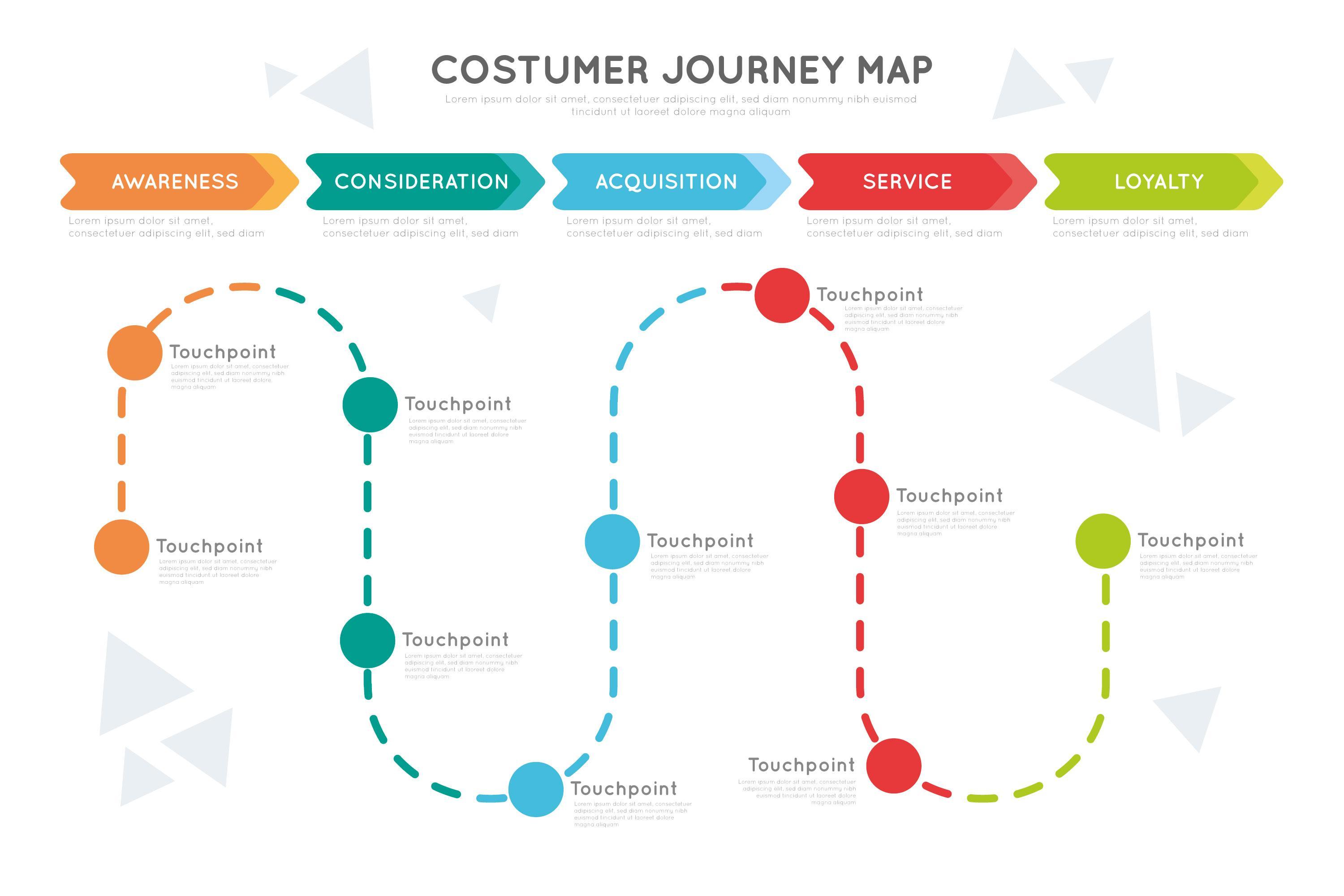
Once I understand who I’m mapping for, I define the journey stages, the high-level phases a customer moves through. While every business is unique, I generally use five stages as my framework:
- Awareness: They discover the problem or your brand.
- Consideration: They start researching and comparing options.
- Purchase: They make a decision and take action.
- Retention: They continue using the product and form habits.
- Advocacy: They recommend your brand to others.
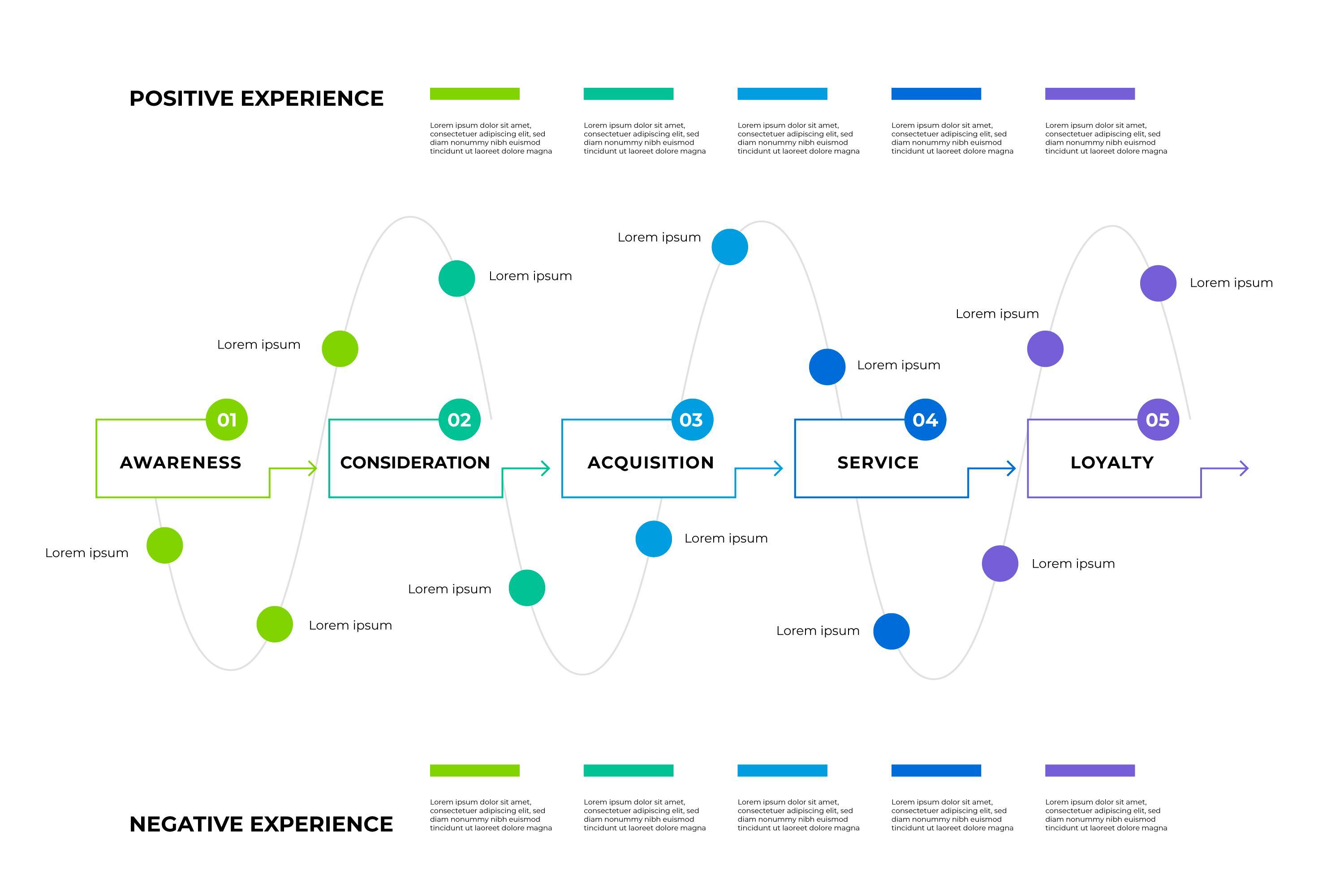
Each stage is like a chapter in a story with its own emotions, actions, and pain points. What matters most isn’t just defining the stages, but understanding what customers feel in each one.
In my own journey mapping process, I often use color coding, red for frustration, yellow for uncertainty, green for satisfaction, to make emotional highs and lows visible at a glance.
You can see how this connects to modern strategy in The Evolution of the Customer Journey Map, where journeys move from linear to emotional and circular.
3. Customer Goals: The Heartbeat of Every Stage
A mistake I made early on was focusing on brand goals instead of customer goals. But a customer journey map isn’t about what I want, it’s about what they need.
At each stage, I now ask myself:
- What is the customer trying to achieve here?
- What’s stopping them from achieving it?
- What would success feel like to them?
Let’s take the Awareness stage as an example: a user looking for “time management tips” isn’t just after an article, they want relief from feeling overwhelmed. When I align brand messaging with that emotional goal, engagement improves noticeably.
So, instead of thinking, “How can I sell to them?” I think, “How can I help them win?” That small mindset shift changes everything.
To understand how emotional alignment improves retention, check out Benefits of Customer Journey Mapping.
4. Touchpoints: Every Interaction That Shapes Perception
Touchpoints are the “moments of truth”, where the customer meets your brand. These can be online (like ads, emails, or blog posts) or offline (like events or packaging).
When I map touchpoints, I write them in chronological order, from discovery to advocacy, and I label how they make people feel.
| Stage | Touchpoint | Emotion |
|---|---|---|
| Awareness | Instagram Ad | Curiosity |
| Consideration | Product Page | Interest |
| Purchase | Checkout Page | Anxiety → Relief |
| Retention | Email Follow-up | Gratitude |
| Advocacy | Referral Program | Pride |
The emotion column is what changes everything because it reminds me that each click or interaction is tied to a feeling. Sometimes the best way to improve a journey isn’t to add more touchpoints, it’s to make existing ones more emotionally consistent.
If you want to explore this idea further, see The Evolution of the Customer Journey Map, where I discuss how emotion became central to mapping.

5. Pain Points and Friction: The Gaps That Break the Flow
Every journey has roadblocks, moments of frustration or confusion that stop progress. These are the pain points, and honestly, they’re where most growth opportunities hide.
When I audit a journey, I ask:
- Where do users hesitate or drop off?
- What frustrates them most?
- What questions go unanswered?
For instance, if people abandon carts, I dig deeper: Is the pricing unclear? Is the checkout process too long? Do they trust the payment system?
Sometimes a small change, like adding transparent shipping info or social proof, removes massive friction. I’ve learned to treat pain points as data rather than dread them. Every friction point is a chance to create delight if you catch it early enough.
If you want to learn how to identify and fix these moments strategically, explore Steps to Creating a Customer Journey Map, where I detail the mapping and refinement process.
6. Emotions: The Hidden Engine of the Journey
This part is my favorite. If customer personas are the “who” and stages are the “when,” then emotions are the “why.” Mapping emotions allows me to predict behavior more accurately than any analytics tool ever could.
Here’s what I mean:
- If I notice frustration peaks during the consideration phase, I know to simplify comparisons, add testimonials, or improve FAQs.
- If joy peaks during onboarding, I build follow-up campaigns to reinforce that feeling.
Emotion is the invisible thread connecting every interaction. And when I design journeys that nurture positive emotion, I don’t just convert customers, I keep them.
This ties directly into Benefits of Customer Journey Mapping, where emotional understanding translates into loyalty and advocacy.
7. Opportunities: Turning Insight into Action
Once I’ve mapped personas, stages, goals, touchpoints, and emotions, I always end by listing opportunities, the actions I can take to improve the experience.
These are insights like:
- Add live chat to reduce hesitation during checkout.
- Create onboarding videos to boost post-purchase satisfaction.
- Personalize email sequences for inactive users.
I treat every journey map as a living document, something that evolves as I test, learn, and adapt. The goal isn’t to make a perfect map. It’s to create a framework that keeps improving as customers do.
8. Data Sources: Where the Map Actually Comes From
A component that doesn’t get discussed enough is where the raw material for a journey map actually comes from. Guessing at stages and emotions produces a map that looks polished but has no grounding in reality.
I pull from a mix of sources depending on what’s available: analytics data showing where people drop off, support tickets revealing recurring frustrations, sales call notes capturing objections in the customer’s own words, and direct interviews or surveys when I have the time and budget for them. Quantitative data tells me where the problem is. Qualitative data tells me why it’s happening. A map built on only one of the two is missing half the picture.
When data is thin, I’ll build a first draft from reasonable assumptions and clearly label it as a hypothesis, then treat the next few weeks of customer interaction as a chance to validate or correct it. A journey map built entirely on guesswork is still more useful than no map at all, as long as everyone using it knows which parts are assumptions and which parts are confirmed.
9. Ownership: Who Actually Keeps the Map Alive
A journey map that lives in a single forgotten slide deck stops being useful the moment it’s presented. The teams that get real value from journey mapping usually assign clear ownership, someone responsible for updating it as the product, market, or customer behavior shifts.
In practice, that often means marketing owns the awareness and consideration stages, sales or product owns purchase, and customer success owns retention and advocacy, with someone senior enough to see the whole picture responsible for keeping the stages connected rather than siloed. Without that ownership, each team ends up optimizing their own stage in isolation, sometimes at the expense of the stages before or after it.
A Simple Way to Start If You’ve Never Built One
If all of this feels like a lot to take on at once, here’s the stripped-down version I’d recommend for a first attempt.
- Pick one persona. Don’t try to map every customer type in your first pass.
- List the five core stages and write one sentence describing what that persona is doing and feeling at each one.
- Add the two or three touchpoints that matter most per stage, not every possible interaction.
- Mark the single biggest pain point per stage using whatever data or anecdotal evidence you have.
- List one opportunity per pain point, even if it’s rough. You can refine it later.
That’s it. A rough version covering all seven core components beats a polished map that only covers two or three. You can always add depth once the basic structure exists and the team has bought into using it. Don’t wait for a perfect data set or a dedicated software subscription before starting. The first draft is meant to be wrong in places, and that’s fine, because the act of building it forces conversations across teams that usually don’t happen otherwise.
Common Mistakes I See When Teams Build Their First Map
Treating it as a one-time project. A journey map built once and never revisited goes stale within a couple of quarters as products, competitors, and customer expectations shift.
Mapping the ideal journey instead of the real one. It’s tempting to map how you want customers to move through your funnel rather than how they actually do, skipped steps, backtracking, and abandoned attempts included.
Skipping the emotion layer entirely. A map with stages and touchpoints but no emotional read is really just a flowchart wearing a journey map’s name.
Building it in isolation from the teams who’ll use it. A map created solely by one department and handed down rarely gets adopted the way one built collaboratively does.
10. Metrics: Tying the Map Back to Numbers
A journey map full of empathy and no measurement eventually loses credibility in a room full of stakeholders who want to know what changed. I always pair each stage with at least one metric that tells me whether things are actually improving, not just whether they feel better on paper.
Awareness might track branded search volume or ad click-through rate. Consideration might track time on comparison pages or content engagement. Purchase obviously tracks conversion rate and cart abandonment. Retention tracks repeat purchase rate or churn. Advocacy tracks referral rate or review volume. None of these numbers replace the emotional layer, but they keep the map honest and give you something concrete to report back when someone asks whether the mapping exercise actually did anything.
Tools I Use to Actually Build the Map
The components matter more than the software, but the right tool makes the process considerably less painful. For quick collaborative sessions, a whiteboard tool like Miro or FigJam lets a whole team add sticky notes for touchpoints and emotions in real time, which tends to surface disagreements about the customer experience that a single person mapping alone would miss entirely.
For a more polished, presentation-ready version, I’ll often move the finished map into a simple table or a dedicated journey mapping template, since stakeholders outside the project usually respond better to a clean, readable artifact than a messy whiteboard export. The specific tool matters far less than the discipline of actually going through each component in order rather than skipping straight to touchpoints because they feel more concrete than personas or emotions.
How Journey Maps Differ Across Business Models
A B2C ecommerce journey and a B2B enterprise sales journey share the same underlying components, but the shape looks different. A B2C journey often compresses awareness through purchase into a single session, sometimes minutes, while B2B journeys frequently stretch across weeks or months with multiple stakeholders entering and exiting the picture at different stages.
For B2B specifically, I usually add a layer showing which persona is active at each stage, since the person researching a solution early on is often not the person who signs off on the purchase later. Mapping a single generic “customer” through a B2B journey tends to flatten out exactly the complexity that makes B2B sales difficult in the first place.
Frequently Asked Questions
How often should a customer journey map be updated?
I revisit mine at least twice a year, and sooner if there’s a major product change, a new competitor entering the space, or a noticeable shift in how customers are behaving. A map that hasn’t changed in two years is more likely to be misleading than helpful.
Do I need customer interviews to build a good map, or can I use existing data?
Existing data, analytics, support tickets, sales notes, gets you a reasonable first draft. Direct interviews add a layer of nuance and specific language that data alone rarely captures, so I treat interviews as a strong upgrade rather than a strict requirement to get started.
What’s the difference between a customer journey map and a sales funnel?
A sales funnel tracks volume moving through defined stages toward a purchase. A journey map captures the same movement but adds emotional context, pain points, and touchpoints, giving you the why behind the funnel numbers rather than just the numbers themselves.
Should every business have more than one journey map?
If you serve genuinely different customer segments or personas, yes. A single map trying to represent an enterprise buyer and a solo freelancer using the same product will end up too generic to be useful for either one.
Who should actually be in the room when a journey map gets built?
Ideally a mix of people who touch different stages directly, someone from marketing, someone from sales or product, someone from support, and if possible someone who’s spent real time talking to customers. A map built entirely by one department tends to over-represent that department’s view of the journey and under-represent everyone else’s.
What’s the biggest sign that a journey map isn’t actually being used?
Nobody can point to a specific decision it influenced in the last few months. A journey map that’s genuinely alive gets referenced in roadmap discussions, informs which support tickets get prioritized, and shapes onboarding flow changes. One gathering dust in a shared drive somewhere isn’t doing its job, regardless of how well-designed it looked the day it was finished.
My Takeaway
Over time, I’ve realized that every component of a customer journey map plays a unique role, like instruments in an orchestra. When they’re in sync, they create harmony; when they’re not, they create noise.
To me, customer journey mapping is less about plotting paths and more about feeling empathy in structure, using logic to design emotion. The components I’ve walked through here, personas, stages, goals, touchpoints, pain points, emotions, opportunities, data sources, ownership, and metrics, aren’t a checklist to complete once and forget. They’re a lens you keep applying as the business changes, the market shifts, and the people you’re serving keep evolving in ways a static document can never fully capture on its own.
Interesting Read
B2B Demand Generation: A Comprehensive Beginner’s Guide
Real-World Examples of Customer Journey Maps
Steps to Creating a Customer Journey Map
Benefits of Customer Journey Mapping
Customer Journey Mapping: Understanding Every Step of Your Customer’s Experience
5 Best WooCommerce Extensions and Addons
12 Best WooCommerce Plugins For Google Product Feed & Boost Your Sales in 2025