Customer Journey Map vs Buyer Journey Map

When I first started building my own customer journey maps, I kept mixing them up with something I’d already been using for years: the buyer journey. On the surface they sound almost identical. Both talk about stages, emotions, and decisions. Look closer, though, and they’re telling two entirely different stories. Understanding the actual difference between a customer journey map and a buyer journey map changed how I design strategies, talk to audiences, and measure whether any of it is actually working. Here’s what sets them apart, and why the distinction matters more than it first appears.
The Buyer Journey: A Story About Decisions
The buyer journey tracks the process someone goes through before they hand over money. It’s the mental and emotional path a person walks while deciding whether to buy something, and who to buy it from. I think of it as a sales lens: it helps explain how people discover a problem, evaluate their options, and eventually commit to one.
The buyer journey typically breaks into three stages.
Awareness Stage
This is where someone realizes they have a problem or a need. The questions running through their head sound something like:
- Why is my website traffic dropping?
- Why isn’t my skincare routine working?
- How do I make my business run smoother?
At this point, nobody’s shopping for a specific product yet. They’re looking for understanding. As a marketer, the job here is to educate and guide, not sell. If you’re planning campaigns around this stage, it’s worth pairing that work with Components of a Customer Journey Map, since it helps align awareness content with the emotional triggers that actually move someone forward.
Consideration Stage
Now the buyer knows their problem and starts comparing options: reading reviews, watching demos, doing homework. This is where trust either forms or breaks. The brands that win this stage aren’t the loudest ones, they’re the ones that help without pushing, educating with something that reads like genuine empathy instead of a sales script.
Decision Stage
The final stretch. The buyer picks the product, vendor, or service that feels right. It’s rarely just about price. It’s about confidence and perceived value, which is why a cheaper competitor doesn’t automatically win this stage.
To see how these three stages connect into a larger emotional map, see Steps to Creating a Customer Journey Map.
The Customer Journey: A Story About Experiences
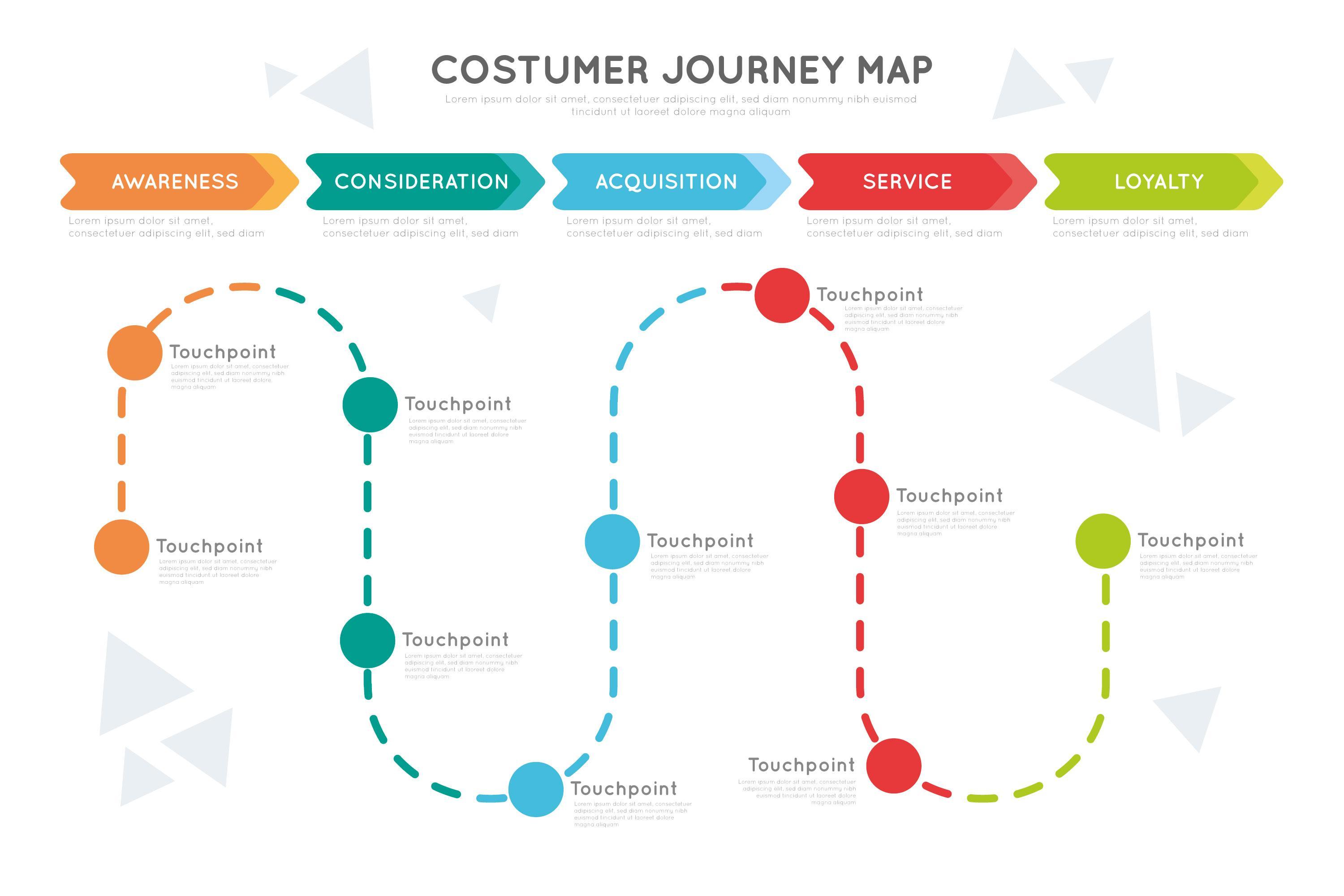
Here’s where things expand. The customer journey goes past the purchase, capturing the full relationship between customer and brand. It starts before awareness and keeps going after the sale, through onboarding, support, satisfaction, advocacy, and renewal or repeat purchase.
If the buyer journey is a short film about one decision, the customer journey is the full series, every season, every twist, every emotional beat that comes after.
Beyond the initial sale, it typically includes:
- Onboarding: How easy it is to actually get started after buying.
- Usage: Whether the product or service delivers on what was promised.
- Support: How quickly and how well issues get resolved.
- Loyalty: Whether the customer feels genuinely valued after the sale closes.
- Advocacy: Whether they end up recommending the brand to someone else.
I’ve seen plenty of businesses spend months optimizing their buyer journey while completely neglecting everything that happens after the sale. That’s a bit like planning the perfect wedding and skipping the marriage that follows. The real relationship starts after the purchase, not before it.
For more on how that relationship grows over time, see The Evolution of the Customer Journey Map.

The Key Difference: Transaction vs Relationship
Here’s how I personally frame the difference between the two:
| Aspect | Buyer Journey Map | Customer Journey Map |
|---|---|---|
| Focus | The path to purchase | The overall brand experience |
| Goal | Conversion | Retention and loyalty |
| Duration | Ends at purchase | Continues after purchase |
| Perspective | Marketing and sales-centric | Customer-centric |
| Emotion | Curiosity to confidence | Trust to satisfaction to advocacy |
Mapping both side by side made something click for me: one feeds directly into the other. A seamless buyer journey brings someone in. A meaningful customer journey keeps them close. The bridge between the two is trust, built through consistent, human experiences at every single touchpoint, not just the ones that lead directly to a sale. Lose sight of that bridge and both maps end up describing two different, disconnected businesses instead of one coherent relationship.
Why This Distinction Actually Matters
Understanding the split helps you design smarter strategies. Here’s what changed once I actually saw the full picture:
- I stopped treating conversion as the finish line. It became the starting point for retention instead.
- My content calendar expanded, I started creating for onboarding, retention, and advocacy, not just awareness and consideration.
- I got marketing, sales, and support aligned around a shared narrative: the customer’s, not any single department’s version of events.
In other words, I stopped asking “how do I sell more?” and started asking “how do I make the customer’s entire experience better?” That single shift improved both conversion and loyalty, and it wasn’t a coincidence, the two turned out to be more connected than most funnel diagrams suggest.
How to Use Both Together
The honest answer is that you need both, not one instead of the other. The buyer journey attracts and converts. The customer journey engages and retains. Here’s how I typically blend them:
- Start with the buyer journey to build awareness and confidence.
- Extend into the customer journey to keep delivering value well past the purchase.
- Measure both continuously, tracking conversions on one side and satisfaction on the other.
That balance produces what I think of as a full-circle experience, one where customers don’t just buy from you once. They come back, because every step along the way, before and after the sale, feels easy, honest, and human.
To learn how to map this entire process, see Customer Journey Mapping: Understanding Every Step of Your Customer’s Experience
Where Teams Usually Get This Wrong
A few patterns come up again and again when I look at how companies actually apply these two frameworks:
Treating the buyer journey as the whole strategy. A lot of marketing teams build detailed funnels for awareness through decision and then stop, as if the relationship ends the moment a card gets charged. Whatever budget exists for “customer experience” tends to get treated as a support-team problem rather than a marketing one, which leaves real retention opportunities sitting untouched.
Building a customer journey map with no connection to the buyer journey that fed it. The reverse mistake also happens. Customer success teams sometimes map onboarding and retention in isolation, with no visibility into what a customer was promised or expected during the decision stage. That disconnect is exactly where a lot of early churn originates, someone bought expecting one thing and experienced another.
Assuming the two journeys look the same across every customer segment. A first-time buyer and a returning customer experience both journeys very differently. Treating them identically in your mapping tends to produce strategies that are technically accurate for nobody in particular.
A Quick Way to Tell Which One You’re Actually Looking At
If a map or diagram ends at “purchase complete,” it’s a buyer journey, useful, but incomplete on its own. If it continues past that point into onboarding, support, and advocacy, it’s a customer journey. Neither is wrong to build in isolation for a specific purpose, a sales team might genuinely only need the buyer journey to fix a leaky funnel, but calling either one the complete picture of the customer relationship is where the confusion usually starts.
What I’d Tell Someone Building Their First Version of Either
Start smaller than feels comfortable. A first attempt at either journey doesn’t need to be a polished, agency-quality deliverable with custom illustrations. It needs to be honest and based on real input, even if that input is five customer conversations and a spreadsheet. A rough map built from real evidence beats a beautiful map built from assumptions every time it actually gets tested against reality.
The second piece of advice: pick one journey to start with rather than trying to build both simultaneously. Trying to map the entire relationship, from first ad impression through year-three renewal, in a single workshop tends to produce something too broad to actually act on. Nail one half first, then extend into the other once the first version has already proven useful.
What Metrics Actually Belong to Each Journey
One of the more useful things about separating these two frameworks is that it clarifies which metrics belong where, instead of jamming everything onto one dashboard where nothing tells a complete story.
Buyer journey metrics tend to be funnel-shaped: traffic by source, cost per lead, conversion rate at each stage, time to close, and win rate against competitors. These numbers answer one question well: is the path to purchase working?
Customer journey metrics look completely different, because they’re measuring an ongoing relationship rather than a single transaction: onboarding completion rate, time to first value, support ticket volume and resolution time, net promoter score, renewal or repeat purchase rate, and referral rate. These answer a different question: once someone’s a customer, are we actually keeping our end of the deal?
As an illustrative example, imagine a subscription software company with a buyer journey that looks excellent on paper, strong conversion rate, healthy cost per acquisition, short sales cycle. If their customer journey metrics show a high cancellation rate in month two, that’s a signal the buyer journey might be overselling something the onboarding experience can’t actually deliver. Looking at either metric set alone would miss that story entirely.
How This Plays Out Differently by Industry
The buyer-versus-customer journey distinction isn’t identical across every kind of business, and it’s worth being specific about how it shifts.
E-commerce. The buyer journey is often short, sometimes a single session from discovery to checkout. The customer journey carries more weight here than people expect, because a strong post-purchase experience (shipping updates, easy returns, a genuine follow-up) is often what determines whether someone becomes a repeat customer instead of a one-time buyer who forgets the brand exists.
SaaS and subscription services. The buyer journey might take weeks with trials and demos involved, but the customer journey is where the real business outcome gets decided, since subscription revenue depends entirely on renewal. A weak onboarding experience can undo months of buyer-journey work in the first thirty days.
Professional services and agencies. The buyer journey tends to be long and relationship-heavy from the start, often involving proposals, references, and multiple conversations. The customer journey here blends almost seamlessly with ongoing account management, since the “sale” and the “relationship” aren’t cleanly separable stages the way they are in e-commerce.
Mapping Emotions Honestly, Not Optimistically
A mistake I made early on was mapping the emotional layer of both journeys too generously, writing down what I hoped a customer felt rather than what they probably actually felt based on real evidence. A journey map full of assumed positive emotions at every stage isn’t useful. It’s decoration.
The more useful version comes from actual sources: sales call notes for the buyer journey, support tickets and churn interviews for the customer journey. If someone canceled and the actual reason was “I never got value from onboarding,” that specific sentence belongs on the map, not a softened version of it that’s easier to present in a meeting.
Frequently Asked Questions
Can a small business realistically maintain both maps at once?
Yes, and it doesn’t require two separate elaborate projects. A lean version works fine: a simple buyer journey outline covering awareness through decision, paired with a shorter customer journey extension covering onboarding through advocacy. The goal is coverage of the full relationship, not necessarily equal depth on both halves right away.
Which one should get built first?
The buyer journey usually comes first for a straightforward reason, most businesses need to understand how customers arrive before they can meaningfully map what happens after. That said, if churn or retention is the more urgent business problem, there’s a reasonable case for starting with the customer journey and working backward to see where expectations were set incorrectly during the buying process.
Does B2B change how these two journeys should be approached?
It does, mainly by stretching out both journeys. B2B buyer journeys often involve multiple stakeholders and a longer consideration stage, sometimes months rather than days. The customer journey side gets more complex too, since onboarding for an enterprise account might involve training multiple teams rather than a single end user. The core distinction between the two frameworks holds regardless, just at a different scale and timeline.
Is it possible for the buyer journey and customer journey to actually conflict with each other?
Yes, and it happens more often than most teams admit. A buyer journey optimized purely for fast conversion, aggressive discounting, urgency tactics, oversimplified messaging, can attract customers who were never a great fit to begin with. Those customers then show up as churn risks or support burdens on the customer journey side. When conversion rate is treated as the only metric that matters, it can quietly work against retention, which is exactly why looking at both journeys together rather than optimizing each in isolation matters as much as it does.
How do you know if your customer journey map is actually being used, versus just existing as a slide somewhere?
A simple test: ask someone in product, support, or sales when they last referenced it to make a decision. If the honest answer is “I don’t remember,” the map has become documentation rather than a working tool. A journey map earns its keep when it’s cited in actual planning conversations, a roadmap prioritization meeting, a support process redesign, not just presented once and archived.
Bringing Both Journeys Into One Team Conversation
The single most useful meeting I’ve run on this topic wasn’t a workshop dedicated to either journey individually. It was a session where sales, marketing, and customer success sat down with both maps side by side and simply asked: where does what we promise during the buyer journey stop matching what we deliver during the customer journey?
That question surfaces gaps almost immediately. A sales team promising “24/7 support” that customer success can’t actually staff. A marketing page implying instant setup for a product that takes two weeks to properly configure. None of these gaps show up if you only ever look at one journey map at a time, because each team is optimizing its own half in isolation and assuming the other half lines up.
Running this exercise even once a year, with real data from both sides rather than assumptions, tends to catch misalignments before they show up as churn or as a wave of frustrated reviews.
My Takeaway
For me, the buyer journey is where connection begins, but the customer journey is where relationships actually get built. Focus only on getting customers, and you win sales. Focus on keeping them, and you build a brand that survives longer than any single campaign.
If I had to boil this down to one mindset worth carrying forward, it’s this: don’t just guide people to buy from you. Guide them to believe in you. That single shift in framing changes almost every downstream decision, from how a landing page gets written to how a support ticket gets answered six months after the sale closed.
Up next, I’ll share how this idea evolved and why modern brands increasingly treat the journey as continuous rather than linear, in Components of a Customer Journey Map
Interesting Read
Top 10 Best WooCommerce Membership Plugins You Should Try in 2025
Website Developers Near Me: How to Hire the Right Local Expert for WordPress Success in 2025
https://woosellservices.com/wordpress-vs-wix-which-is-better/