Building a Niche Service Marketplace, Not Another Fiverr


Every general freelance marketplace looks the same from the inside: a search bar, a wall of categories, and a sea of sellers competing on the same five filters. Price. Delivery time. Star rating. Number of reviews. Whoever wins that race usually wins it by being cheapest, and cheapest is not a strategy anyone actually wants to run for a decade. A niche service marketplace skips the race entirely by narrowing the question from “who’s the best freelancer here” to “who’s the best wedding photographer in Ohio” or “who’s the best Shopify migration specialist,” and that narrower question is a lot easier to answer, and a lot easier to charge properly for.
This isn’t a theory. It’s the same pattern that’s already playing out across dozens of successful niche platforms, most of which started as a general idea somebody narrowed on purpose. Rover didn’t try to be a marketplace for all home services, it picked dog walking and pet sitting and went deep. Codeable didn’t try to be Upwork for everything, it picked WordPress development and vetted every single applicant. TaskRabbit picked odd jobs and home tasks. Wyzant picked tutoring. Each one succeeded by being narrow, not despite it. That’s the whole argument for building a niche service marketplace instead of one more general listing site: narrow wins.
Why “General Marketplace” Is the Hardest Business to Run
A general marketplace has to solve trust from scratch, for every category, every time. A buyer landing on a broad platform searching for “logo design” has no signal about whether the seller they’re looking at is any good, beyond a star rating that could be inflated, gamed, or simply too new to mean anything. The platform has to build reputation systems, category-specific quality checks, and search ranking algorithms sophisticated enough to separate a genuinely skilled illustrator from someone who bought fifty five-star reviews from a review farm. That’s an enormous, ongoing engineering and trust problem, and it’s the reason the big generalist marketplaces spend so much on moderation, verification, and dispute resolution. They have to, because their entire business model depends on strangers trusting strangers across every category simultaneously.
A niche marketplace inherits almost none of that burden. If your site sells only wedding videography, every seller on it has already passed a filter the buyer trusts implicitly: they’re a wedding videographer, on a site built specifically for wedding videographers, curated by someone who presumably knows the category. The trust work gets done once, at the platform level, instead of being re-litigated on every individual listing.
The Math Behind Pricing Power
Buyers on a broad marketplace comparison-shop by default, because the platform’s entire interface is built around comparison: a grid of sellers, sortable by price, practically begging for a race to the bottom. Buyers on a niche marketplace behave differently. They arrived already knowing roughly what they need, often because they searched for something specific like “commercial drone photography Texas” rather than browsing a general category. That buyer isn’t comparison shopping five unrelated service types, they’re comparing three or four specialists who all do exactly what they need, which means the comparison happens on quality and fit rather than pure price. That shift alone is usually worth more to a marketplace’s average order value than any fee structure change. Specialists charge specialist rates. Generalists get commoditized.
What a Niche Service Marketplace Actually Means in Practice
Niching down doesn’t mean picking something tiny and hoping. The successful examples split into a few repeatable patterns worth studying before picking one:
Vertical by skill. One profession, deeply served. A marketplace exclusively for voiceover artists, or exclusively for WordPress developers, or exclusively for video editors. The buyer already knows the skill they need; the marketplace’s job is depth within that skill, portfolio quality, sample work, specific sub-specialties.
Vertical by audience. One type of buyer, many types of service. A marketplace built for wedding planning serves photographers, caterers, florists, and DJs, all under one roof, because the buyer persona (someone planning a wedding) unifies the category even though the services themselves vary widely.
Vertical by geography. One city or region, broad service types. Local home services, local tutoring, local pet care. The trust signal here is proximity and local reputation rather than skill specialization, and the marketplace often adds scheduling, in-person logistics, and location-based search that a global platform handles poorly.
Vertical by price tier. Not narrower in category, narrower in who’s allowed to sell. Codeable’s model, vetting every applicant so the entire marketplace sits at a “senior developer” quality bar instead of spanning from beginner to expert. The niche is quality, not subject matter.
None of these require inventing something nobody’s tried. They require picking a lane specific enough that a buyer landing on the homepage instantly understands what the site is for, without reading three paragraphs of explanation.
Building the Niche Marketplace Without Building a Marketplace Company
The obvious objection to all of this is that running a marketplace, even a small one, sounds like it requires the engineering team of an actual marketplace company. It doesn’t, and that gap between “sounds hard” and “actually is hard” is exactly where WP Sell Services fits. It’s a WordPress plugin that gives a site owner the vendor system, order lifecycle, checkout, and messaging infrastructure a real marketplace needs, without requiring anyone to write a line of code or hire a development team.
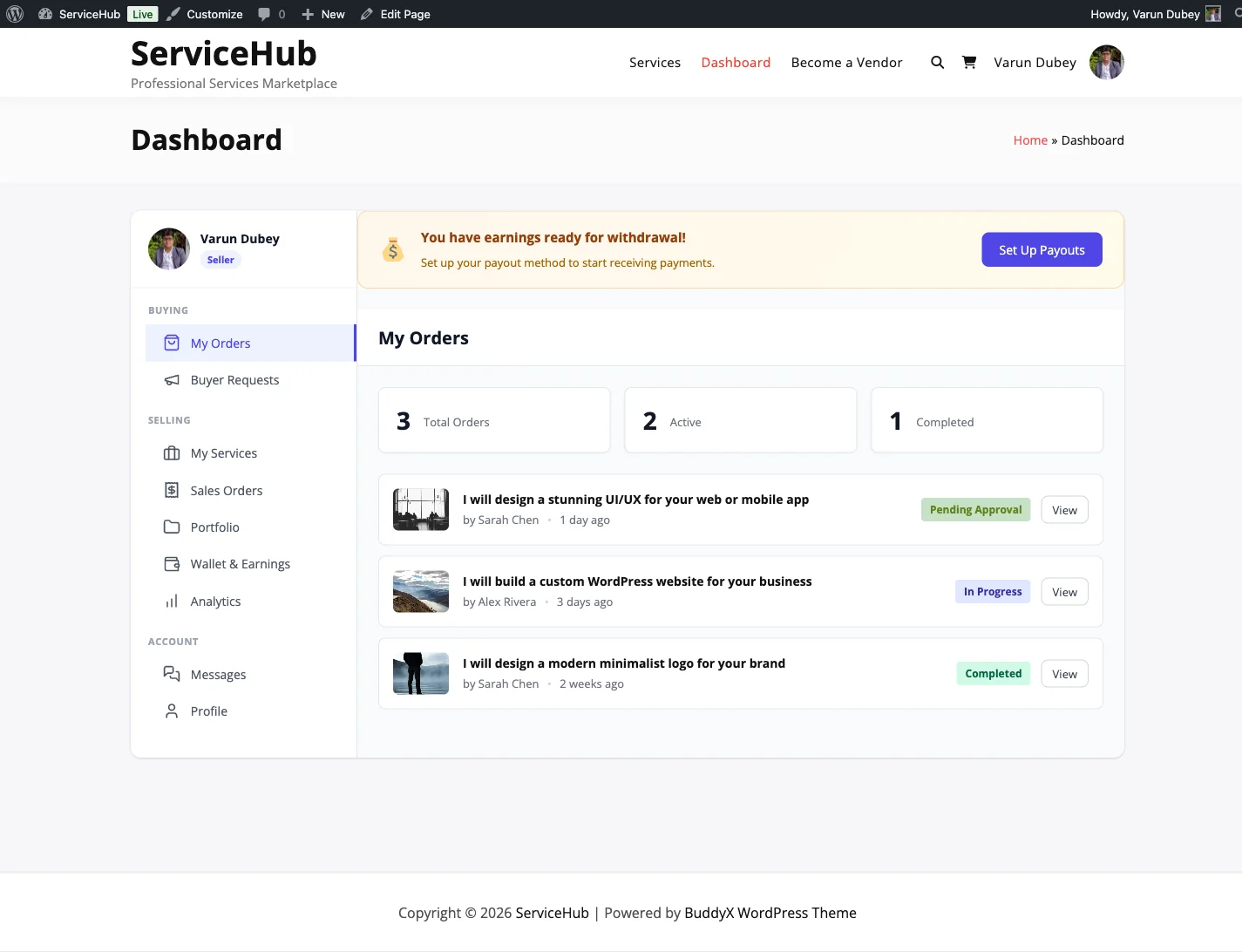
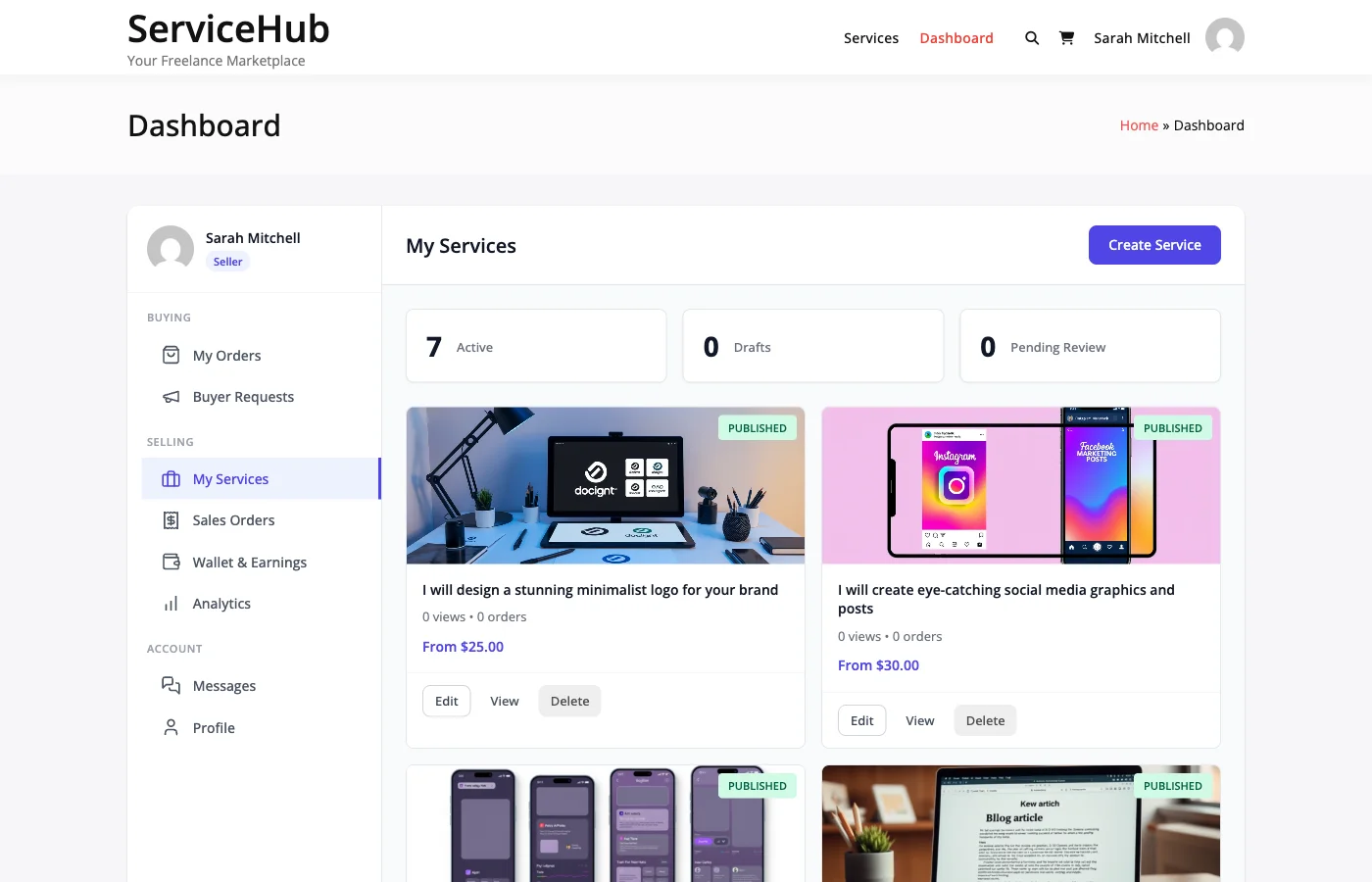
The free version needs no WooCommerce, no BuddyPress, and no separate ecommerce plugin sitting underneath it. It ships with built-in Stripe, PayPal, and offline checkout, so a niche marketplace can accept payment from day one without stitching together a separate payment processor. Vendors register, get their own dashboard, list services under a 3-tier pricing structure, and start taking orders through a defined lifecycle that covers everything from payment to delivery to revision requests. None of that infrastructure has to be built. It has to be configured.
Curation Is the Product, Not a Feature
The single biggest difference between a niche marketplace that works and one that quietly dies is moderation discipline. A general marketplace can survive some noise in its listings because buyers are already filtering hard by the time they’ve narrowed down a category. A niche marketplace can’t. If the entire pitch is “every seller here is a vetted specialist,” then one obviously unqualified listing undermines the whole premise for every visitor who sees it. That means the moderation and approval queue matters more on a niche marketplace than on a general one, not less. Every new vendor application, every new service listing, deserves a real look before it goes live. It’s slower than auto-approving everything, and it’s also the entire reason a buyer trusts the site enough to skip comparison shopping five other options.
The Vendor Trust System Does the Curation Work for You Over Time
Manual review handles the front door, but a niche marketplace also needs an ongoing signal for who’s actually good once they’re inside. WP Sell Services auto-calculates seller levels based on completed orders, ratings, and on-time delivery, moving vendors through New Seller, Rising Seller, and Top Rated tiers as they build a track record, with a fourth Pro Seller tier the site owner can grant by hand to recognize standout vendors. Buyers see the badge on every listing and in search results, which means the trust signal compounds automatically instead of requiring the site owner to manually vouch for every seller forever. For a niche marketplace specifically, this matters more than it would on a general platform, because the whole value proposition rests on “everyone here is legitimately good.” A visible, earned badge system is how that claim stays true as the vendor roster grows past the point where the owner personally knows everyone.
Picking Your Niche: A Framework, Not a Guess
Three questions separate a niche that works from one that quietly starves for lack of supply or demand.
Is there already a group of buyers actively searching for this, somewhere? Google Trends, existing Facebook groups, subreddit activity, and even the existence of a broad-marketplace category with real volume are all signals. A niche needs proof of demand before it needs a website.
Can you find twenty qualified sellers before launch? A marketplace with zero supply is a landing page, not a marketplace. The chicken-and-egg problem is real, and the fix is almost always manual: personally recruit the first cohort of vendors rather than waiting for them to discover the site organically.
Does the niche support pricing above commodity rates? If the category is already a race to the bottom everywhere it exists, on Fiverr, on Upwork, on Craigslist, a new niche site inherits that pricing pressure unless it’s doing something structurally different, like vetting quality or bundling adjacent services.
If your niche leans local rather than skill-based, the logistics differ too, see how a pet care marketplace handles scheduling and meet-and-greets for a working example of the location-based pattern. Several of the strongest existing examples answer all three clearly. Codeable’s model works because WordPress development has enormous demand, a large qualified developer pool, and buyers who’ve already been burned by cheap, unvetted freelance work and are willing to pay for a guarantee. Tutoring marketplaces work because parents actively search for subject-specific, credential-verified tutors rather than browsing a general “education” category. Neither niche was invented from nothing. Both were built where demand and supply already existed, just without good infrastructure connecting them.
What Changes Once You’ve Picked the Niche
The service creation flow itself doesn’t change much between a general marketplace and a niche one, a multi-step wizard, pricing tiers, requirements questions, portfolio media. What changes is the category structure, the search filters that actually matter to that specific buyer, and the language on the homepage. A general marketplace’s homepage has to explain what the site does. A good niche marketplace’s homepage should be instantly legible to the right buyer and instantly boring to everyone else, that’s the point. Search and category filters deserve real thought here too. A general marketplace filters by price and delivery time because that’s all it has in common across categories. A niche marketplace can filter by whatever actually matters in that vertical, years of experience, specific certifications, service radius, style or genre, equipment owned. Those filters are worth more to a buyer than generic sort options, because they answer the actual question the buyer showed up with.
The Cold-Start Problem, and How Niche Marketplaces Actually Solve It
Every marketplace, niche or general, faces the same launch-day problem: buyers won’t come if there’s nothing to buy, and sellers won’t join if there are no buyers. General marketplaces usually solve this with money, paid acquisition, incentivized early sellers, aggressive growth spending to force both sides of the market to show up at once. A niche marketplace solves it differently, and more cheaply, because the founder usually already knows where the first twenty buyers and twenty sellers live. If you’re building a marketplace for, say, commercial drone photography, you almost certainly already know real estate agencies, construction firms, or event companies who need aerial footage regularly, and you can find working drone operators through existing Facebook groups, subreddits, or professional associations built around that exact skill. That’s not cold outreach into a void. That’s warm recruitment into a community that already exists, just without a dedicated commerce layer connecting it. This is worth spelling out because it’s the actual reason niche marketplaces are more achievable for a solo founder or small team than a general one. The hard part of a marketplace business, finding the first hundred transactions, is dramatically easier when you already know exactly who both sides of the transaction are.
What a Niche Marketplace Looks Like Once It’s Running
A month or two after launch, a working niche marketplace has a recognizable shape. There’s a small, curated vendor roster, usually under fifty sellers at this stage, each one manually approved and genuinely qualified. There’s a homepage that says exactly what the site does in one sentence, no explanation needed. There’s a search and filter setup built around the two or three things that actually matter in that vertical, not a generic price-and-rating sort inherited from a broad marketplace template. Orders start moving through the same lifecycle any marketplace uses, requirements collected, work delivered, revisions handled if needed, payment released on completion, but the conversations inside those orders read differently than they would on a general platform. A buyer hiring a vetted WordPress developer through a curated marketplace isn’t negotiating price the way they would on a race-to-the-bottom general site. They’re discussing scope, because the trust question was already answered by the platform itself before the conversation started. That’s the compounding effect worth building toward. Every completed order adds to a vendor’s track record, every good review reinforces the platform’s curation claim, and every buyer who has a good experience becomes a source of the kind of word-of-mouth referral that a general marketplace, drowning in undifferentiated listings, structurally cannot generate.
Retention Is Where Niche Marketplaces Actually Win
A general marketplace has to keep winning new buyers because it has weak reasons for anyone to come back to the same category twice. A niche marketplace, done well, becomes the default destination for that specific need. Someone who found a great wedding videographer through a wedding-specific platform doesn’t need to shop broad marketplaces the next time a friend gets engaged, they remember the site that got it right the first time and tell the friend directly. That word-of-mouth loop is stronger in a niche than in a generalist category, because “the site for X” is a much easier thing to recommend than “a site where you can find anything, including X if you dig.”
When a Niche Marketplace Should Expand, and When It Shouldn’t
Success eventually raises the question of whether to widen the lane. A wedding-videography marketplace that’s dominating its category might be tempted to add wedding photography, then florists, then catering, chasing the same buyer through more of their spending. Sometimes that works, because the buyer persona stays coherent, someone planning a wedding needs all of those things, and the trust already built in one category can extend to adjacent ones under the same roof. Other times it dilutes the whole premise. A marketplace for vetted senior WordPress developers that starts accepting junior developers to grow revenue faster isn’t expanding, it’s abandoning the reason buyers trusted it in the first place. The test worth applying before widening anything: does the new category share the same buyer, and can the same curation standard be honestly maintained at the new scope? If either answer is no, the growth is better pursued as a second, separate marketplace rather than a compromise on the first one.
Frequently Asked Questions
How narrow does a niche need to be to actually work?
Narrow enough that a first-time visitor understands the entire value proposition within a few seconds of landing on the homepage. “Marketplace for freelance services” is too broad. “Marketplace for vetted WordPress developers” or “marketplace for wedding photographers in the Pacific Northwest” is specific enough to be legible and defensible.
Do I need hundreds of vendors before launching a niche marketplace?
No. Most successful niche platforms launched with a small, hand-recruited group of qualified vendors, sometimes as few as ten or twenty, and grew supply alongside demand rather than waiting for either to arrive first.
Is a niche marketplace easier to build technically than a general one?
The underlying infrastructure, order management, checkout, vendor dashboards, is the same either way. What’s simpler in a niche marketplace is the decision-making: category structure, search filters, and homepage messaging are all more obvious once the audience is specific.
What happens if I pick a niche and it doesn’t have enough demand?
This is exactly why validating demand before building matters more than the build itself. Check for existing search volume, active communities, and buyer behavior in adjacent broad marketplaces before committing. A platform can always expand into an adjacent niche later if the first one proves too narrow, expanding is far easier than surviving a launch with no buyers.
Can a niche marketplace still use tiered pricing packages like a general one?
Yes. The 3-tier Basic, Standard, Premium structure works the same regardless of niche, what changes is what each tier actually includes, which should reflect the specific deliverables that matter in that vertical rather than a generic template.
Should I moderate every single listing on a niche marketplace, even at scale?
Yes, and this is non-negotiable for a curated niche. The moment unvetted listings start appearing, the entire trust premise that justified going niche in the first place starts to erode. Scale the review process with more moderators or clearer standards, not by skipping the review.
How do I find the first vendors before the marketplace has any traffic to attract them?
Recruit directly rather than waiting. Existing professional groups, subreddits, LinkedIn searches, and local associations built around the niche almost always already exist. Reach out individually, explain the platform, and offer favorable early terms, waived commission for the first cohort is a common approach, in exchange for being part of the founding vendor group.
The Marketplace You Can Actually Defend
If you want to see the pattern applied across a dozen different verticals rather than just described in the abstract, the site’s own build guides walk through on-demand task platforms, pet care marketplaces, and half a dozen other niches step by step, each one a working example of the same underlying framework applied to a different specific lane. A general marketplace competes on scale, and scale is expensive to win. A niche marketplace competes on being unmistakably the right answer to a specific question, and that’s a fight a small, well-run site can actually win against platforms a thousand times its size. The infrastructure to run it, vendor management, tiered pricing, checkout, order tracking, isn’t the hard part anymore. The hard part was never technical. It’s picking the lane specific enough that nobody has to ask what your site is for, and specific enough that the buyers who find it never bother checking anywhere else.