Do You Need a Business License to Sell Services Online? A Plain-English Checklist
Do you need a business license to sell services online? A plain-English checklist built on US SBA, state, UK and India government pages, with the questions to ask your local office.

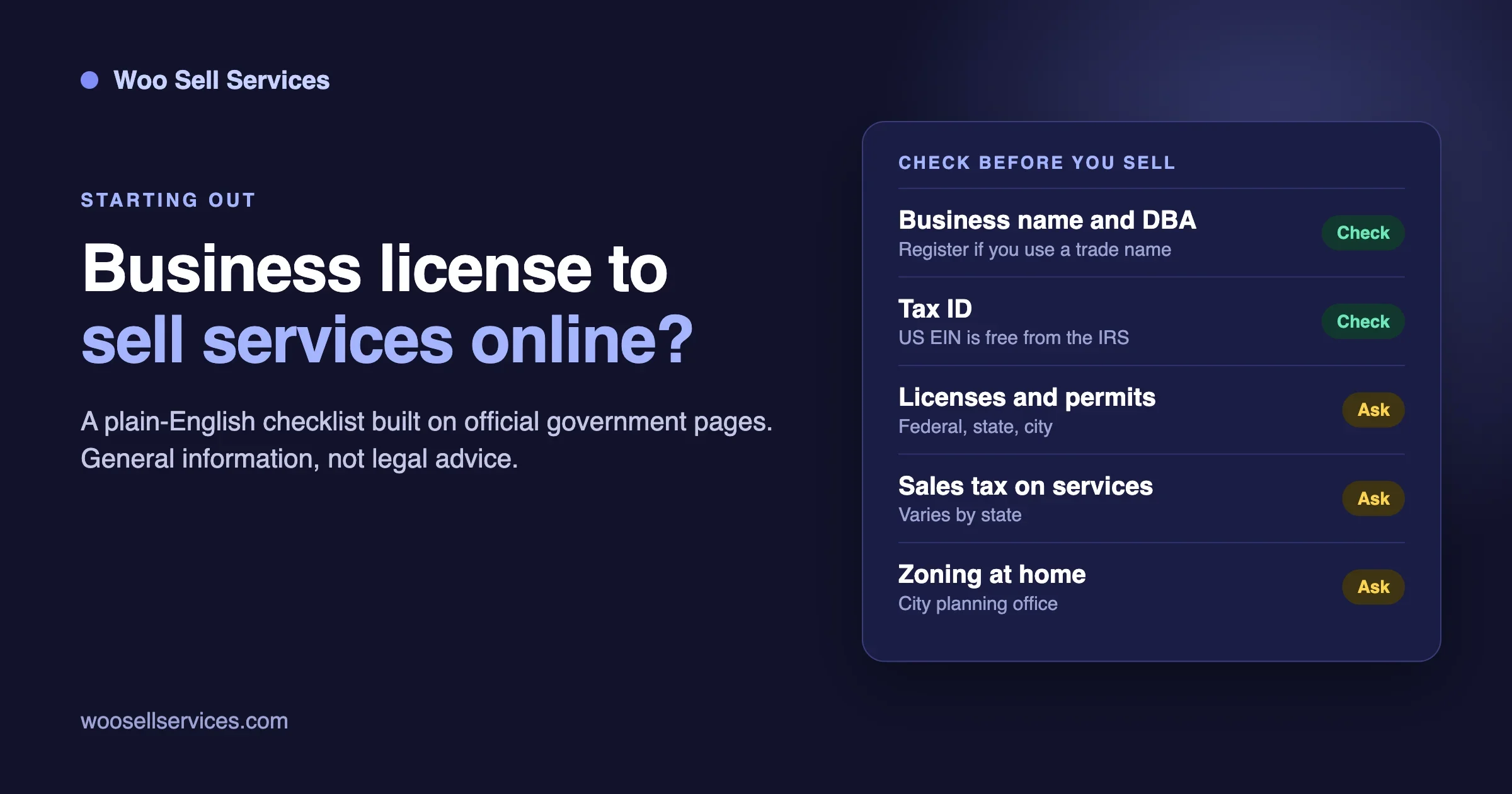
Do you need a business license to sell services online? Often you need something, but it is rarely one single license, and the answer depends on where you live, what you sell and where you work from. This post gives a plain-English checklist you can walk through in an afternoon. It is built on official government pages that we read on 11 November 2026: the US Small Business Administration (SBA), one US state sales tax page, the UK government and the Government of India’s Udyam site. The checklist and the examples are ours.
This is general information, not legal or tax advice. Rules change, they differ by country, state and city, and we are not lawyers or accountants. Use this post to learn which questions to ask, then confirm the answers with the government office that covers your place, or with a licensed professional.
Do you need a business license to sell services online? The short answer
There is no single rule that says “online sellers need a license” or “online sellers do not”. The SBA says the requirements and fees “vary based on your business activities, location, and government rules.” Selling on the internet does not remove those rules. In the SBA pages we read, we did not find a separate rule for online sales. What counts is what you do, where you are, and who regulates that activity.
For most people who sell a service such as design, writing, coaching, bookkeeping or web work, the questions fall into six groups:
- Is your business registered, and under what name?
- Do you need a tax ID?
- Does your activity need a license or permit from a federal, state or local office?
- Do you need to register to collect sales tax on what you sell?
- Do local zoning rules apply to where you work, even at home?
- Do you need insurance and a business bank account?
The rest of this post goes through each one.
Do you have to register your business?
It depends on how you work. The SBA says that if you conduct business and do not register as another business type, you are automatically a sole proprietorship. A sole proprietorship does not create a separate legal entity, so your business and personal assets and liabilities are not separate. The SBA also says that if you operate under your own legal name without a separate business, you may not need to register, but you could miss out on personal liability protection and legal and tax benefits.
The SBA lists the steps to register a business in this order: choose a location, choose a structure, choose and protect your name, register with the state and check local requirements, get a federal tax ID and a state tax ID if needed, apply for licenses and permits, open a bank account and get insurance. The order is worth noticing. Your location comes first because it decides which rules apply.
What if you use a trade name?
If you sell under a name that is not your own legal name, it may need to be registered. The SBA calls this a DBA, also known as a trade name, fictitious name or assumed name. It says a DBA “doesn’t provide legal protection by itself,” but most states require one if you use such a name, and requirements vary by state, county and city. The SBA also says some counties and cities require you to register a DBA. A DBA combined with a tax ID also lets you open a business bank account.
What about LLCs and corporations?
The SBA says LLCs, corporations, partnerships and nonprofit corporations typically must register in each state where they conduct business. It says you are generally conducting business in a state if you have a physical presence there, meet clients in person, earn significant revenue there or have employees there. It adds that most states handle this through the Secretary of State or a similar office, that a registered agent is needed before filing, and that total registration costs are usually under $300, though fees vary. Which structure suits you is a question for an accountant or lawyer, not for this post.
Do you need a tax ID?
In the US, the federal tax ID is the Employer Identification Number, or EIN. The SBA says you need it to pay federal taxes, hire employees, open a bank account and apply for business licenses and permits. It lists who needs one, including businesses that pay employees and corporations and partnerships. It also says applying is free, and it warns against websites that charge a fee for it. The application is through the IRS.
A state tax ID is a separate matter. The SBA says whether you need one depends on whether your business must pay state taxes, mainly income and employment taxes, and that the process varies by state. It points to each state’s Department of Revenue. The SBA tax page also states that sole proprietors report their personal and business income taxes using the same form. We did not find self-employment tax covered on that page, so check IRS guidance for it.
Does your service need a license or permit?
This is the question people usually mean. The SBA breaks licenses and permits into levels.
- Federal. The SBA says business activities regulated by a federal agency need a federal license or permit. It lists activities such as agriculture, alcohol, aviation, firearms and transportation, with the agency for each. Most people who sell design, writing, coaching or web services will not find their work on that list, but check it.
- State. The SBA says states “tend to regulate a broader range of activities than the federal government.” Many professions are licensed by state boards. If your service gives advice, treatment or a result that the state regulates, such as health care, legal help, accounting or building work, check with the board or agency for that field.
- County and city. The SBA says these depend on your activities and location. It lists commonly regulated local activities such as auctions, construction, farming, plumbing, restaurants, retail and vending machines. Some cities also require a general business license for anyone who operates there, which you learn by asking.
To find what applies, the SBA gives four steps: check whether your activity is in the federal table and contact the listed agency, visit your Secretary of State’s website for state permits and licenses, research state, county and city rules because industry requirements often vary by state, and check local government websites because local governments set their own licensing requirements.
Do licenses expire?
Some do. The SBA advises tracking renewal dates, and notes that renewing is often easier than applying again. Put the date in a calendar the day you receive the license.
What happens if you skip it?
We did not find penalties described on the SBA page we read, and we will not guess. The penalty for working without a required license depends on the place and the activity. If you are unsure, asking the office before you start costs less than finding out afterwards.
Do you charge sales tax on services?
This is the part that surprises many service sellers. Many places do not tax most services, but some tax certain ones. The rules differ by state in the US, so a single answer would be wrong. Two official pages show how much they differ.
- New York. The state tax department says: “Sales of services are generally exempt from New York sales tax unless they are specifically taxable.” It gives accounting services as an example that does not need registration, and certain information services, parking and storage as examples that do. It says that if you make taxable sales you must register for a Certificate of Authority, and that you must apply at least 20 days before you begin operating.
- Washington. The state Department of Revenue defines retail services as services subject to sales tax, and lists examples such as construction, installation, cleaning and repair services, landscaping, personal training, tattooing, car washes, catering and digital goods and services.
Two states, two different default positions. Neither page covers every case, and the Washington page does not say whether custom website work is on its list, so a web designer there would need to ask the Department of Revenue. The SBA says only that sales tax varies by location and that you should check your state and local government websites.
A practical point for online sellers: if sales tax applies to what you sell, your store must be set up to charge it, and your registration usually comes before your first sale. Tell your store software only what your tax authority has told you.
Does working from home change anything?
Less than people hope. The SBA says you might have fewer zoning restrictions if you base your business out of your home, but zoning rules can still apply to home-based businesses. It says zoning is set mainly at the local level and advises contacting your city’s planning department or a similar office, because zoning can limit or prohibit certain business types in an area. For an office-style service with no customers visiting and no signs or deliveries, this is often a short phone call. For a service where clients visit, or where you store equipment, ask first.
The SBA also notes that homeowner’s insurance can be extended with a rider that covers a small amount of business equipment and some third-party liability, and that a business owner’s policy bundles common coverages. Check what your own policy says. Many standard home policies are written for a home, not a business.
What if you sell on a marketplace instead of your own store?
The government rules above are about your business, not about the platform. A marketplace may have its own seller rules, tax forms and verification steps, and those are in its terms, which we have not covered here. Selling through your own store, a hosted tool or a marketplace does not change whether you need a license for the work itself. For help choosing where to sell, see our post on where to sell services online.
What about the UK and India?
Rules differ by country, and we give only official starting points we could read. We did not research the full rules in either country.
United Kingdom
The GOV.UK page on registering as a sole trader says you can start trading without registering, but you must register for Self Assessment as a sole trader if you earn more than £1,000 in a tax year, which runs from 6 April to 5 April. You can also register before you reach that figure. It says that you may need a licence or permit, for example to play music, sell food or to trade in the street, and it points to the GOV.UK licence finder. The licence finder page says it lists 451 licences, permits and certifications, can be searched by keyword and filtered by England, Wales, Scotland or Northern Ireland, and warns that the list “may not include all the licences you need.” Treat it as a starting point and ask your local council if your activity is unusual.
India
The Udyam Registration site of the Government of India describes the process that registers an enterprise as a micro, small or medium enterprise. It says the process is free, that no fees are to be paid to anyone, that an Aadhaar number is enough to register, and that registration is a permanent number with no renewal. The page also says PAN and GSTIN details are required from 1 April 2021, subject to GST applicability. It does not say whether Udyam registration is optional or required, and we did not find the GST turnover threshold for services on the portal page we read. So for India, start with the Udyam and GST portals, and ask a chartered accountant about GST, shop and establishment rules in your state, and any licence for your type of work.
Anywhere else
Search for your government’s business registration portal and its page on licences or permits for your trade. Use an official domain, not a paid agent that appears first in search. The SBA gives the same warning about tax ID sites that charge for a free service.
A business license checklist for online service sellers
Work down the list and write the answer next to each line. If an answer is “I do not know”, that is your next phone call.
- Where is the business based? Write the city, county, state or country. This decides everything else.
- What exactly do you sell? Write one line, for example “logo design” or “one-to-one business coaching”.
- Is the activity regulated? Check the federal table, then your state board or agency for your field.
- How are you set up? Sole proprietor under your own name, sole proprietor with a trade name, or a registered company.
- Do you use a trade name? If yes, check whether your state, county or city requires a DBA.
- Do you need a tax ID? Check the rules for your structure. In the US, the EIN is free from the IRS.
- Does your city or county require a business license? Check its website or call its business office.
- Does sales tax apply to your service? Check your state’s revenue department. Register before selling if it does.
- Does zoning apply to your workplace? Ask the city planning office if clients visit or if you keep equipment.
- Do you have the right insurance? Read your home policy, then ask about a business policy.
- Do you have a business bank account? It keeps your records clean when tax time comes.
- When does each license renew? Put the dates in your calendar.
What does this look like for a real seller?
Here is a made-up example, to show the process. It is not a real customer, and the answers will differ where you live. A person in the US offers one-to-one website audits from a spare room, sold through an online store.
- She writes down her city, county and state.
- She checks the federal table, and website audits are not on it.
- She visits her Secretary of State’s site and her state revenue department’s page, and checks whether her kind of work is taxed or needs a state license.
- She calls the city business office and asks: “Do I need a general business license to run an online consulting business from my home address?”
- She asks the planning office whether a home office with no visiting clients needs a permit.
- She decides whether to use her own name or a trade name, and checks the DBA rule if she picks a trade name.
- She applies for a free EIN from the IRS if she needs one, and opens a business bank account.
- She writes every answer and date in one document and sets renewal reminders.
It takes a few phone calls and a few web pages. It does not take a lawyer in the simple case, though a lawyer or accountant is a good idea if your case is not simple.
What should you ask the city or state office?
Offices answer specific questions faster than general ones. These are plain questions you can use word for word:
- “I sell [your service] online from my home in [city]. Do I need a general business license?”
- “Is there a fee, and how often does it renew?”
- “Does my activity need any state license or board registration?”
- “Is this kind of service subject to sales tax in this state?”
- “Do I need to register a trade name if I use one?”
- “Do home-based businesses need a permit in my zone?”
Write down the name of the person, the date and what they said. If a rule matters to you later, you will be glad to have it.
What mistakes do new sellers make?
Assuming online means no rules
The SBA pages we read tie rules to your activity and location, not to whether you sell online. If you work from a place, that place has rules.
Paying a service for a free thing
A federal tax ID in the US is free from the IRS, and the SBA warns about sites that charge for it. Some registration steps also have official portals that are free or low cost. Start at an official government domain.
Registering a company before checking if you need one
A company brings fees and paperwork. Some people need it. Some do not yet. Ask an accountant what suits your income and risk, then decide.
Forgetting renewals
The SBA says some licenses and permits expire. A lapsed license can cause trouble. A calendar reminder fixes it.
Mixing up the license with the tax
A license says you may operate. A tax registration says you must collect or pay tax. A tax ID is a number. You can need one, two or all three, and each comes from a different office.
Not telling the store about tax
If your service is taxable, your store must charge the tax. Settle the rule first, then set the store.
Questions service sellers ask
Do I need a business license to sell on Fiverr or a similar marketplace?
The marketplace’s own rules apply to your account, and the government rules apply to your business. Treat them as two separate checks. Our post on where to sell services online compares the options.
Can I use my home address?
Often yes, but the SBA says zoning rules can still apply to home-based businesses, so ask the city planning office. Some people use a business mailing address for privacy. Check that your registration accepts it.
Do I need an LLC to start?
The SBA says that if you conduct business and do not register as another type, you are a sole proprietor. Whether an LLC is worth it for you is a legal and tax question for a professional.
Do I need a license if I only make a little money?
It depends on the place. Some thresholds exist for tax registration, such as the UK Self Assessment figure above, but a threshold for tax does not tell you whether a local license applies. Ask the local office.
Do freelancers need to charge sales tax?
It depends on the state and the service. New York says services are generally exempt unless specifically taxable, and Washington lists services that are taxable. Check your own state’s revenue department.
Is this the same in every country?
No. Use the official government site for your country. We included UK and India starting points because we could read them, not because they are complete.
Once the paperwork is done, what next?
The legal side is one part of a service business. The other part is what the customer sees: a clear offer, a fair price, a form that collects what you need, and rules for revisions and cancellations. Our guide to how to sell services with WooCommerce walks through that from start to finish. If you are choosing how to price what you sell, see fixed price, quote, milestones or retainer, and for what to ask a client before you start, see our client intake form guide. Our own product, Woo Sell Services, is made for selling services in a WooCommerce store, with the buyer answering your questions after payment and chat, files and a status tracker on the order. See the features page. It does not handle licenses or tax rules for you, and no plugin can decide those for you.
What we could not confirm
- We are not lawyers or accountants, and nothing here is legal or tax advice.
- We read the SBA pages as they stood on 11 November 2026. They are US federal guidance, and your state and city rules are separate and not covered in full.
- We read one page each for New York and Washington sales tax. Neither is a full list, and we did not confirm whether custom website work is taxed in Washington.
- For the UK we read the sole trader page and the licence finder. We did not research other UK rules.
- For India we read the Udyam home page. We could not confirm from it whether registration is required, or the GST thresholds.
- We did not find the penalties for operating without a license on the SBA page we read.
How can we help?
We build and run WooCommerce stores that sell services, and we can help you set up the store side once you know your rules: checkout, intake, delivery and the pages that explain your terms. See our WooCommerce customization services and custom development page, or contact us with a short note about what you sell. We do not give legal or tax advice, so for the rules themselves please speak to your local government office or a licensed professional.
Sources
- Apply for licenses and permits, US Small Business Administration, read 11 November 2026.
- Register your business, US Small Business Administration, read 11 November 2026.
- Get federal and state tax ID numbers, US Small Business Administration, read 11 November 2026.
- Pick your business location, US Small Business Administration, read 11 November 2026.
- Pay taxes, US Small Business Administration, read 11 November 2026.
- Do I need to register for sales tax?, New York State Department of Taxation and Finance, read 11 November 2026.
- Services subject to sales tax, Washington State Department of Revenue, read 11 November 2026.
- Set up as a sole trader, GOV.UK, read 11 November 2026.
- Find a licence, GOV.UK, read 11 November 2026.
- Udyam Registration, Government of India, read 11 November 2026.